The best tool to create content that answers ChatGPT's fan-out queries, from an SEO agency's desk
How we find ChatGPT's fan-out queries for clients, why classic SEO still decides who gets read, and the tool we use to write and track pages that answer them.
Clients usually come to us with the same puzzle. Their pages rank on Google, sometimes in the top three, and ChatGPT still recommends a competitor. When we open the answer and look at what ChatGPT searched to produce it, the reason is almost always mechanical. The model ran a handful of short searches, and our client's site didn't show up for most of them.
Those short searches are fan-out queries. Writing for them is less exotic than it sounds. It's keyword work, done against a keyword list you can't see unless you capture it.
Fan-outs are search queries, so SEO still matters
OpenAI's Help Center article "Searching the web with ChatGPT" says ChatGPT search typically rewrites a question into one or more targeted queries for its search partners, then may send more specific queries after reviewing results. Google says the same kind of thing about its own AI features. Its Search Central page "AI features and your website" states that AI Overviews and AI Mode may use a query fan-out technique, and that the best practices for SEO remain relevant for them.
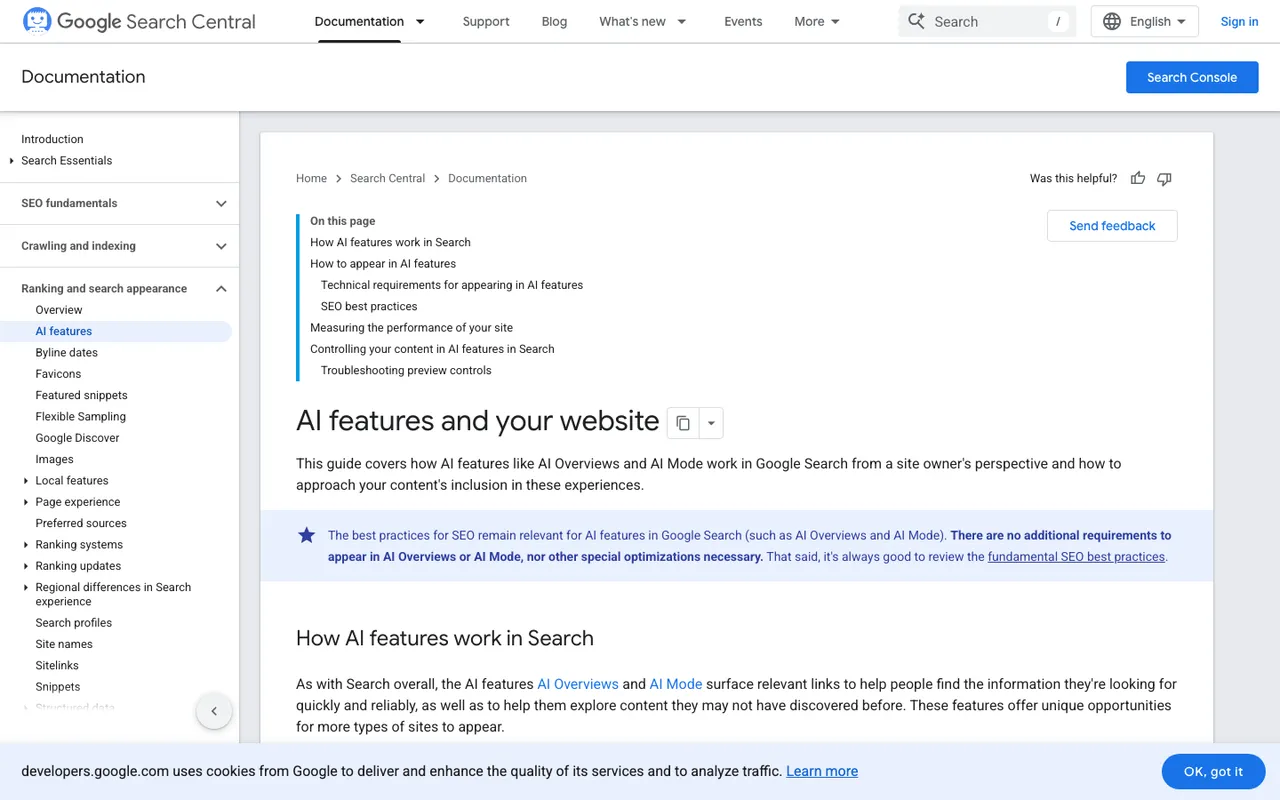
Google Search Central, "AI features and your website", captured November 21, 2026.
For our full-service clients that's good news. The same page says there are no additional technical requirements to appear as a supporting link: the page has to be indexed and eligible to show with a snippet. No special schema, no AI text file. So the classic checklist (crawlable, indexed, a clear title, the answer in text near the top) is still the price of entry. What changes is which queries you optimize for.
How we turn fan-outs into a content plan
We run client programs on Promptwatch, and the fan-out work starts in its query fan-out view. For each tracked prompt it stores the exact sub-queries each model ran behind each response. We don't plan from predicted lists. A predicted sub-query is a guess about what the model might search, and a content calendar built on guesses burns writing budget on pages nobody's prompt ever reaches.
Our process from there is plain:
- Pull the prompts where the client is weak. Visibility Score and Share of Voice tell us which buyer questions they lose.
- Read the fan-outs for those prompts. For each sub-query we ask whether the client's site would show up if a person typed it into a search engine. If not, that's the gap.
- Decide refresh or new page. Often an existing service page covers the topic but buries the answer. Promptwatch's Content Refresh gives diff-style suggestions for those. Where nothing covers the sub-query, we brief a new page.
- Write against the sub-query. Content Creation in Promptwatch can write directly from a fanout or a cited page, with internal links chosen before the draft starts. Our editors then rewrite for the client's voice and check every claim.
- Track the URL. Page Tracker follows the page through citations, and crawler logs show whether ChatGPT-User or OAI-SearchBot fetched it.
Where classic SEO and fan-outs collide
Two patterns show up again and again in our audits.
The first is headings written for people who already know the product. Fan-out queries are short and literal. Promptwatch's report "Query Fanouts: How ChatGPT Searches the Web" measured ChatGPT's search queries shrinking from about 117 characters in early December to roughly 53 in April, on a chart without a year. A heading that reads like one of those searches gets matched more easily than a clever one.
The second is thin site sections. On August 8, 2026, site: searches rose from 0.37% to 16.8% of ChatGPT's fan-out queries, per Promptwatch's site: operator report. A site: search can only return pages that are indexed, so an unindexed pricing page or a weak category page now costs answers directly. That's an indexation fix, the most traditional SEO task there is.
Why we don't split the work across five tools
A writing grader, a separate tracker and a separate log analyzer can each do their part. The handoffs between them are where things get lost: the writer never sees the fan-out, and the tracker doesn't know the page is new. Keeping the sub-queries, the drafts, the publish status and the crawler logs in one workspace means the team writing the page can see whether it worked. Content Creation needs Professional or above, and crawler logs start there too.
If you want to see where your own brand stands before talking to us, Promptwatch's free AI Visibility Report runs your site against ChatGPT, Gemini and Perplexity without a login. Bring that report to our first call and we'll walk through which fan-outs your pages are missing.