Content mix by prompt intent: how we build client roadmaps
Promptwatch's content type data shows ChatGPT citing different page types for commercial, informational and branded prompts. How we turn that into a client content roadmap.
A content roadmap used to start with a keyword list sorted by volume. Ours now starts with a different question: for each thing a buyer asks, what kind of page does an AI engine actually cite when it answers? The answer turns out to depend heavily on intent, and Promptwatch has data on it.
This post walks through that data and the way we use it to decide which pages a client builds, in what order, and how we check the roadmap is working.
The overall mix
Promptwatch's report Which content types does ChatGPT cite the most? classifies every ChatGPT citation by content type. It covers September 28 to October 4, 2026, and counts each citation separately, so a page cited in several answers counts several times.
Across all prompts in the September 28 to October 4, 2026 window (content type report), product pages lead at 22.4% of classified citations, then landing pages at 16.8%, listicles at 13.6%, how-to guides at 8.7%, and documentation at 7.5%. General articles (6.1%), comparisons (5.9%), and news (5.7%) follow, with FAQs at 3.3% and reviews at 1.7%. Product and landing pages together come to 39%, which the report describes as pages describing what a company sells. Editorial content in total comes to 43%.
That overall mix is useful for one thing: it tells a client that their commercial pages are cited far more than most content teams assume. But it hides the real pattern, which only shows up when you split by intent.
How the mix changes by intent
The same report breaks citations down by three prompt intents.
Commercial prompts
Commercial prompts are the shortlist questions, like "best CRM for small businesses." In the same window (content type report, September 28 to October 4, 2026), product pages rise to 26.0% and landing pages to 20.6%, with listicles at 15.0% and comparisons at 7.9% (against 5.9% across all prompts). The report says these four types make up almost 70% of commercial citations.
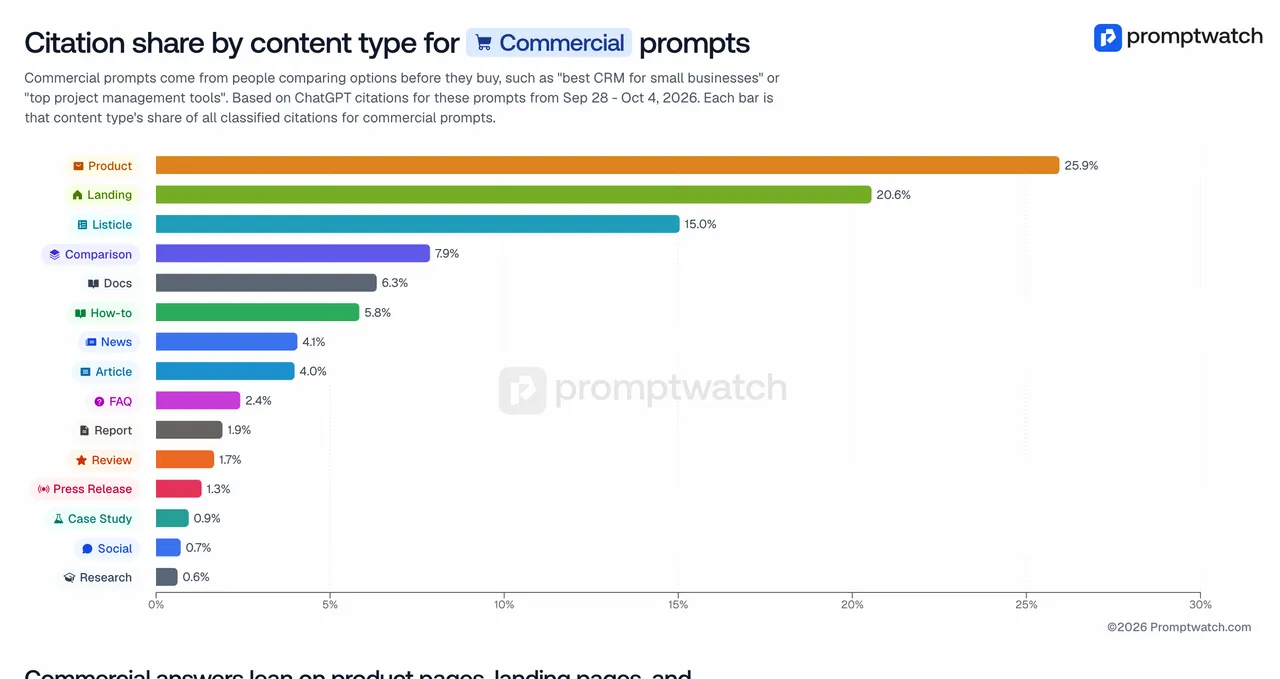 Promptwatch's "Citation share by content type for Commercial prompts" chart, captured November 14, 2026. We cite the report's text figures; one bar label on the chart rounds a tenth of a point differently.
Informational prompts
Informational prompts ask how something works, like "how does a CRM work." For the same week (content type report, September 28 to October 4, 2026), product pages still lead at 19.1%, then landing pages at 13.9% and listicles at 13.6%. But how-to guides rise to 10.7%, documentation to 8.5%, and general articles to 7.7%. Guides and docs gain ground, as the report puts it, without displacing the commercial pages at the top.
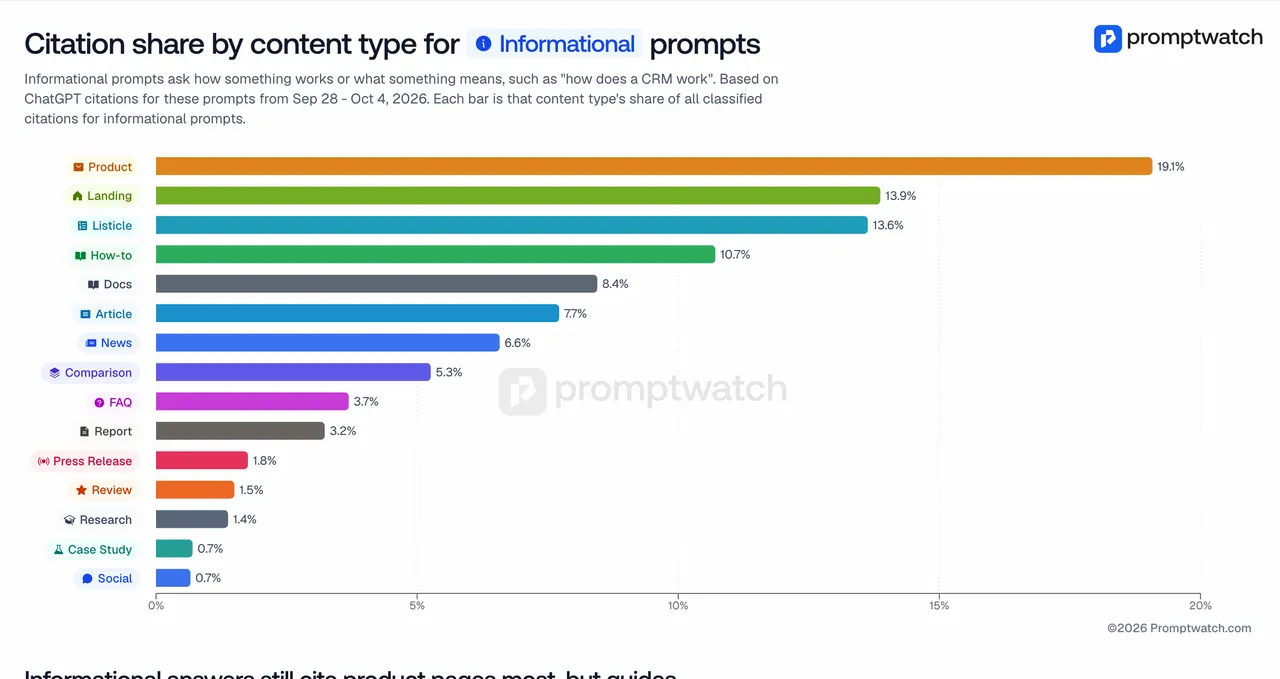 Promptwatch's "Citation share by content type for Informational prompts" chart, captured November 14, 2026. We cite the report's text figures; one bar label on the chart rounds a tenth of a point differently.
Branded prompts
Branded prompts name a company, like "is HubSpot good for startups." In the content type report for September 28 to October 4, 2026, product pages (23.3%) and landing pages (22.8%) make up almost half. Reviews rise to 5.6%, more than three times their overall share. FAQs reach 4.8%, social posts 3.0%, and press releases 2.1%.
All of this is one week of ChatGPT data. We treat it as a strong hint about page types, not a fixed rule, and we check it against the client's own citations before committing a quarter of content budget.
What we take from it
Our interpretation, and it is ours: every intent cites commercial pages heavily, so a client with thin product and landing pages has a problem no amount of blogging fixes. Beyond that, each intent has its own secondary formats. Commercial answers reward being on listicles and having honest comparisons. Informational answers reward how-tos and docs. Branded answers reward reviews and a clear FAQ.
There's a time dimension too. Promptwatch's separate content half-life report, which follows pages ChatGPT cited on July 6, 2026 through October 4, 2026, found 78% of landing pages and 76% of documentation pages were still cited 30 days later, while half of the news pages ChatGPT cited were no longer cited after 36 days. We cover how we schedule refreshes from that data in how we schedule content refreshes using ChatGPT half-life data. For roadmaps, it means product, landing, and docs pages are durable assets worth investing in properly, and news is a short burst.
How we build the roadmap
Step 1: tag the prompt and keyword set by intent
We start from the client's tracked prompts plus their Search Console queries. Each gets an intent: commercial, informational, branded, and for some clients navigational or transactional. In Promptwatch, prompts carry intent labels (Branded, Informational, Navigational, Commercial, Transactional) and prompt types (Organic, Brand Specific, Competitor Comparison), so the set is already split when we export it.
Step 2: map each intent cluster to page types
For each cluster, we decide which page type answers it, using the mix above as a starting point:
- Commercial clusters get product and landing page improvements first, then comparison pages the client can write honestly, then outreach to the listicles that cover the category.
- Informational clusters get how-to guides and documentation, each answering its question in the opening lines.
- Branded clusters get a proper FAQ on the client's site, a review collection plan, and a check that product and pricing pages answer the obvious "is X good for Y" questions directly.
Step 3: order by gap, not by volume
Volume still matters, but we order the roadmap by where the client is missing. Content gap analysis in Promptwatch, which is on every plan, shows prompts where competitors are cited and the client isn't, with a coverage score. A commercial cluster where the client has no comparison page and three competitors do goes to the top.
Step 4: schedule by durability
Product, landing, and docs pages go into the first months because they keep being cited longest. How-tos follow. News and timely posts fill gaps around launches.
Step 5: keep the classic SEO checks
Every page in the roadmap still needs what it always did: a target query, a clean title, internal links into and out of it, structured data where it applies. Most of these pages serve classic search and AI answers at the same time.
How we produce and measure it
We run client roadmaps on Promptwatch, the platform we use for all client programs.
For production, AEO articles start on the Professional plan ($245/mo, which includes five, with more available as an add-on), and the automated Content Agent, which plans, writes, and publishes against visibility gaps on a schedule with a review inbox, is on Business ($579/mo) and Enterprise. Content Refresh suggests diff-style updates to existing pages, which is how we handle the durable pages after launch. Many clients write in-house; the roadmap works the same either way.
For measurement, Citation Trends classifies each citation of the client's prompts into content types and source types and tracks first cited date, ramp-up, peak rate, and decay per page. That lets us check, for this client, whether commercial answers really lean on product pages and listicles the way the population report suggests, and whether a new comparison page started being cited. Page Tracker follows specific URLs. Visitor Analytics shows AI-referred visits and conversions per page, so the roadmap gets judged on leads as well as citations.
We review the mix quarterly. If the client's own citations show a different pattern from the population data, the client's data wins.
If you want to see your own content mix by intent, book a Promptwatch demo. The content type, half-life, and citation type reports are all on the Promptwatch data index.