AI brand perception: what it means for your SEO program
How AI brand perception connects to classic SEO work: entity clarity, brand SERPs, citations versus mentions, Search Console data, and what changes in the roadmap.
Our short answer, for clients who ask whether AI brand perception is an SEO problem or a PR problem: it's both, and the SEO half is bigger than most teams expect. The pages that shape how an AI engine describes you are mostly pages search teams already own or already monitor. Your about page, your pricing page, the comparison posts ranking for your brand name, the directory profiles that show up on page one for "[brand] reviews". What's new is the reader. A search engine ranked those pages. An AI engine reads them, extracts claims, and repeats those claims to buyers in its own words.
So this isn't a separate discipline you bolt onto an SEO retainer. It changes what you prioritize inside the one you have. Below is how we connect the two on client programs, and what actually moves in the roadmap.
Two things AI does with a brand
Every SEO lead needs to understand one distinction before the rest of this makes sense: the difference between being mentioned and being cited.
A mention is your brand named in the text of an AI answer. A citation is your page attached to that answer as a source. Promptwatch's Academy is blunt about it: the two are recorded independently, move independently, and improve through different work.
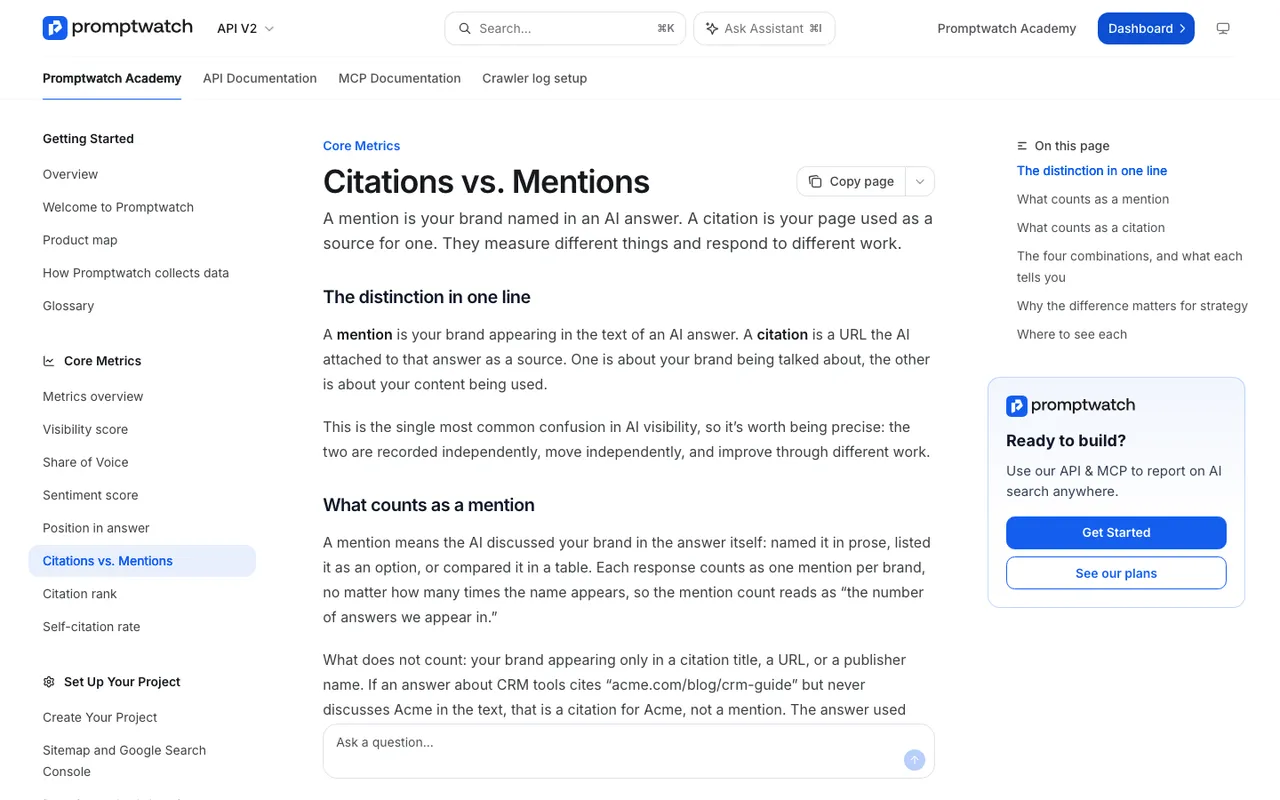 Promptwatch Academy's Citations vs. Mentions page, captured November 14, 2026.
That split maps neatly onto perception. A mention carries a description. When AI names you, it also says something about you: affordable, enterprise-only, hard to set up, best for agencies. That description is your perception. A citation tells you which page the engine leaned on while saying it. If the description is wrong and the citation is your own outdated blog post, you have an SEO task. If the citation is a third-party comparison article, you have a content or outreach task.
The Academy describes four combinations, and we find them useful as a diagnostic in the first month of a program:
- Mentioned and cited: AI recommends you and backs it with your content. You control a good part of the description.
- Mentioned, not cited: the model knows you from training data or third-party sources. Your own pages aren't doing the work, so someone else is writing your description.
- Cited, not mentioned: your page fed the answer but your brand wasn't part of it. Common with informational blog content.
- Neither: the visibility gap, which comes before any perception question.
Note one practical point from the same page. Citations only exist where the model searched the web. Live-search platforms like ChatGPT, Google AI Overviews, AI Mode, Copilot, Gemini, and Perplexity return sources. Models answering from training data usually cite nothing. So for those engines, your levers are slower and less direct.
Entity clarity is the SEO work that matters most here
In classic SEO, entity work means making it unambiguous who you are: what the company does, who it serves, where it operates, what it's called. Search engines benefited from that clarity. AI engines depend on it more, because they summarize.
When we audit a client for perception, the first thing we read isn't the AI answer. It's the client's own site, looking for places where it describes itself inconsistently. The homepage says "for teams of every size", the pricing page lists only an enterprise tier, and a 2023 blog post announces a free plan that was retired. Each of those pages is a candidate source for a claim. An AI engine that reads all three may repeat any of them.
Brand Narrative in Promptwatch files claims under nine themes, and one of them, Company, covers facts about the business itself: founding, ownership, headcount, where it operates. Another, Audience, covers who the brand is for. Those two themes are where entity problems show up first. If AI describes the client as serving a market they left, or attributes them to a parent company that sold them, that's an entity clarity problem with an SEO fix: consolidate the self-description, update or remove the stale pages, and make the current facts easy to find in plain sentences.
Promptwatch's Academy has a line about Fact Check that applies here even if you don't use the feature: AI repeats what pages say outright. A fact that's only implied by your site gets left out or guessed.
Your brand SERP is now an input, not just an outcome
SEO teams have watched brand SERPs for years as a reputation signal: what appears when someone searches your name. We now treat the brand SERP as one of the inputs to AI perception as well.
The reasoning is practical. When a live-search engine answers "is [brand] any good" or "[brand] vs [competitor]", it searches the web, and the pages it finds are often the same kind of pages that rank for those queries in Google: review sites, comparison articles, forum threads, the brand's own pricing and FAQ pages. We don't assume the overlap. We check it. In Promptwatch we look at which URLs AI cites for the client's branded and comparison prompts, then compare that list with what ranks for the matching search queries. Where the same third-party page appears in both, it becomes a priority, because fixing it improves the brand SERP and the AI description at once.
Search Console data sits next to the AI data
The piece that made this practical for our SEO team is that we no longer switch tools to make the comparison. Promptwatch's 360 Insights includes Search Insights, which brings in Google Search Console and Bing Webmaster clicks and impressions and overlays them on AI crawls, citations, and clicks per page and per topic.
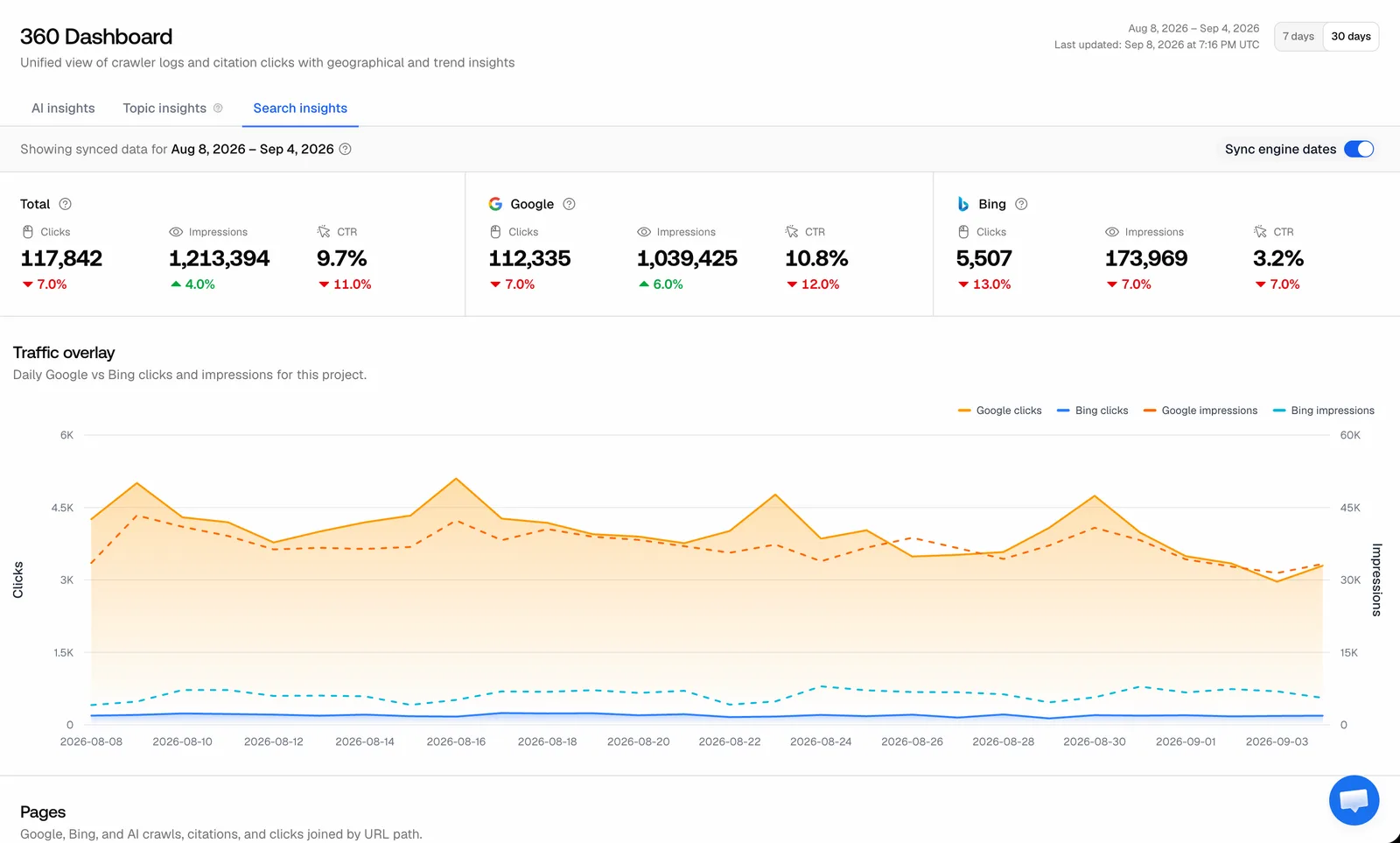 Promptwatch 360 Dashboard, Search insights tab, from the Promptwatch changelog, captured November 6, 2026. Example project data.
Here's how we use it on a perception problem. Say Brand Narrative shows a recurring negative claim on the Pricing theme, and the claim's Citations tab points at the client's old pricing comparison post. Search Insights then tells us whether that post still gets impressions and clicks from Google, and whether AI crawlers are fetching it. If it gets search traffic, we rewrite it rather than delete it. If it gets nothing from search and AI crawlers still read it, we can retire it and redirect without losing anything on the classic side.
One plan note: 360 Insights is included on every Promptwatch brand plan and on Enterprise, but not on the self-serve agency plans. For agency-run programs we check which plan the client sits on before promising this view.
What changes in the SEO roadmap
Very little of the craft changes. The priorities do. These are the shifts we make when perception becomes part of the program.
Branded and comparison pages move up the list. Pricing, alternatives, "[brand] vs [competitor]", and FAQ pages used to be conversion pages that SEO touched occasionally. They're now the pages most likely to be read when an engine answers a branded question. We keep them current, state facts in full sentences, and avoid hedged marketing language that a model might paraphrase into something inaccurate.
Content pruning gets a new criterion. We used to retire old posts for thin content or cannibalization. Now we also retire or update posts that contradict the current offer, because an old post that says the opposite of the pricing page gives AI two answers.
Crawl access becomes a perception question. If AI crawlers can't fetch your current pages, the engines describe you from whatever else they can reach. Agent Analytics in Promptwatch shows IP-verified AI crawler visits per page, starting on the Professional plan ($245 a month), so we can confirm that bots like GPTBot, OAI-SearchBot, ClaudeBot, and PerplexityBot are reading the corrected pages.
Internal linking points at the pages that state the truth. If the page that correctly describes your audience is buried four clicks deep, it's less likely to be the page that gets fetched and cited.
Digital PR gets judged by citations, not just links. A placement that AI cites while describing you has a perception effect. A placement that never gets fetched may still help classic rankings, but it won't change what AI says.
What it doesn't change
Plenty of SEO fundamentals stay exactly where they were. Technical health still matters, because a page AI can't fetch can't be cited. Content quality still matters. Rankings still drive the clicks that pay for most programs. We haven't stopped tracking any of the classic metrics.
What we have stopped doing is treating "we rank for our brand name" as the end of brand work. Ranking puts your page in front of a reader. AI perception is about what a different kind of reader does with that page.
Where we'd start
If you run an SEO program and want to see how AI engines currently describe your brand, run a short version of this before changing anything. Pull the claims AI makes about you, find the pages cited alongside the negative or inaccurate ones, and sort those pages into "ours to fix" and "theirs to influence". That list usually rewrites the next quarter's roadmap on its own.
We do this work on Promptwatch, the platform we run client programs on, because Brand Narrative, the citations behind each claim, Agent Analytics, and Search Insights sit in the same project. You can try it yourself with the 7-day free trial on any self-serve plan, starting with Essential at $95 a month, and see your own brand's claims before you commit to a roadmap change.