AI brand perception in B2B: what each buyer role hears
Why AI describes the same B2B brand differently to a CFO, an IT lead, and an end user, how we measure each role with Persona Insights, and what content fixes each gap.
Take a mid-market HR platform we'll call Acme. Three people at a prospect company are evaluating it, and each one asks an AI assistant a different question in the same week. The finance director asks whether Acme is worth the cost for a 300-person company. The IT lead asks whether Acme supports single sign-on and how it handles employee data. An HR manager, who would use it every day, asks whether it's easy to run payroll changes in Acme.
All three get answers about the same product. They may not hear about the same product. The finance director might hear "expensive but comprehensive". The IT lead might hear "limited integration options". The HR manager might hear "intuitive, popular with HR teams". Then the three meet, and the deal is shaped by whichever description was most convincing, or most negative.
This is the part of AI brand perception B2B marketing teams tend to miss. A brand doesn't have one perception in AI answers. It has one per question, and buying committees ask very different questions.
Why the same brand reads differently per role
Three things vary when the role changes.
The question changes. A CFO asks about cost, contract terms, and return on investment. An IT lead asks about security, integrations, and deployment. An end user asks about ease of use and support. Each question pulls different facts about the brand into the answer.
The sources change. A pricing question sends a live-search engine to pricing pages, comparison articles, and reviews that discuss cost. A security question sends it to documentation, trust pages, and technical forums. If Acme's trust page is thin and a competitor's is detailed, the IT lead hears about the competitor's security and not much about Acme's.
The framing can change too. When a prompt carries context about who's asking (a finance leader, a technical evaluator), the answer may emphasize different things. Whether it does for your brand is something to test rather than assume, and Promptwatch's personas exist for exactly that test, which we'll come to.
The result is a brand that's well perceived by one member of the committee and poorly perceived by another, with the marketing team only watching the average.
Mapping roles to what AI says
We start by mapping each role in a client's buying committee to the themes AI uses when describing the brand. Brand Narrative in Promptwatch files every claim AI makes about a brand under one of nine themes, which line up fairly naturally with buyer roles:
- The financial buyer cares about Pricing (cost, discounts, value for money) and Company (ownership, size, where the business operates, which signals stability).
- The technical evaluator cares about Features (named features, integrations, capabilities) and Quality (reliability, speed, how well it works).
- The everyday user cares about Usability (ease of use, workflow, interface) and Support (customer service and help).
- Everyone reads Reputation (ratings, reviews, overall verdicts) and Audience (who the product is for).
Reading the Benchmark view in Brand Narrative with this mapping in mind is often eye-opening. A client that ranks first among tracked brands on Usability and fifth on Features has a product that end users love and IT leads doubt. That's a committee problem, not a brand problem, and it calls for content aimed at one role.
One caveat on the financial side: Brand Narrative drops claims that state a price, because prices change too often to be a useful narrative. The Pricing theme still captures how AI frames cost ("expensive", "good value"). For exact figures, we read the responses themselves.
Measuring each role with Persona Insights
Mapping themes gets you halfway. To see what each role actually hears, we track the same questions from different personas.
Promptwatch lets you define personas, each with a description and an AI-generated avatar, and run prompts as that persona. The Persona Insights page then shows how visibility, position, and sentiment change per persona. Each persona gets a radar chart against the general audience, meaning the answers that ran without a persona, so you can see which audience AI recommends the brand to least. The spokes of the radar can be topics or AI models, and a card points out the persona with the biggest gap and its weakest topic or model.
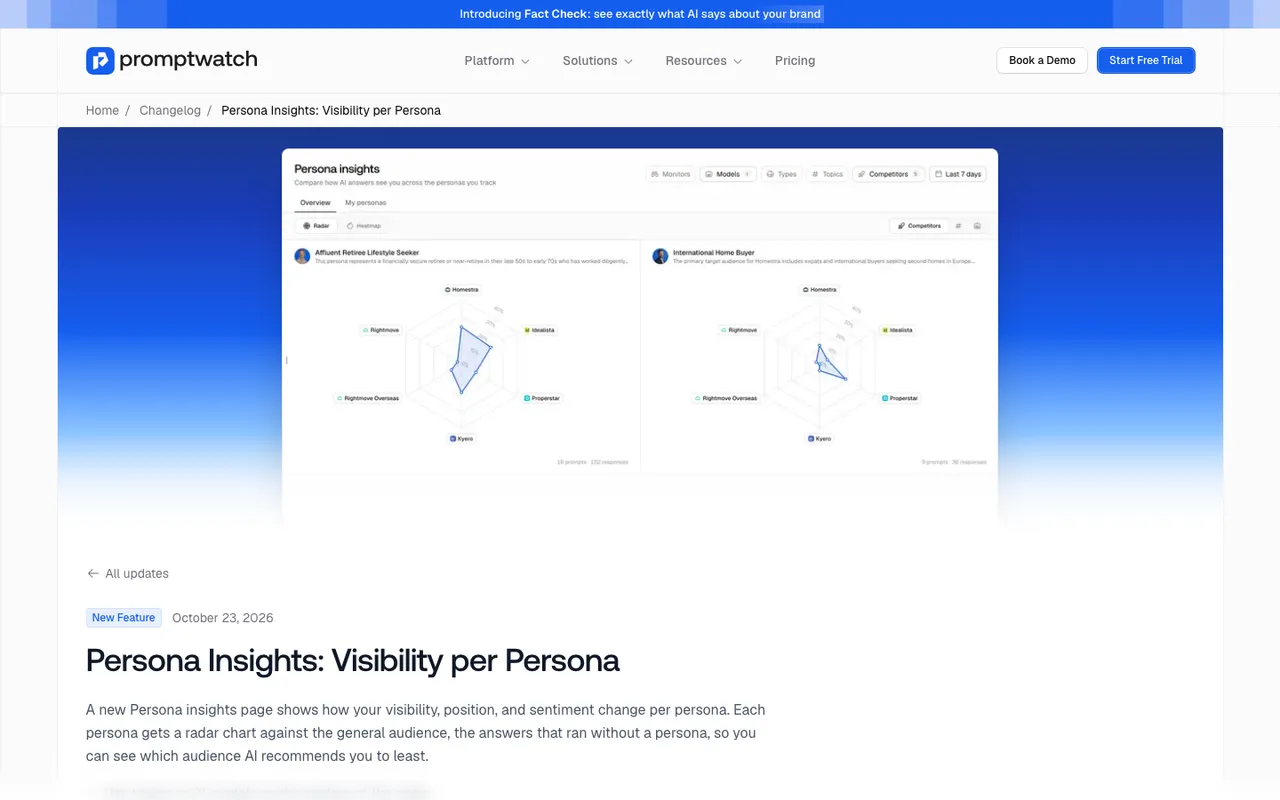 Promptwatch's changelog entry for Persona Insights, captured November 14, 2026. The personas and brands shown are example data.
For a B2B client, our persona set usually mirrors the buying committee: a financial decision maker, a technical evaluator, an everyday user, and sometimes an executive sponsor. Each persona description says who they are and what they care about, in plain language, without leading the engine toward a conclusion. "A finance director at a 300-person manufacturing company, responsible for software budgets and contract approval" works. "A finance director who wants the best value HR platform" nudges the answer.
Personas are also an axis on the heatmap, and the persona radar is available as a custom dashboard widget and in PDF reports, which is how it reaches the client's monthly review.
Prompts per role
Personas change who's asking. The prompts still need to fit the role. A CFO persona asking "what's the best HR platform?" tells you something, but a CFO persona asking the questions a CFO would actually ask tells you more. We write role-specific prompts alongside the shared ones:
- Financial: "is Acme worth it for a 300-person company?", "Acme total cost compared to Globex", "what contract terms does Acme require?"
- Technical: "does Acme support SSO?", "how does Acme handle employee data?", "Acme API and integrations"
- User: "is Acme easy to use for payroll changes?", "how good is Acme's support?"
To read the claims for one role, we often put that role's prompts in their own monitor, because the filter bar on the Brand Narrative page includes monitors. Then switching the monitor filter shows the claims AI makes about the client when it's answering finance questions, versus IT questions. On the Sentiment page, topics serve the same purpose.
What we fix, per role
The fixes are classic B2B content work, aimed at the role with the gap.
For the financial buyer, that usually means a pricing page that states what's included in plain sentences, a page explaining how pricing scales with company size, and content on the business case that doesn't overpromise. If AI frames the client as "expensive", the question is whether that's fair. If it is, the content should explain the value. If it isn't, the pages AI cites for that claim need checking.
For the technical evaluator, it's documentation that's crawlable, a security and data-handling page that states facts outright, and integration pages that name the systems supported. Technical evaluators ask specific questions, and engines answer specific questions from specific pages. A vague "enterprise-grade security" line gives a model nothing to repeat.
For the everyday user, it's help content, onboarding guides, and review profiles that reflect the current product. User-facing perception often comes from review sites, so the work overlaps with what we described in review sites, directories and how AI describes your brand.
Promptwatch's Academy has a GEO for B2B playbook in its playbooks section, which is a decent companion if you're setting this up for the first time. Our own planning approach is in how we use Persona Insights to plan client content.
How Promptwatch shows it
The Promptwatch brands page describes the product as tracking how ChatGPT, Gemini, and Perplexity describe a brand next to its competitors, and its product illustration includes a persona breakdown for a single persona.
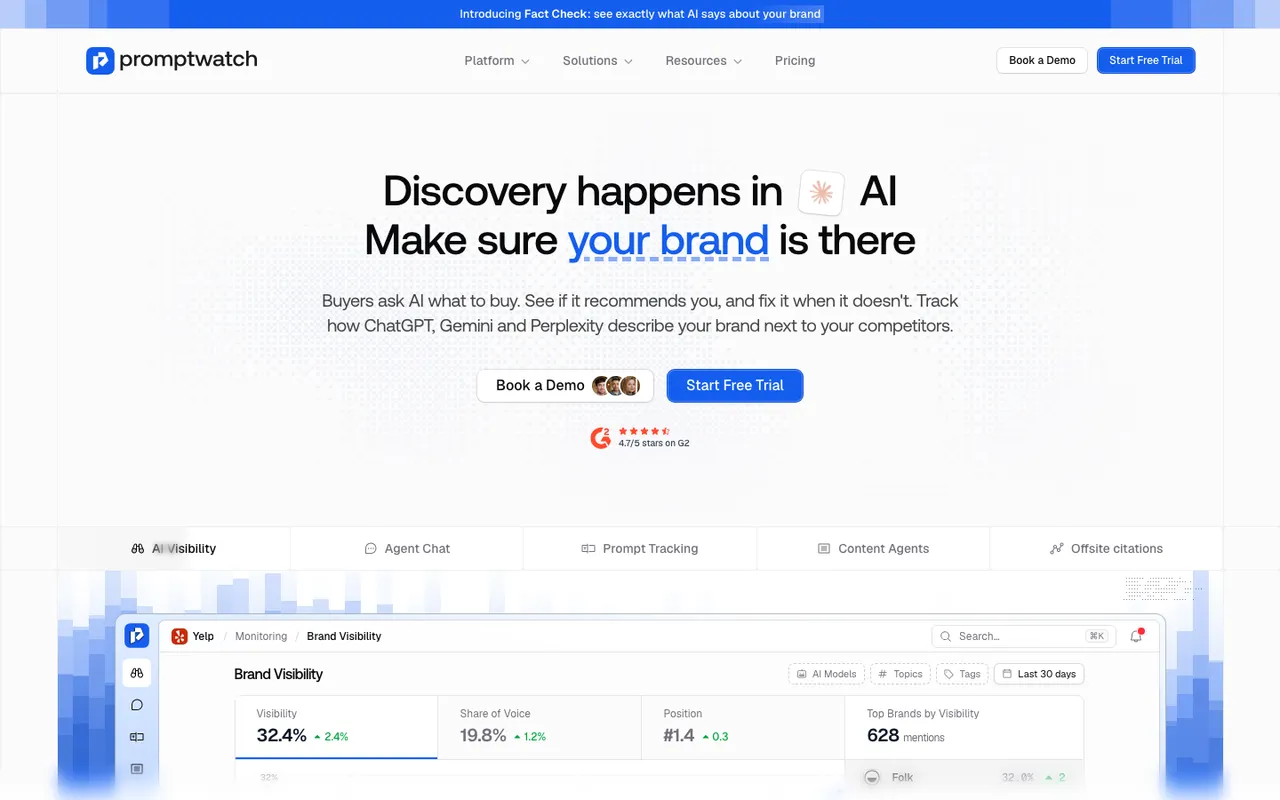 Promptwatch's solutions page for brands, captured November 14, 2026. The dashboard is Promptwatch's own illustration with example numbers.
That illustration is a fair picture of the question to ask for each committee member: against a named competitor, on each theme that role cares about, who wins?
Limits
Personas simulate context. They don't reproduce a real buyer's chat history, which the engines may also use. We treat persona results as a structured test of how the description shifts with who's asking, not as a record of what a specific CFO saw. And as with all perception work, measuring the gap doesn't close it. Content and sources do, and the engines decide what to read.
Getting started
List your buying committee, write three honest questions per role, and look at the descriptions side by side. The differences usually point to the content you're missing. We run this on Promptwatch for client programs. To see your own committee's view, book a Promptwatch demo and ask them to set up two personas from your committee.