Review sites, directories and how AI describes your brand
How review sites and directories shape the way AI describes your brand, how to measure their share against your own pages, and which profiles we fix first.
When an AI engine describes a software product, a hotel, or a local service, a surprising amount of the description can come from pages the brand didn't write. Review platforms, software directories, marketplace listings, "top 10" roundups. These pages are built to summarize and compare, which is exactly the kind of material an engine needs when someone asks "is X any good?" or "X vs Y".
So when clients ask us how to change the way AI describes them, one of our first questions is: how much of that description is coming from your own site, and how much from review sites and directories? The answer decides where the work goes. This post covers how we measure it, how we decide which profiles matter, and what we actually change.
The number that frames the problem
Promptwatch calls it the self-citation rate: the share of all citations in your tracked AI answers that point at your own domain rather than third-party pages. A review site's page about you doesn't count toward it, and neither does a subdomain like docs.yourbrand.com, which appears as its own domain.
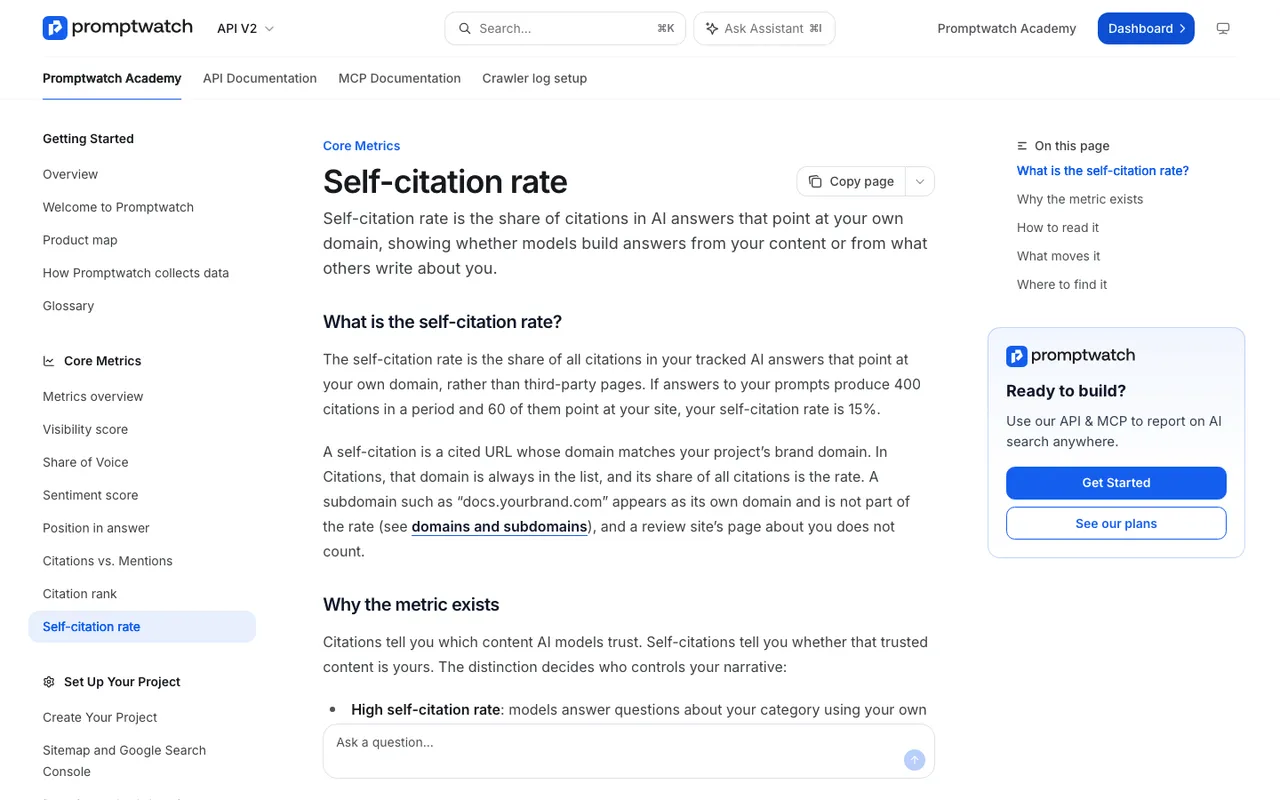 Promptwatch Academy's Self-citation rate page, captured November 14, 2026.
The Academy is clear that neither extreme is a goal. A rate near 100% would just mean nobody else writes about you. A low rate means answers are assembled from review sites, comparison articles, forum threads, and news, which can still be favorable, but someone else wrote it. Correcting it means influencing pages you don't own.
For perception work we read the rate in a specific way. A low self-citation rate on branded and objection prompts ("is [brand] worth it", "[brand] complaints") tells us third parties are writing the client's description at the exact moment a buyer is evaluating them. That's where review profiles and directories usually come in.
Two reading habits from the Academy keep us honest. Branded prompts self-cite heavily and category prompts mostly cite third parties, so a change in the prompt mix moves the blended rate without anything changing in the market. We filter by prompt type before reading a trend. And the rate often differs by model: your own pages may feed one engine's answers while another relies entirely on third-party sources. We filter by model too.
Which review sites and directories are feeding the answers
Knowing that third parties dominate isn't enough. We need to know which ones.
Promptwatch's Citation Trends classifies each citation into one of 22 content types and 20 source types. One of those source types is Directory, which covers G2, Capterra, Trustpilot-style listing and review sites, and marketplaces. Filtering to Directory shows which listings AI cites for the client's prompts, how often, and how that has changed over the trailing 90 days. Per page, Citation Trends also shows when it was first cited, how long it took to peak, its peak rate, and how quickly that rate decayed.
That last part helps with prioritizing. A directory listing that's been cited steadily for months is a durable input to the description. One that spiked once and faded probably isn't worth an afternoon.
We also look at which models cite which directories. Promptwatch's Academy notes that sentiment often differs by platform because each model reads different sources, and gives the example of a score that's fine on ChatGPT and poor on Perplexity pointing at the review sites and forums Perplexity favors. Whatever the pattern is for a given client, the model filter is how we find it.
What the listings are actually saying
Once we know which profiles matter, we read them. Not the star rating, the text. Three things in particular.
Facts the listing states about the brand: category, main features, who it's for, company details, integrations. Directory profiles are often filled in once at launch and never touched again, so they drift from the current product. If a listing still describes a feature set from two years ago, an engine reading it may repeat that description.
Recurring themes in reviews. Individual reviews come and go, but if a third of the recent reviews mention onboarding or support, that theme is likely to show up in summaries.
How the listing categorizes the brand relative to others. A directory that files a product under the wrong category, or next to the wrong alternatives, can shape which competitors AI compares it with.
Then we compare that reading with what AI actually says. Brand Narrative in Promptwatch files claims under nine themes, and the Reputation theme covers ratings, reviews, awards, market standing, and verdicts like "the best CRM for startups". Each claim has a Citations tab listing the pages cited alongside it.
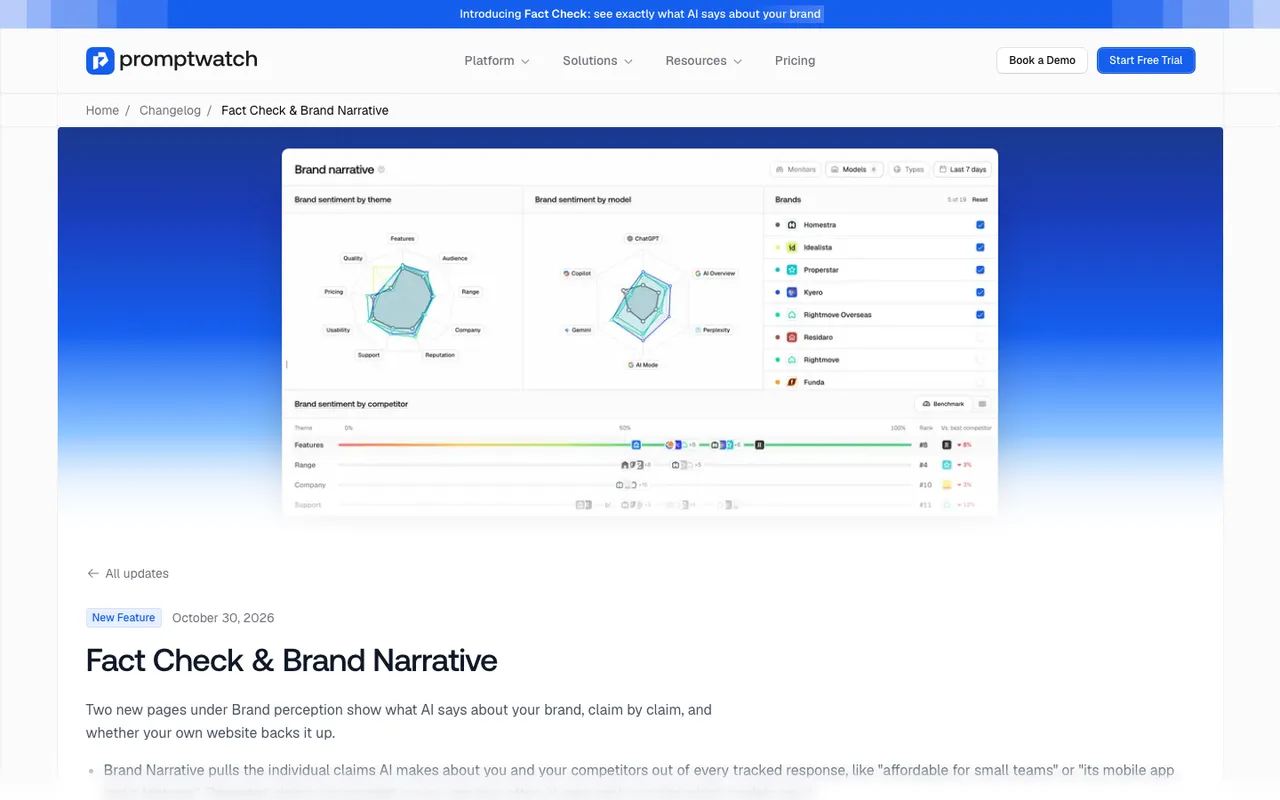 Promptwatch's changelog entry for Fact Check and Brand Narrative, captured November 14, 2026. The brands and scores shown are example data.
When a negative Reputation or Support claim keeps citing the same review profile, we have a direct line from a specific page to a specific sentence AI repeats. That's the profile we work on first.
What we fix, in order
Profiles the client controls
Most review platforms and directories let the brand claim and edit its profile. This is the fastest win and the most neglected. We update the description, the category, the feature list, the screenshots, the company details, and the integrations, so that the listing says what the product does today. We use plain sentences that state facts outright, because AI repeats what pages say outright.
We keep a register of every claimed profile, who has the login, and when it was last reviewed. Profiles drift again if nobody owns them.
Responses to reviews
Brands can't edit reviews and shouldn't try. They can respond. A specific, factual response to a critical review ("this was fixed in the March release; onboarding now takes a single session") adds current information to the page. Whether an engine picks up the response is outside anyone's control, but it gives the page a more accurate story to tell.
The flow of new reviews
If a fair complaint dominates recent reviews, the honest fix is operational, and we say so. If the complaint is out of date (the issue was fixed a year ago), then encouraging current customers to leave reviews, within each platform's rules, gradually shifts the recent picture. We don't buy reviews, gate them, or script them.
Third-party roundups that list the brand
Comparison listicles and roundups that sit outside the formal directories often carry the framing. If one is cited heavily and has stale facts, a polite note to the editor with corrected details is worth sending.
How Fact Check fits
On Promptwatch's Business plan ($579 a month), Agency Scale, and Enterprise, Fact Check takes a claim about the client's own brand and reads both the client's site and up to 50 of the most-cited pages AI uses, quoting the sentences that support or contradict it. The result shows separately what your site says and what cited sources say. For review-site problems, the useful outcome is "Inaccurate, and your site already says the opposite": the Academy's guidance is that the cited sources are the likely origin, so you ask those sites for a correction and make sure the page that states the truth is easy to find.
Fact Check reports what the pages say, not what is true. If a review site says support is slow and support really is slow, there's nothing to correct. Only the operation can fix that.
What we don't do
We don't invent review volume or chase ratings for their own sake. We don't promise a client that fixing a profile will change an AI answer by a certain date, because the engines decide what they read and when. And we don't treat every directory as equal. A profile AI never cites can wait. For a wider take on whether software directories help with recommendations at all, see do review sites like G2 and Capterra help a software brand get recommended by ChatGPT.
Start with your own numbers
The cheapest first step is to find out which review sites and directories AI cites for your brand, and read what those pages say. We do that on Promptwatch, using the self-citation rate, the Directory source type in Citation Trends, and the Citations tab in Brand Narrative. You can check your own brand with the 7-day free trial on any self-serve plan.