Digital PR and AI brand perception: which coverage moves the answer
Which digital PR placements change how AI describes a brand: coverage that gets cited, says the right thing in plain words, and lasts. How we plan and measure it.
The coverage that changes what AI says about a brand is the coverage AI reads while answering. That sounds obvious, but it overturns a lot of how digital PR has been judged. A feature in a famous publication that no engine ever cites won't touch the description. A detailed comparison on a mid-sized trade site that gets cited every day for "[brand] vs [competitor]" can rewrite it.
We still pitch big outlets when there's a real story, and we still build links for classic SEO. But when a client hires us to change how AI engines describe them, we plan PR differently. This post covers what we look for in a placement, where the evidence comes from, and how we check afterwards whether the coverage actually moved the answer.
What "moves the answer" means
Perception is how an AI engine describes a brand once it names it: the attributes, the claims, the framing against competitors, the tone. A PR placement can affect that description in three ways. It can add a claim the engine didn't make before ("strong for agencies managing many clients"). It can contradict a claim the engine keeps repeating ("setup takes weeks"). Or it can shift the framing, so the brand gets compared to a different set of competitors.
For any of that to happen, a live-search engine has to find the page, fetch it, and use it. That's the filter we apply to every placement idea before we pitch it.
Which sites get cited
The question every PR lead asks first is about authority. Do you need the biggest sites? Promptwatch's ChatGPT citation share by domain rank report for August 2026 gives a useful answer for ChatGPT specifically. Domains ranked DR 46-60 took 22.6% of citations and DR 61-75 took 23.4%, together almost half. The top tier, DR 91-100, started the month around 7% and ended it at about 3%.
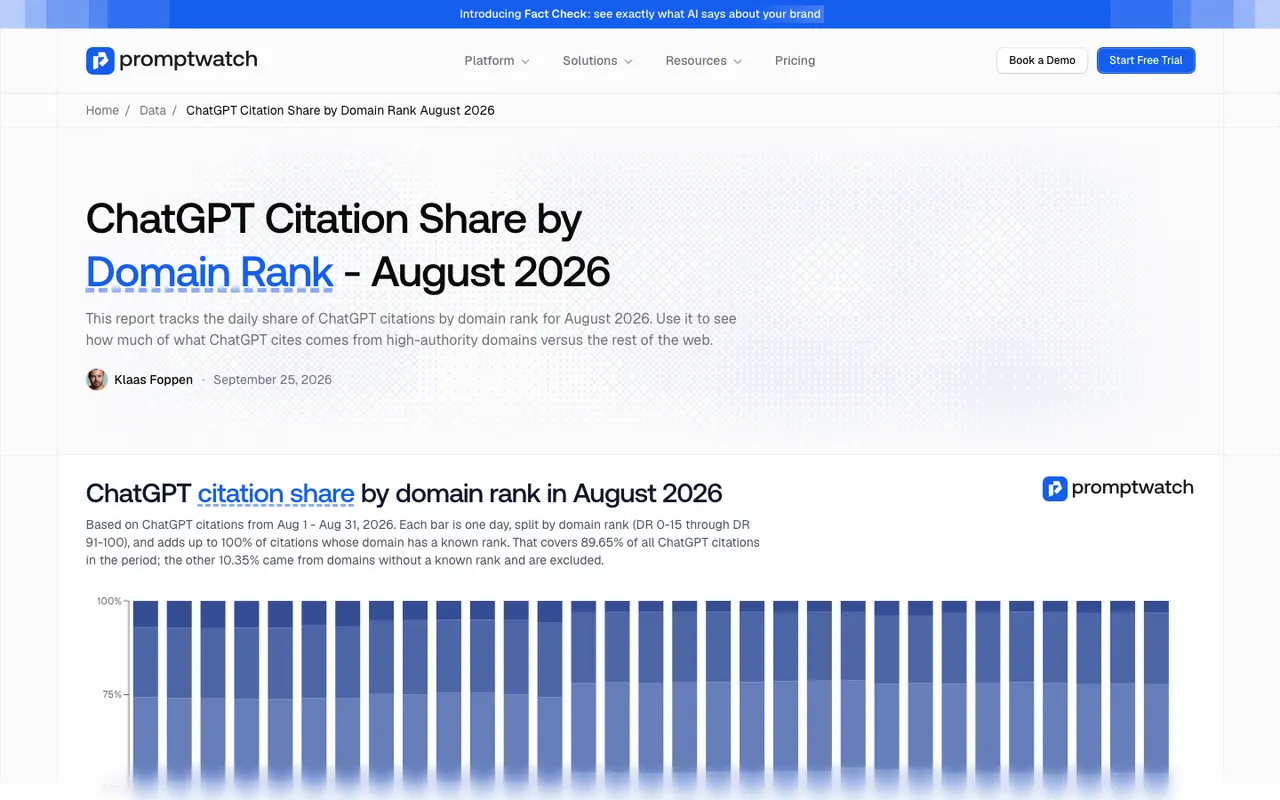 Promptwatch's ChatGPT citation share by domain rank report for August 2026, captured November 14, 2026.
Two cautions before anyone rewrites a PR plan around those numbers. The report covers ChatGPT only, for one month, and only citations whose domain had a known rank (89.65% of the total). Other engines may behave differently. And a citation share is an average across every topic ChatGPT answers. In a client's category, the cited sites might skew higher or lower. We've written separately about how we choose PR targets using the domain rank data. For perception work, we treat the report as a reason to stop dismissing mid-tier trade publications, not as a target list.
The target list comes from the client's own data.
Start from the pages already shaping the description
Before pitching anyone, we look at which third-party pages AI already cites when it describes the client. Three places in Promptwatch give us that list.
The Citations tab on a claim in Brand Narrative is the most direct. Open a negative claim (say, "limited reporting for agencies") and the tab shows the pages the responses cited alongside it. The Academy notes that a cited page isn't necessarily where the claim came from, but it's the first place to look. If the same comparison article shows up next to that claim across several responses, the author of that article is a better pitch target than any outlet on a generic media list.
The Citations page under Sources lists every cited URL and domain across the client's tracked prompts, with source type, content type, domain rank, and position in the source list. Filtering by topic shows which publications AI reads for the subjects that matter to the client.
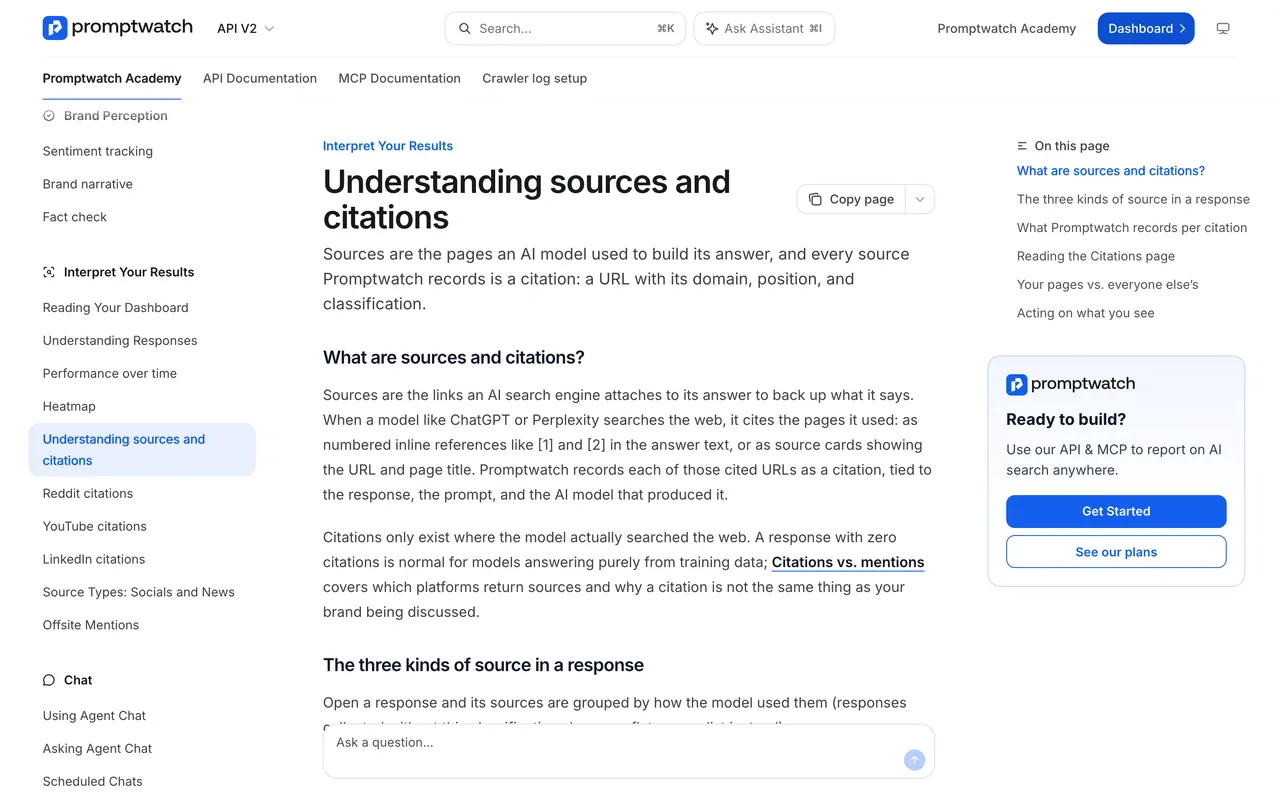 Promptwatch Academy's Understanding sources and citations page, captured November 14, 2026.
Offsite mentions add the pages that name the client without linking to them, ranked as opportunities. For PR this is a goldmine of warm contacts: the writer already covers the client, and the page already feeds AI answers. A correction or an update there is often a faster win than a new placement elsewhere.
What a placement needs to say
Once we know where to pitch, we think hard about what the coverage should contain, because AI quotes sentences. A beautifully written profile that never states the facts plainly gives the model nothing to extract.
Brand Narrative keeps a claim only if it's backed by a verbatim quote of at least four words. That's a decent rule of thumb for PR briefs too. If you want AI to say "Acme is built for agencies managing many client accounts", somewhere in the coverage a sentence should say roughly that, about Acme, in plain words. We give journalists and partners the facts in a form that's easy to repeat: a short fact sheet, a clear statement of who the product is for, and current details on whatever the AI keeps getting wrong.
We also prefer formats that engines tend to cite for comparison and evaluation questions. Comparisons, reviews, and listicles that evaluate several options put the client next to competitors, which is where framing gets set. A company announcement mostly states that something happened.
News fades, evaluations last
There's a timing question too, and Promptwatch's ChatGPT content half-life report answers it well. It followed every page ChatGPT cited on July 6, 2026 for about 90 days. News decayed fastest: half of the news pages were no longer cited after 36 days. Reviews, how-to guides, and product pages reached their half-life after 74 to 77 days. Listicles held up better, with 60% still cited after 60 days, and landing pages, docs, comparisons, and listicles only crossed 50% at the very end of the window.
For perception work, that changes how we split the effort. News coverage is good for a short burst, around a launch or a correction that needs to spread quickly. Evaluative coverage (a comparison, a review, an inclusion in a well-maintained roundup) keeps feeding answers for months. When a client asks which to prioritize to fix a persistent negative claim, we usually say the evaluative piece.
Planning a campaign around a perception gap
Here's how a perception-led PR plan comes together for us.
- Pick the gap. In Brand Narrative's Benchmark view, each theme shows the client's rank among tracked brands and the gap to the best competitor. A theme where a competitor leads by a wide margin, and where the client has a real story, is a candidate.
- Read the claims. Open that theme in the claims table and read what AI actually says, positive and negative, for the client and for the leader.
- Find the sources. Use the Citations tab on those claims, plus the Citations page filtered to the relevant topic, to list the publications feeding the theme.
- Brief the story. Write down the claim the coverage needs to support, the evidence the client can share, and the publications most likely to be read for that topic.
- Pitch and place. This part is classic digital PR, and nothing about AI replaces relationships with editors.
Checking whether it worked
PR teams have always struggled to prove impact. For AI perception, the measurement is more direct than it used to be.
When a placement goes live, we add its URL to Page Tracker in Promptwatch, which follows a specific page, yours or someone else's, and shows whether it gets cited and in which responses. If the page never gets cited, it didn't feed the answer, whatever else it did for the brand. If it does, we check the claims table for the theme we targeted and set the date range to the weeks after the placement went live, to see whether the claim it supports starts to appear and whether the negative claim it contradicts starts to fade.
We're careful about attribution. Engines read many sources, and a theme score can move for reasons that have nothing to do with our placement. We report a placement as "cited in N responses on these prompts" first, and only connect it to a perception change when the claims themselves line up.
Where this sits in the agency
For a full-service agency, perception gives SEO, content, and PR a shared target. The SEO team fixes the client's own pages. The content team writes what the site is missing. The PR team works on the third-party pages AI reads. We run all three against the same data on Promptwatch, the platform we use for client programs.
If you want to see which publications currently shape how AI describes your brand, book a Promptwatch demo and ask to start from the Citations tab of your most repeated negative claim.