AI search visibility tools for enterprise: what we use and why
The AI search visibility tools for enterprise we evaluate for clients, what security and procurement ask, how we split work with in-house teams, and why we run programs on Promptwatch.
When an enterprise client asks us which AI search visibility tools for enterprise programs we would buy, they usually expect a feature comparison. What they get first is a question back: who in your company has to sign off, and what will they ask? In our experience the tool that wins the demo is not always the one that survives the security questionnaire, the data protection review, and the first quarterly business review with the CMO.
So this post is less a ranking and more a description of how we actually choose. It covers what enterprise security and procurement teams ask, which platforms we put on the shortlist and what we know about each from their own pages, how we split the work between our team and the client's people, and how we make AI search reporting sit next to the SEO reporting the business already trusts. The short version: we run client programs on Promptwatch, and the reasons are mostly about governance and evidence rather than dashboards.
What security and procurement ask first
The questionnaire arrives before anyone has logged in. The questions we see most are predictable: which certifications does the vendor hold, where is data handled, can we use single sign-on, is there an audit trail, how are permissions scoped, how is API access controlled, and what does it cost to add people.
For Promptwatch the answers we can give from its own documentation are these. The company is ISO/IEC 27001 certified and GDPR compliant, and data is handled by an EU-based company (Promptwatch B.V. is registered in Amsterdam). SSO is part of the Enterprise plan. The audit log is on Business, Agency Scale, and Enterprise, it is visible to owners only, and it shows whether a change came from the dashboard, the API, an MCP client, or Agent Chat. That last detail matters more than it sounds. Once an organization lets AI agents edit monitors or queue content, the security team wants to know which changes a human made and which an agent made.
Permissions use owner, editor, and viewer roles with project-level access, and API keys can be scoped to a project, to the organization, or to read-only. Seats are unlimited on every paid plan, which removes an annoying procurement conversation: nobody has to decide which regional marketer gets a login.
What we do not have in our sourcing is a SOC 2 report for Promptwatch. Some enterprise questionnaires insist on SOC 2 by name. When that happens we say so plainly and ask Promptwatch directly, rather than letting the ISO certificate stand in for something it is not. Profound's pricing page lists SOC 2 on Enterprise, and our research notes on Brandlight record SOC 2 Type II, so if that single checkbox decides the deal, the client should know who states it.
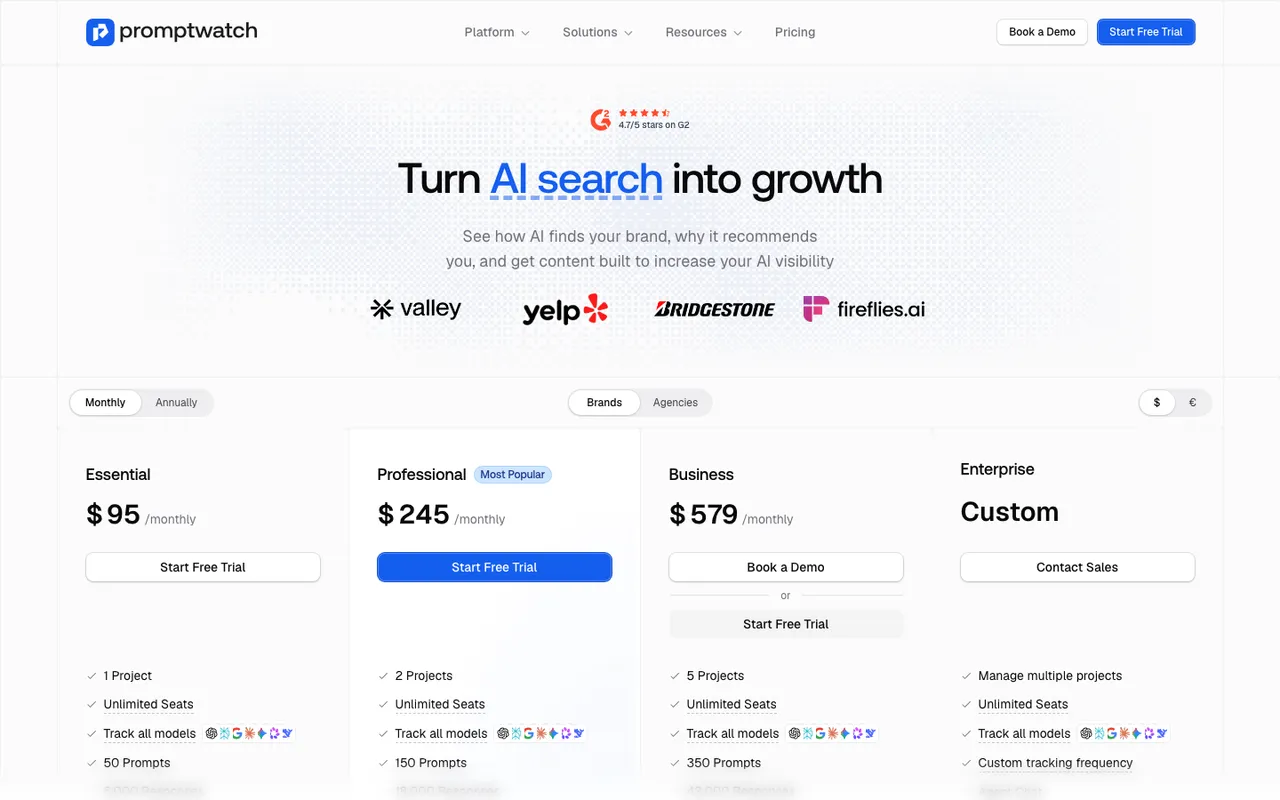 Promptwatch brand pricing, monthly billing, captured November 6, 2026.
On cost, Promptwatch publishes its prices, which already sets it apart from most of the enterprise shortlist. Essential is $95 a month, Professional $245, Business $579, and Enterprise is custom. Every self-serve paid plan has a 7-day free trial on monthly billing. For enterprise work we nearly always end up on Business or Enterprise, because that is where the audit log, state and city tracking, the automated Content Agent, and faster tracking (every 12, 6, or 1 hours) sit. Enterprise adds SSO, a dedicated success manager, priority support, managed content workflows, and API capacity of 50,000 requests an hour against 10,000 on Business.
The shortlist we run against
We do evaluate alternatives for every enterprise client, partly because procurement requires it and partly because some projects genuinely fit another product better. Here is what each vendor states on its own pages, as recorded in our research notes.
AthenaHQ is the dedicated platform we compare most closely. Starter is $295 a month with 3,600 credits, where one credit is one AI response, across 11 models with country-level support. API access and extra credits are paid add-ons on Starter. The enterprise features sit in the custom Enterprise tier: SAML and OIDC SSO, an organization audit log, multi-region and multi-language support, persona targeting, and an executive dashboard with BI tool support. The credit model is the thing to model carefully, because prompts times engines times frequency adds up quickly once a global brand turns on several markets.
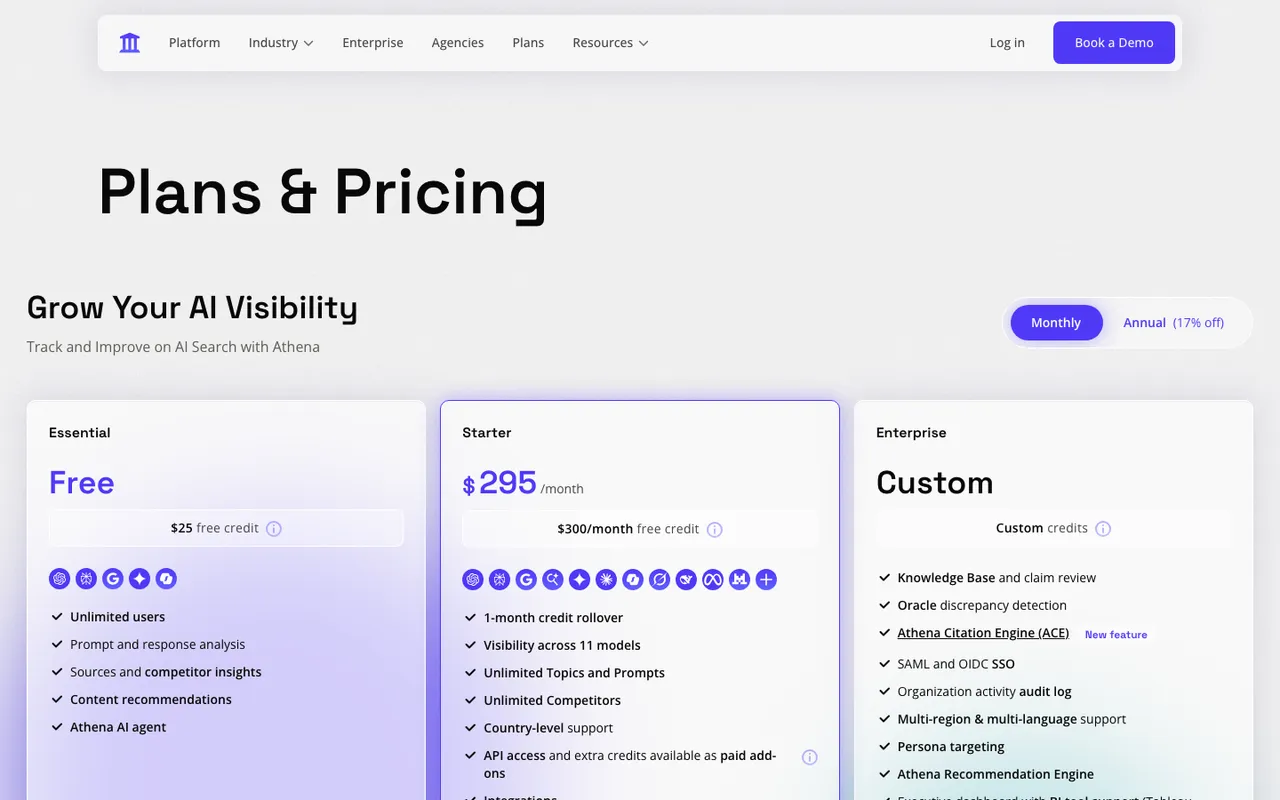 AthenaHQ plans page, captured November 6, 2026.
Scrunch lists Core at $250 a month for 125 unique prompts, 5,000 responses a month, one brand workspace, five user licenses, and four LLMs (ChatGPT, Perplexity, Google AI Overviews, Copilot). Enterprise is custom and adds nine LLMs, SSO, API access, a dedicated account team, and AXP, its Agent Experience Platform that serves AI-optimized page versions to crawlers. Sitecore acquired Scrunch in June 2026, which is worth raising in procurement: for a Sitecore shop that may be an advantage, and for everyone else it is a roadmap question to ask.
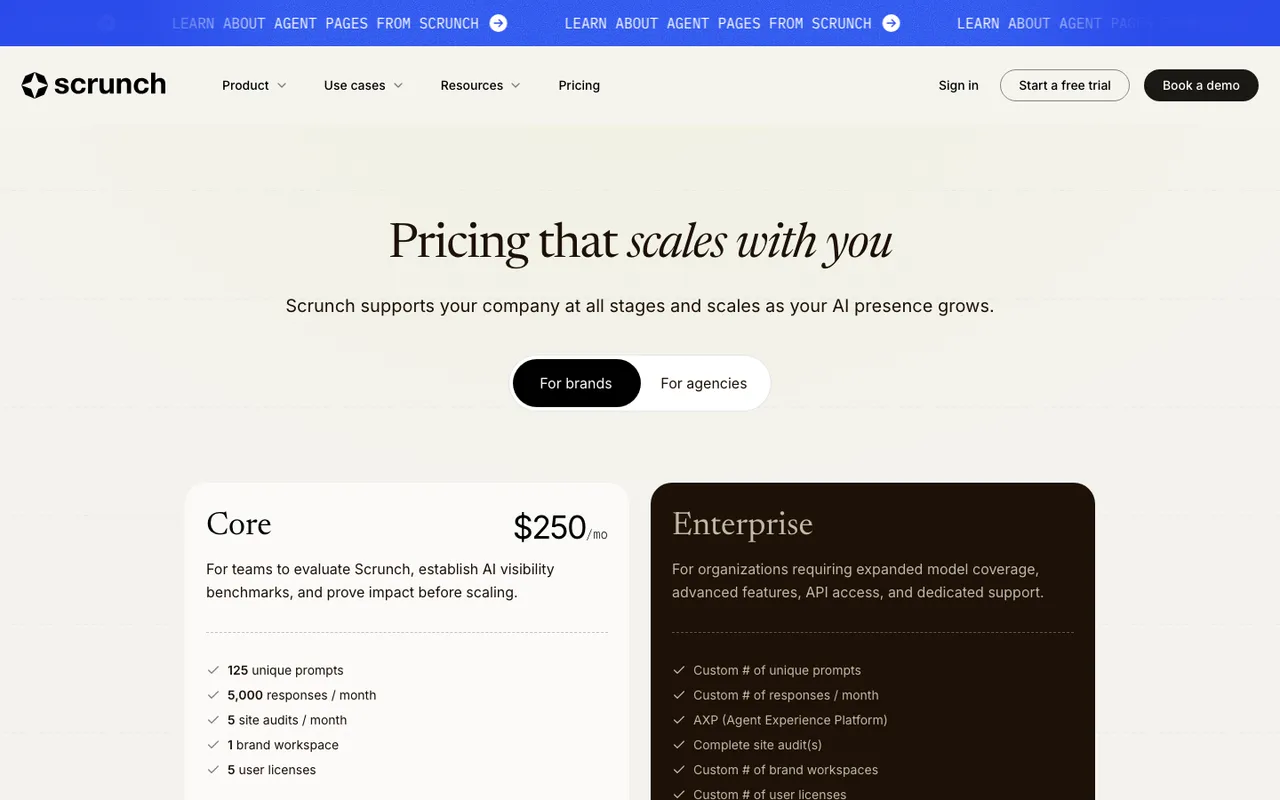 Scrunch pricing for brands, captured November 6, 2026.
Profound now sells itself as an "AI Marketer", a set of agents for research, content, reporting, and workflows, with AI search tracking as one part. The public page shows a free trial (50 prompts daily for 7 days across ChatGPT, Gemini, and Google AI Overviews) and a custom Enterprise plan with up to nine answer engines, dedicated support, and SSO/SAML plus SOC 2. The page also lists Agent Analytics for AI-sourced traffic with CDN integrations. No Enterprise price is published; the roughly $40k a year figure in our notes is an earlier estimate, not something on the page. It suits a marketing organization buying an agent program. For a team that wants a dedicated AI search platform it is a bigger commitment than the job needs.
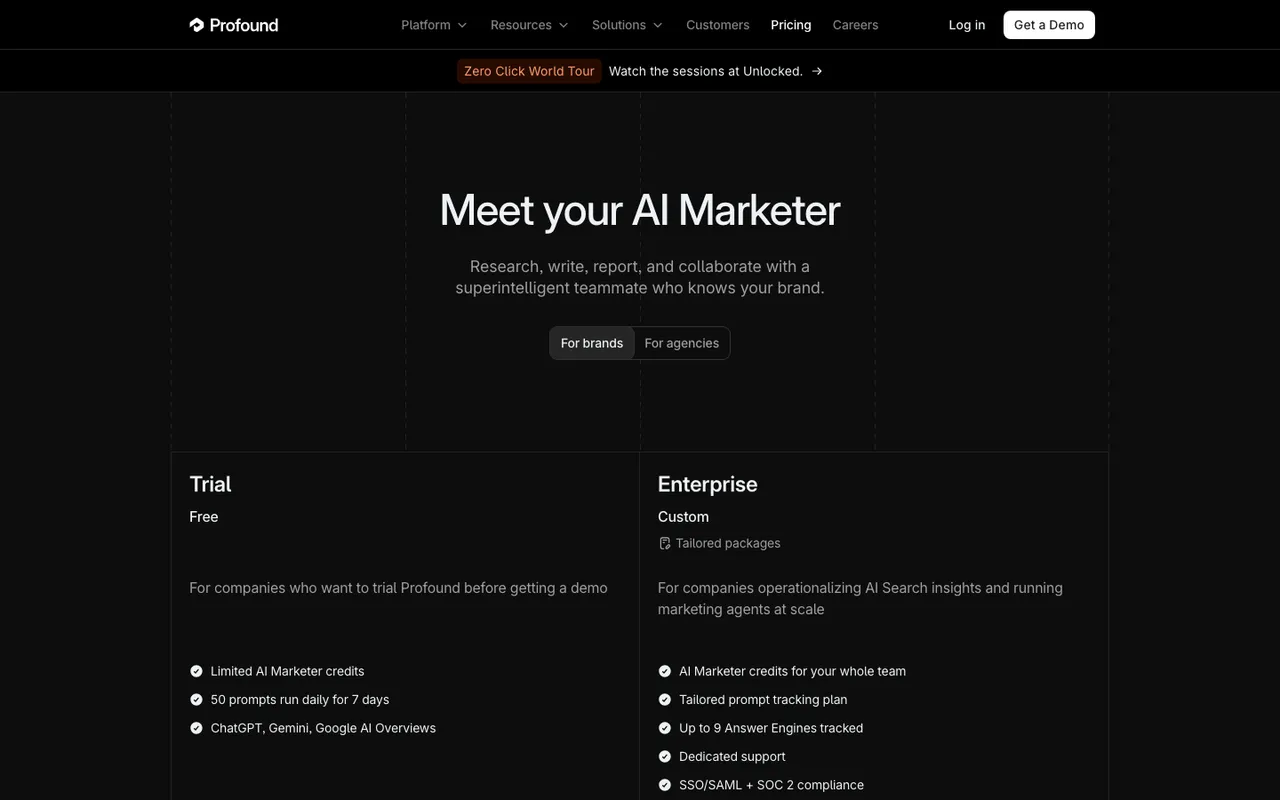 Profound pricing for brands, captured November 6, 2026.
The enterprise SEO suites come up in almost every evaluation because the client already pays for one. Conductor publishes tiers but no prices. seoClarity lists packages from $2,500 a month, with its Clarity ArcAI module as a separate add-on. BrightEdge publishes no prices at all. If the contract exists, we read what the AI module actually stores before recommending anything on top. Botify is a different animal: crawl, rendering, and feed delivery to agents, with no published price, and we keep it when it is already in place. Evertune (large-sample measurement, each prompt sampled up to 100 times per model) and Brandlight (enterprise visibility with SOC 2 Type II and SSO listed) are both sales-led with no published prices.
Why we still land on Promptwatch
None of those tools is a bad purchase. Our reason for running programs on Promptwatch is that one workspace covers the whole chain we have to report on: prompt tracking across ChatGPT, Google AI Overviews, AI Mode, Gemini, Perplexity, Copilot, and others; citation analytics down to the page, Reddit, and YouTube level; IP-verified AI crawler logs with a crawl-to-citation path and a citation rate per page; visitor analytics that tie AI-referred visits to conversions; and content work that runs through the Action Board and the Content Agent with a review inbox.
In a steering committee that matters because every number comes with one definition. When the CMO asks why visibility fell in Germany, we can show whether GPTBot stopped fetching the page, whether the page is fetched but not cited, or whether a competitor's review site took the citation. With four tools stitched together, that same question becomes a reconciliation exercise.
One procurement detail people miss: Promptwatch tracks some engines through their real interfaces (ChatGPT, Google AI Overviews and AI Mode, Gemini, Perplexity, Copilot, Meta AI, Amazon Alexa) and others through the API (Claude, DeepSeek, Mistral, Grok). Ask every vendor for that split in writing. It changes what the numbers mean.
How we split the work with the in-house team
Enterprise programs fail on ownership far more often than on tooling. Our default split looks like this.
The client owns the account. The Promptwatch organization sits under the client's billing and the client's owner role, and we work as editors. That keeps the data with the business if the relationship ends, which we cover in more detail in our note on handing a GEO program to an in-house team. It also has a practical reason: Search Insights, the view that overlays Search Console and Bing data on AI crawls and citations, is part of 360 Insights, which sits on the brand plans and Enterprise rather than the agency plans. So for enterprise clients we usually set up a brand plan they own instead of hosting them inside our agency workspace.
The client's engineering or platform team owns the crawler log connection (Cloudflare Logpush, CloudFront, Fastly, Akamai and the rest) and the visitor analytics script, usually deployed through their own tag manager. We write the tickets and verify the data. Their legal and brand reviewers own the Content Agent's review inbox. Nothing goes live without them, and on enterprise accounts we never switch on fully automated publishing.
We own the prompt set design, the Brand Book that defines what counts as a mention, the weekly triage of the Action Board, the content briefs, and the monthly reporting. Action Board items carry assignees and comments, so a crawler error lands with the developer and a content gap lands with the writer, and both of them see the evidence. Scheduled Agent Chat briefings can go to a Slack channel, which tends to reach regional marketers who would never open a PDF.
How SEO and GEO reporting combine
Executives do not want a separate AI deck. They want AI search inside the search report they already read. Three things make that possible.
First, Search Insights puts Google Search Console and Bing Webmaster clicks and impressions next to AI crawls, citations, and clicks per page and per topic. That is where we answer "did the page that lost its ranking also lose its ChatGPT citation?"
Second, the Looker Studio connector (from Professional) and custom reports let us drop AI visibility into the client's existing dashboards. Promptwatch's own case study with the agency Monks describes exactly this pattern: dashboards combining LLM visibility, organic, and paid search, with the Answer Gap Report and Visibility Score feeding client content roadmaps. For the blending itself we follow the steps in our Looker Studio guide.
Third, traffic attribution has to survive platform changes. ChatGPT stopped sending a referrer on October 8, 2026. Promptwatch added an "Include ChatGPT UTM referrers" toggle that counts utm_source=chatgpt.com visits as ChatGPT again, without double counting when a real referrer is present. Enterprise analytics teams notice gaps like that within a week, and it helps to have the explanation ready.
What we would do this week
If you are building an enterprise shortlist, send the security questionnaire to every vendor before the demos, ask each one for the real-interface versus API split, and price the plan that actually carries SSO and an audit log rather than the entry tier. Then book a Promptwatch demo with your own revenue prompts on the screen. If you want us to run the evaluation or the program, email hello@1001seomedia.com with your current stack and who signs off.