The AI visibility tool that tracks every AI model on the entry plan: what we use and why coverage matters for SEO
A full-service SEO and GEO agency on picking an AI visibility tool that tracks every AI model from the entry plan, and why Google and ChatGPT need different fixes.
A question we hear in almost every first call now: "Is there a tool that tracks all the AI engines without us paying enterprise prices?" It usually comes from a marketing lead who has tried one cheap tracker, seen ChatGPT numbers only, and suspects the picture is incomplete.
They're right to suspect it. In our client work the engines often disagree. A brand can be named in most ChatGPT answers for its category and barely appear in Google AI Overviews for the same questions, or the other way round. Tracking one or two engines doesn't give you a smaller version of the truth. It gives you a different answer.
Why the engines split, from an SEO point of view
This is where classic SEO and GEO meet, and it's the reason we push for full coverage.
Google's AI features sit on top of Google Search. Google Search Central's page "AI features and your website" says the best practices for SEO remain relevant for AI Overviews and AI Mode, and that there are no additional requirements or special optimizations to appear in them. A page has to be indexed and eligible for a snippet. So when a client is missing from AI Overviews, our first look is often a classic one: indexing, internal links, content in text rather than images, structured data that matches what's on the page.
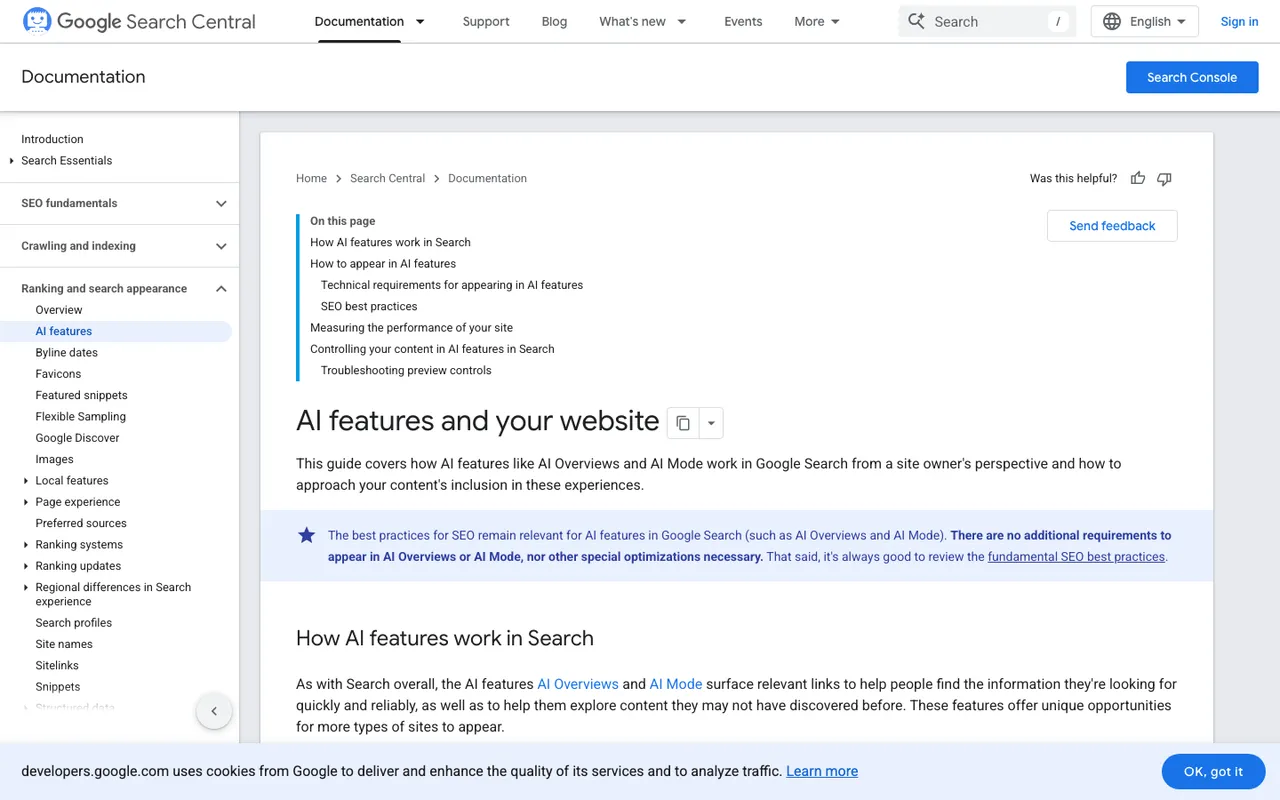
Google Search Central, "AI features and your website", captured November 21, 2026.
ChatGPT works differently. OpenAI's crawler documentation says a site has to allow OAI-SearchBot to appear in ChatGPT's search answers, and its Help Center says ChatGPT search rewrites a question into targeted queries sent to search partners. Fixing a ChatGPT gap often means crawler access, or pages that answer those rewritten queries, or third-party sources that ChatGPT already cites.
Perplexity, Copilot, Gemini and the API-based models each add their own wrinkle. If your tool can't see an engine, you can't tell which kind of fix it needs.
What "every model on the entry plan" means in practice
We run our client programs on Promptwatch, and its pricing is the cleanest answer we've found to this question.
On the agency side, every plan includes all AI models, unlimited prompts and unlimited projects, starting with Kick-off at $199 a month. That's how we can add a new client without first negotiating which engines they get.
For brands that want their own seat, Essential is $95 a month. The pricing cards say "Track all models", and every paid plan can track any of the supported engines. The quota is what you plan around: 50 prompts and 6,000 responses a month, where each prompt answered by each engine is one response. We usually help brands pick the four or five engines that matter for their buyers first, then widen once the prompt set is stable.
The engines on offer cover what our clients ask about: ChatGPT, Google AI Overviews, Google AI Mode, Gemini, Perplexity, Copilot, Meta AI and Amazon Alexa through their real interfaces, plus Claude, DeepSeek, Mistral and Grok through their APIs.
The part that connects it back to SEO
For full-service work, the feature we lean on most is Search Insights. It puts Google Search Console and Bing Webmaster clicks and impressions next to AI crawls, citations and clicks, per page and per topic. When a page loses AI Overviews presence and its Search Console impressions fall in the same week, that's one problem with one fix. When the Search Console line holds steady and only the AI citations drop, we're looking at something else.
Search Insights is part of 360 Insights, which comes with every brand plan, Essential included, but not with the agency plans. That's one reason we often suggest a client holds its own brand account and gives us access: unlimited seats on every paid plan make that easy, and the client keeps the history if the engagement ever ends.
Our advice before you buy any tracker
Don't trust an engine list until you've seen the quota next to it. Multiply your prompts by the engines you want and by the days in a month, and check the plan covers it. If it doesn't, you'll end up sampling, and sampling hides exactly the engine where you're weakest.
Then write prompts the way your buyers talk, not the way your keyword tool lists them. That habit matters more than any tool choice.
If you want to see your own coverage gaps before deciding anything, Promptwatch's free AI Visibility Report scans ChatGPT, Gemini and Perplexity for your brand without a login. It's a reasonable first look, and a good way to find out whether a full program is worth it.