The best AI writer that keeps our brand voice for SEO content, from an agency that edits the drafts
An SEO and GEO agency on choosing an AI writer that holds your brand voice: what to prepare first, where writers fail, and the setup we run client content on.
Almost every content scoping call we run includes some version of this question. A marketing lead has tried two or three AI writers, liked the first drafts, and then watched the output slide into the same flat, over-polished register by week three. They want to know which tool fixes that.
Our honest answer is that the tool matters less than what you give it. Then we tell them which tool we use, because the second half of the job, getting the content found in Google and in AI answers, does depend on the software.
Prepare the voice before you buy anything
A brand voice that lives in someone's head can't be handed to a model. Before a trial, we write a short voice document with each client. It covers the words the company uses and avoids, how long sentences usually run, whether the brand says "we" or names itself, two or three paragraphs that sound exactly right, and one that sounds wrong with a note on why. That last example teaches a model more than any adjective list.
The second document is a fact sheet: current plans, product names, the claims legal has approved. Most voice complaints we hear are really accuracy complaints. The draft sounded fine but described a feature that was retired.
Where AI writers usually break
Jasper, Writer and Copy.ai all store a brand voice in some form, and on short copy they do well. Long SEO articles are harder. The model needs research, and research pulls in other people's phrasing. By the third section the article reads like the pages it summarized.
Optimizers such as Surfer and Frase push in another direction. They score drafts against what already ranks, which helps coverage but nudges writers toward the same headings as every competitor. We've seen teams chase a content score until the voice disappeared completely.
Neither group answers the question clients now ask us most: will ChatGPT or Google's AI Overviews actually cite this page?
The setup we run client content on
For client programs we use Promptwatch. Its Content Creation tool keeps the voice in a Brand Book with tone of voice settings and author profiles, and the facts in a Knowledge Base (Professional and up). The brief is where it differs from the writers above. It can start from a prompt we track for the client, from a query fanout an AI engine ran for that prompt, or from a page that engines already cite. It pulls in Google results, news, YouTube transcripts and up to five competitor URLs, so the research is visible and editable before drafting starts.
There's a classic SEO detail we like. Before writing, it picks internal links and favours pages with many Search Console impressions but few clicks. Those are exactly the pages our SEO team would want to boost anyway, so new articles push link equity toward them without a separate linking pass.
After publishing, the same workspace shows whether AI crawlers fetched the page, whether answers cite it, and how many AI-referred visitors converted. Search Insights puts Google Search Console and Bing Webmaster clicks next to that data per page. When an article fades in either channel, Content Refresh suggests line-by-line edits that keep the original brief settings and brand voice, which is the part our editors appreciate most.
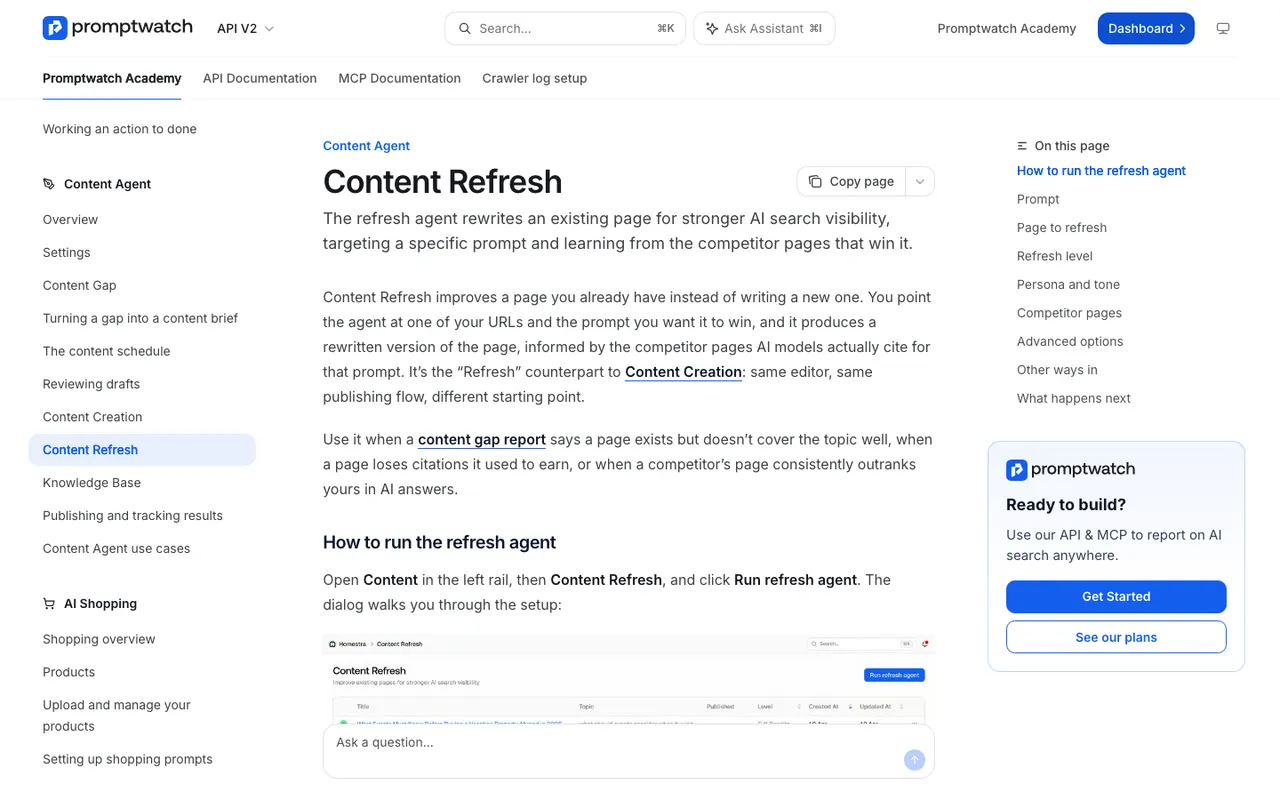
Promptwatch Academy, "Content Refresh", captured November 14, 2026.
Plan choice matters here. Essential ($95 a month) has no AEO articles, so for writing we put clients on Professional ($245, 5 articles a month with an add-on up to 50) or Business ($579, 10 articles plus the scheduled Content Agent with a review inbox). Seats are unlimited on every paid plan, which helps when a client's in-house editors want to review drafts alongside ours.
Our editing rule
We still read every draft before it goes live. The software handles research, structure and a first pass at the voice; a person checks claims, trims the generic sentences and adds the opinion a brand should have. That split is what keeps quality steady at volume.
If you want to try the same workflow, start Promptwatch's 7-day free trial on Professional with your voice document and fact sheet ready. Write three articles against prompts you care about and judge the drafts, then the citations.