The best tool to track AI visibility by topic cluster, from an agency that builds the clusters
How we track AI visibility by topic cluster for SEO and GEO clients: mapping content hubs to prompt groups, what we measure per cluster, and the tool we use.
Most of our clients already think in topic clusters, because that is how we plan their SEO. A pillar page on "employee onboarding", a dozen supporting articles underneath, internal links tying them together. When AI search came along, the obvious question from clients was whether those same clusters show up in ChatGPT and Google's AI answers. The honest answer is that you can't tell from rankings alone. You need a tool that tracks prompts grouped the same way.
Why we track AI visibility per cluster, not per site
A site-wide AI visibility score is a vanity metric for us. It goes up, everyone is pleased, and nobody knows which content did it. When we break it down by cluster, the picture usually changes. One hub is named in most answers. Another, sometimes the one with the best Google rankings, barely appears. That second hub is where the next quarter's work goes.
There is also a planning benefit. Our SEO roadmap is already organized by cluster, so AI visibility data that uses the same structure slots straight into it. We don't have to translate between "prompts" and "content hubs" in every client meeting.
How we map an SEO cluster to an AI prompt group
For each content hub, we write prompts the way a buyer would actually ask an assistant. Not keywords. "What should a 40-person company include in onboarding?" rather than "onboarding checklist". We add comparison prompts ("X vs Y for onboarding") and a few problem prompts. Then we group them under one topic in the tracker, named exactly like the hub in our SEO plan.
Two rules we've learned to keep. Clusters need enough prompts that one odd answer doesn't swing the number. And the cluster names must match the content plan, or the reporting stops being useful the moment someone new joins the account.
The tool we run it on
We run client programs on Promptwatch, and its Topics page is the reason this approach works without spreadsheets. Since October 26, 2026, every topic shows Visibility, Citation Share, Avg. Position, Share of Voice and Sentiment for the dates you pick, and so does each prompt inside it. Citation Share is the number we check first: the client's own citations divided by all citations in that topic's answers. When a cluster has decent mentions but low Citation Share, AI engines are talking about the brand while sourcing the answer elsewhere. That's a content problem we know how to fix.
The By Competitor view shows which rival wins each cluster, which often differs from who wins in Google. And since November 13, a Manage tab lets us rebuild a cluster in one screen, with suggestions for prompts that share words with the topic.
Where classic SEO data comes back in
This is the part a pure AI tracker misses. Promptwatch's Search Insights puts Google Search Console and Bing Webmaster clicks and impressions next to AI crawls, citations and clicks, per page and per topic. Topic Insights flags pages that underdeliver for their topic. So for a weak cluster we can see, side by side, whether the pages rank in Google, whether AI crawlers fetch them, and whether answers cite them.
Bing itself has started offering topic-level AI data. Its AI Performance report in Bing Webmaster Tools added Topics and Citation Share in a June 2026 preview. We look at it, but it covers Copilot and Bing's AI summaries only and, by Microsoft's own description, doesn't show competitor domains.
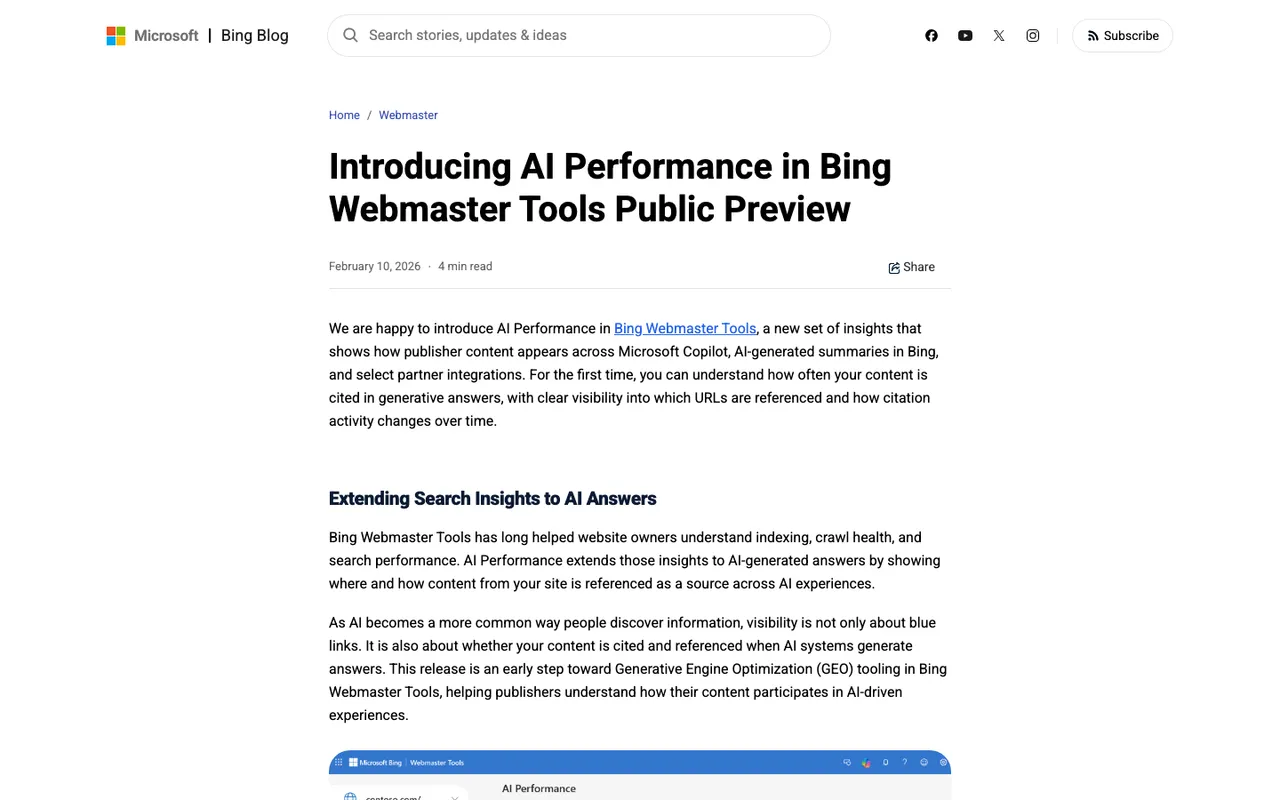
Bing Webmaster Blog, "Introducing AI Performance in Bing Webmaster Tools Public Preview", captured November 21, 2026.
What we tell clients who want to try it themselves
Start with three clusters you already have content for, plus one you don't. The empty one is a useful control. Track them daily for a few weeks before drawing conclusions, because AI answers vary from run to run. And read Share of Voice per cluster before you read the overall number.
If you'd rather see your own clusters before talking to us, Promptwatch's free AI Visibility Report gives a quick first scan of how ChatGPT, Gemini and Perplexity treat your site. If you want us to build and run the cluster tracking as part of an SEO and GEO program, email us and we'll start with your existing content plan.