ChatGPT ads for PPC clients: what the first 90 days of data show
ChatGPT went from no ads to ads in about three in ten web-search answers within weeks. What the 90-day data shows and how we fold AI answer ads into PPC reporting.
Zero. That was the share of ChatGPT web-search answers carrying an ad until May 27, 2026. By mid-August, the 30-day average in Promptwatch's ChatGPT ads report (May 20 to August 17, 2026) put ads in 29.6% of them. For the PPC side of our agency, that turned a curiosity into a reporting question almost overnight: if ads now sit inside AI answers to the same queries our clients bid on in Google, where does that show up in a paid search report?
This post covers what Promptwatch's 90-day ad data shows, how to read it without overreaching, and the way we've started folding AI answer ads into the paid search reporting we already do.
What the 90 days show
Promptwatch's report How often does ChatGPT show ads? covers May 20 to August 17, 2026. It only counts responses where ChatGPT searched the web, returned at least one citation, and completed ad extraction. Each day's bar splits those responses into ones with at least one ad and ones without.
Within that May 20 to August 17, 2026 window (ads report), there were no ads at all until May 27, when they appeared in 1.69% of responses. A brief spike followed on June 25 and 26. Then, on July 1, the rate jumped past 30% and, in the report's words, it stuck. Since then it has mostly moved between the low 20s and the high 30s. Daily rates reached as high as 43.9%.
Averaged over the full 90 days to August 17, 2026, 20.1% of web-search responses had ads (ads report). That average includes the empty first week, so the more recent level is higher: the report gives 32.4% for the last seven days and 29.6% for the last 30, both ending August 17.
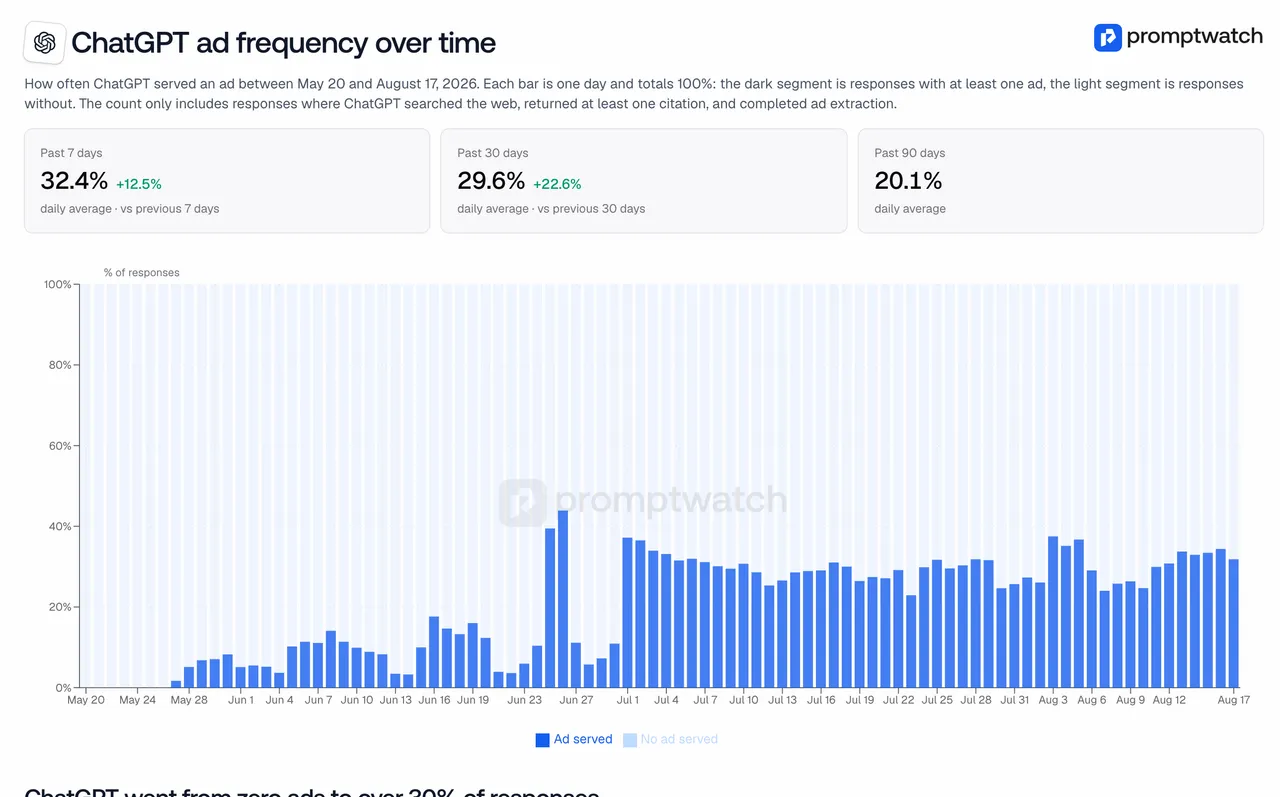 Promptwatch's "ChatGPT ad frequency over time" chart from the ChatGPT ads report (May 20 to August 17, 2026), captured November 14, 2026.
The prompt-type split, read correctly
The ads report also splits ad-bearing responses by prompt type for the same May 20 to August 17, 2026 window. On an average day, 73.1% of them came from organic prompts (no brand named), 17.9% from brand-specific prompts, and 9.1% from competitor comparison prompts.
It is tempting to read that as "organic prompts are most likely to show ads." The report says plainly that it isn't. The split is a volume mix: it shows where the ads appeared, not how likely each prompt type is to trigger one. It also warns that adding more organic prompts to a monitor raises their share in this chart even if nothing changed on OpenAI's side. Days without ads are left out of the type chart, and the report advises checking ad visibility across several days, since a single run can land on an outlier day.
For PPC clients, the practical point is simpler. Ads now appear across all three prompt types, including questions that name the client and questions that compare the client with a rival. Those last two are the ones paid search teams care about most, because in Google they map to brand defense and conquesting.
What this means for paid search teams
Our interpretation, and it's only that: ChatGPT ads behave like a new placement next to the organic answer, much as Google's ads sit next to organic results. That framing helps PPC teams, because the questions they already ask about Google carry over.
Who is advertising on our client's brand terms? Which competitors appear on the category questions we bid on? What do their ads claim, and where do they send the click? Is our client's organic answer losing value because a rival's ad sits right next to it?
What doesn't carry over is the measurement. Google Ads reports impression share and auction insights for the client's own campaigns. For ChatGPT ads placed by competitors, the client's own ad account has no data at all. That gap is why we track them separately.
We also keep one boundary clear. Tracking ads inside AI answers is not the same as running ChatGPT ads. Reporting on a client's own OpenAI campaigns is a job for OpenAI's own ads tools. What we report is the competitive picture on the prompts that matter.
How we fold AI answer ads into PPC reporting
Map paid keywords to prompts
We take the client's paid search keyword groups, especially brand, competitor, and high-intent category groups, and write the matching questions a buyer would ask ChatGPT. A brand keyword becomes "is [client] worth it" or "[client] pricing." A conquest keyword becomes "[client] vs [competitor]." These go into tracked monitors so they're checked every day, not once.
Add an AI answer ads section to the monthly report
Next to the usual Google and Microsoft Ads sections, the report gets a short AI answer ads section. It lists which advertisers appeared on the client's tracked prompts, how often, on which prompts, and with what message. For brand prompts, we flag every competitor ad by name. For category prompts, we show the top advertisers and how that list changed from last month.
Compare ads with the organic answer
For each prompt with ads, we show the client's organic standing in the same answer: whether they were named, their position, and whether their page was cited. A competitor ad on a prompt where the client is the first organic recommendation is a different problem from a competitor ad on a prompt where the client isn't mentioned at all. The first is a brand defense question. The second is mostly an organic visibility problem that ads happen to be exploiting.
Read the landing pages and claims
We open the landing pages competitor ads point to and note the offer and the claims. Paid search teams do this in Google already; it belongs in the AI section too. It's often the fastest way to spot a competitor's new pricing or positioning.
Watch AI-referred traffic
On the client's own site, we track visits from ChatGPT and other AI engines separately from Google traffic, with conversions. ChatGPT stopped sending a referrer on October 8, 2026, and still adds utm_source=chatgpt.com to links, so we make sure UTM-tagged ChatGPT visits are counted. That keeps the AI traffic line honest when we compare it with paid channels.
Our earlier post, ChatGPT ads: what we advise brands after 90 days of data, covers the broader question of whether a brand should buy ads at all.
Where we measure it
We run this on Promptwatch, the platform we use for all client programs.
Ads Radar captures sponsored ads inside ChatGPT Search, Google AI Overviews, and Google AI Mode answers to the client's tracked prompts: the ad's title, description, image or price, the advertiser's name and domain, the target URL, the prompt that triggered it, the ad copy, its claims, and the landing page. Views include ads per day, top advertisers, By Ad, and By Prompt (ad count, the client's average visibility, latest ad), with filters for model, advertiser domain, prompt type, and date range. It doesn't cover Perplexity, and it doesn't report on the client's own OpenAI campaigns.
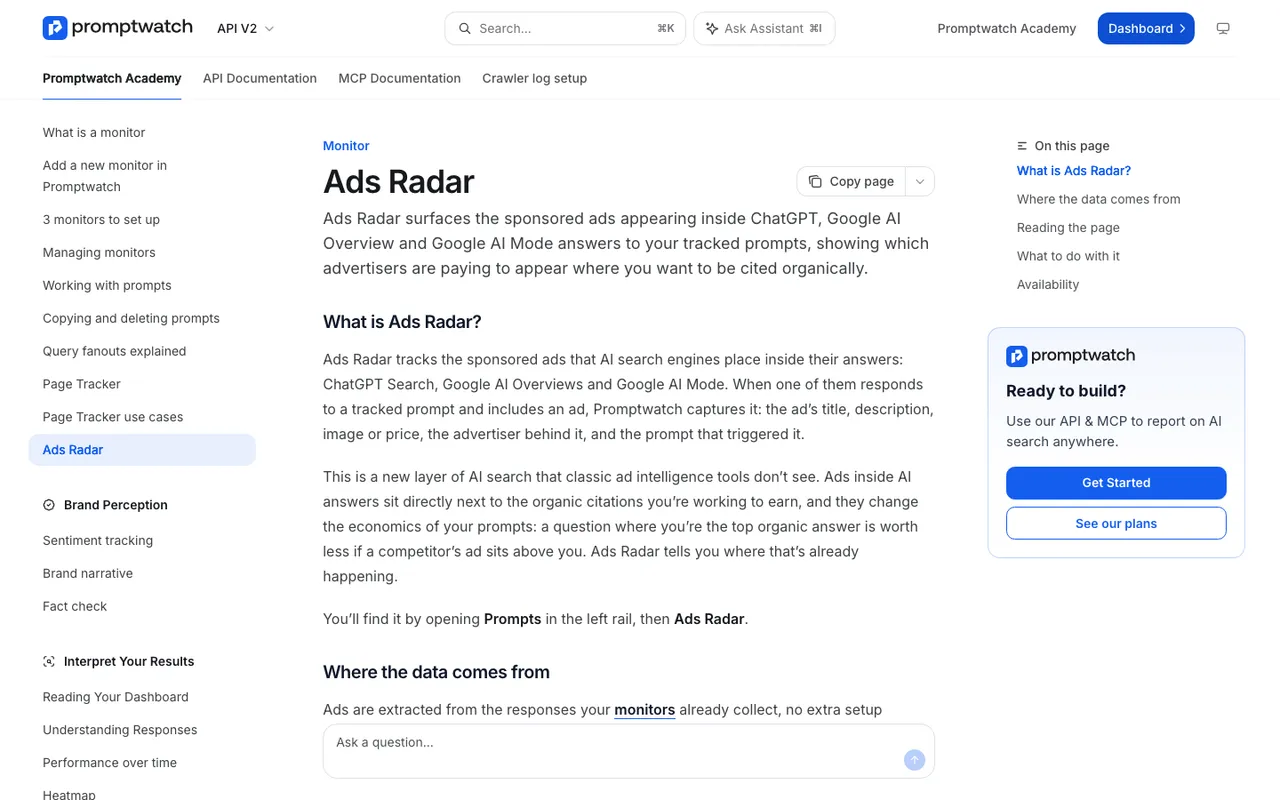 Promptwatch Academy's Ads Radar page, captured November 14, 2026. Ads Radar is on the Business plan, every agency plan, and Enterprise.
Plan gating matters for budgeting. On brand plans, Ads Radar starts on Business ($579/mo). It's included on every agency plan, starting with Kick-off ($199/mo), and on Enterprise. For agencies that already manage paid search for several clients, an agency plan is usually the simpler route.
Visitor Analytics handles the traffic side, with AI-referred visits and conversions per engine and the "Include ChatGPT UTM referrers" toggle that counts utm_source=chatgpt.com visits as ChatGPT. A real referrer always wins, so nothing is double counted.
We don't promise that tracking competitor ads will win a client more clicks. It gives the paid search team a view of a placement they otherwise can't see, on the questions they already pay to win in Google.
If you manage paid search and want to see which advertisers appear in AI answers for your terms, book a Promptwatch demo. The ads report and the rest of the data are on the Promptwatch data index.