How often does ChatGPT change the sources it cites for the same question? What we tell clients
Clients ask why ChatGPT cited them last week and not today. Our practitioner answer on source churn, what OpenAI documents, and how classic SEO work steadies citations.
The message usually reads something like this: "ChatGPT cited our guide on Tuesday, and today it's gone. What did we break?" Usually nothing. ChatGPT's source list for a given question is not fixed, and OpenAI doesn't publish how often it changes. What we can do is explain why it moves, show which changes are worth reacting to, and point out that a lot of the stabilizing work is the same SEO work clients already pay for.
Why the sources move
OpenAI's Help Center article on searching the web with ChatGPT describes the process. When ChatGPT search works with partner search providers, it usually rewrites the question into one or more targeted queries, and after reading the first results it can send further, narrower ones. It ranks results on multiple factors and says placement is not guaranteed. The privacy policies it links for those providers are Microsoft's and Shopify's.
For us that has a very practical reading. ChatGPT's citations depend on what a search index returns for queries you never see. So a page that is poorly indexed, thin on a sub-topic or slow to be recrawled is fragile in ChatGPT for the same reasons it is fragile in classic search.
The three speeds we watch
Day to day. Some churn between runs is normal. We never judge a page on one check. In Promptwatch, the platform we run client programs on, prompts run every day, and we look at citation rates over a few weeks rather than single answers.
Week to week. Pages lose citations as they age, and content type matters. Promptwatch published a content half-life study that took one day's ChatGPT citations (July 6, 2026) and watched those pages for 90 days. After 30 days, ChatGPT was still citing 78% of the landing pages and 76% of the docs. Half the news pages were gone after 36 days.
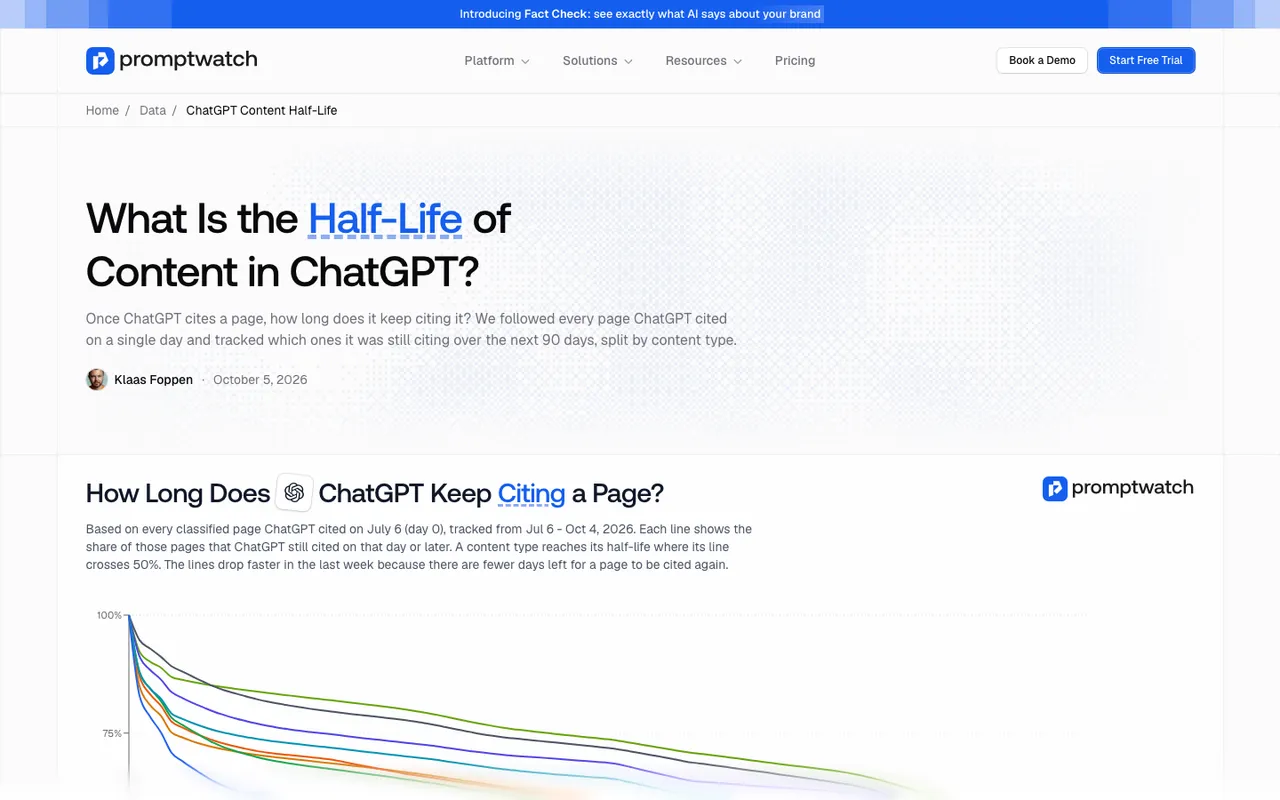
Promptwatch data page "ChatGPT Content Half-Life", captured November 14, 2026.
Overnight. Occasionally everything shifts at once. On August 8, 2026, the share of ChatGPT fanout queries using site: went from 0.37% to 16.8% in a day, per Promptwatch's report on site:operator fanouts. When that happens, every client's citations move together, and the right reaction is to check indexing, not rewrite copy.
Where classic SEO earns its keep
That site: shift is a good example of why we don't separate SEO from GEO in our programs. A query scoped to one domain can only surface pages a search engine has indexed. Sitemaps, internal linking, crawlable navigation and fixing orphan pages all matter more, not less. The same goes for crawler access on the AI side: OpenAI says sites must allow OAI-SearchBot, and let its published IP ranges through the host or CDN, to be eligible for ChatGPT search results.
We check both layers in one place. Promptwatch's Search Insights puts Google Search Console and Bing Webmaster clicks and impressions next to AI crawls, citations and clicks for each page, and Agent Analytics shows whether OAI-SearchBot and ChatGPT-User are actually reaching the page.
How we track a page that matters
For a client's money pages (pricing, comparisons, the main product page) we add each URL to Page Tracker. It shows how many responses cite the page, from how many prompts, when it was last cited, and the AI crawler visits and click-throughs it gets. Citation Trends adds the page's citation lifecycle (first citation, ramp-up, peak and decay), so we can see a slow fade before it becomes a missing citation.
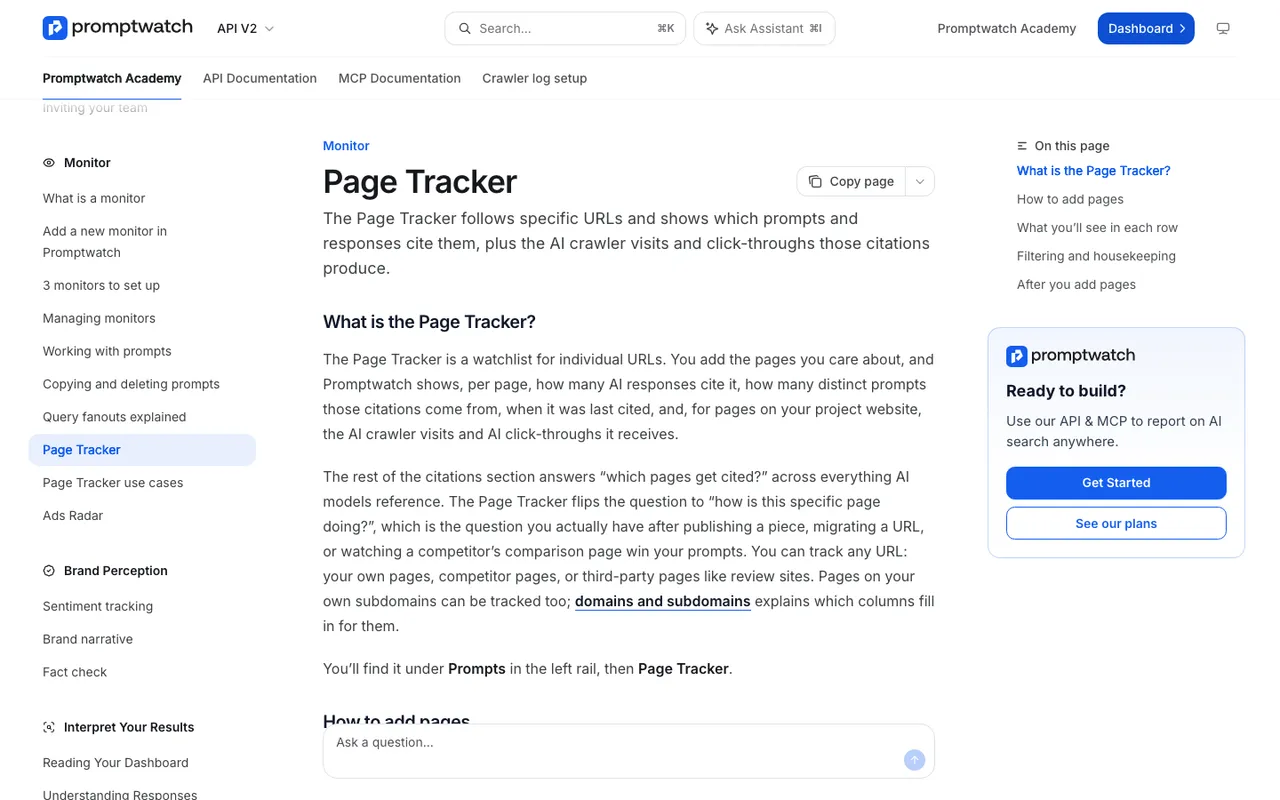
Promptwatch Academy, "Page Tracker", captured November 14, 2026.
What we tell clients to do
Don't react to a single missing citation. Do react when a page's citation rate trends down for two or three weeks, or when every page drops on the same day (then check indexing and crawler access first). Refresh pages with a short shelf life on a schedule, and keep landing and pricing pages accurate, because those are the ones ChatGPT keeps citing the longest.
If you want to see how stable your own citations are, start a Promptwatch trial (seven days, monthly billing) and track your ten most valuable prompts. Then send us the results and we'll tell you which movements are worth worrying about.