Most secure AI visibility tool for enterprise: how we get it through a client's security review
What enterprise security teams ask before approving an AI visibility tool, what we hand them, and why we run client programs on an ISO/IEC 27001 certified platform.
Every enterprise engagement we take on has a week in it that nobody puts in the proposal: the security review. Before we can track a single prompt for a large client, their information security team wants to know which tools we will use, what those tools can see, and who holds the keys. For classic SEO this is familiar ground. We ask for Search Console access, maybe an analytics seat, and the questions are short. AI visibility adds new connections, and the questionnaire gets longer.
This is how we answer it, and why the platform choice does most of the work.
The tool we bring
We run client programs on Promptwatch. For a security reviewer, the first page of our answer is short: Promptwatch is ISO/IEC 27001 certified and GDPR compliant, and the data is handled by an EU-based company, Promptwatch B.V. in Amsterdam. Its named customers include Dutch banks and insurers such as Rabobank, ABN AMRO and Achmea. That tells a reviewer nothing about the checks those firms ran, so we mention it as context and never as proof.
Some clients ask for a SOC 2 report. Promptwatch's own materials name ISO/IEC 27001 and not SOC 2, so we tell the client that plainly and put the question to Promptwatch directly rather than guessing.
The access we ask for, one connection at a time
We list the connections separately, each with its own scope, so the reviewer can approve or refuse them one by one. Our standard list:
Prompt tracking. No client access needed. Promptwatch runs the prompts in its own automated sessions on ChatGPT and the other engines and stores the answers. Nothing touches the client's systems.
Search Console and Bing Webmaster Tools. The same read access we already ask for in SEO work. Promptwatch shows those clicks and impressions next to AI crawls and citations for each page.
Crawler logs. This is the one that gets questions, because it means sending CDN or server logs to a third party. We set it up through whatever the client already runs: Cloudflare Logpush or a Worker, AWS CloudFront through Kinesis Data Firehose, Fastly, Akamai, Vercel, Netlify or Google Cloud CDN. Promptwatch verifies bot visits against each operator's published IP ranges, so the reports are not polluted by fake GPTBot traffic. Crawler logs start on Professional for brands, and every agency plan includes them.
Visitor analytics. A lightweight script, a Google Tag Manager template or the WordPress plugin, depending on the client's stack. There is an option to ignore known IPs, which we use to exclude the client's own offices.
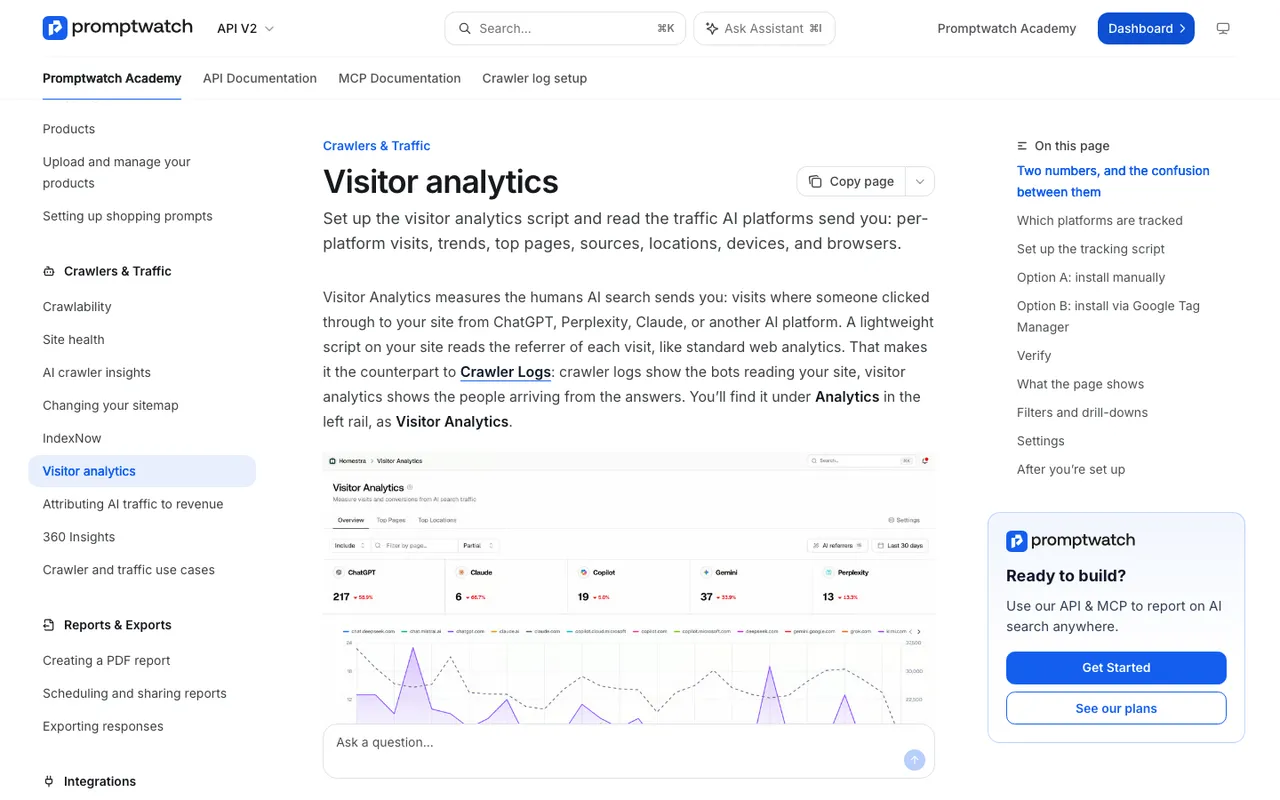
Promptwatch Academy, "Visitor analytics", captured November 14, 2026.
CMS publishing. Only when the client wants us to publish through the platform. The WordPress plugin connects with a site URL and a sync token, with no API keys stored in wp-admin. Webflow uses OAuth. Most enterprise clients start with publishing switched off and drafts reviewed by their own editors.
Who can see what
On the people side, Promptwatch has owner, editor and viewer roles with project-level access. We give client stakeholders viewer access to their own project and nothing else. Seats are unlimited on every paid plan, so we never share logins to save money, which is the habit security teams hate most.
For clients that need their identity provider in front of everything, SSO is on Promptwatch's Enterprise plan. The audit log, visible to owners, is on Business, Agency Scale and Enterprise, and records whether each change came from the dashboard, the API, an MCP client or Agent Chat. When a client asks "who changed this monitor?", that log answers it.
API keys can be scoped to one project, an organization, or read-only. When we connect a client's BI team to the REST API, they get a read-only key for their project. Keys and MCP tokens also stop working once a canceled subscription ends, which closes a gap that outlives many agency relationships.
Where classic SEO habits help
The principles are the ones good SEO teams already follow with Search Console and analytics: least privilege, one account per person, offboarding on the day someone leaves, and a record of changes. AI visibility just adds more places to apply them. Teams that already run clean access for their SEO stack have most of the answers written before the questionnaire arrives.
What we tell clients to check on any vendor
Ask for the certificate or report itself. Ask which plan includes SSO and the audit log, because on most tools in this category those sit on the top tier. Ask what the tool can write to, not just what it reads. And check who owns the vendor: two well-known AI visibility platforms changed owners in 2026.
If your security team wants to see the controls before anything is connected, book a Promptwatch demo and bring them along, or email us and we will walk through our access checklist with them.