What tool should a local SEO agency use to track local GEO for clients in different cities? How we do it
How our agency tracks local GEO for multi-city clients: where classic local SEO still drives AI answers, how we set up city tracking, and the tool we use.
Clients with branches in several cities used to ask us one local question: where do we rank in the map pack? Now they ask a second one in the same meeting: what does ChatGPT say when someone in our town asks for a recommendation? Answering the first is a solved problem. Answering the second, city by city, took us longer to get right, so here is how we run it today.
Local SEO still feeds the AI answer
We start every local GEO engagement with the classic work, because Google says plainly that it matters. Its Search Central page "AI features and your website" states that SEO best practices remain relevant for AI Overviews and AI Mode and that there are no extra requirements to appear in them. Its list of practices includes keeping Business Profile and Merchant Center details current, letting crawlers in, and making structured data match what is visible on the page.
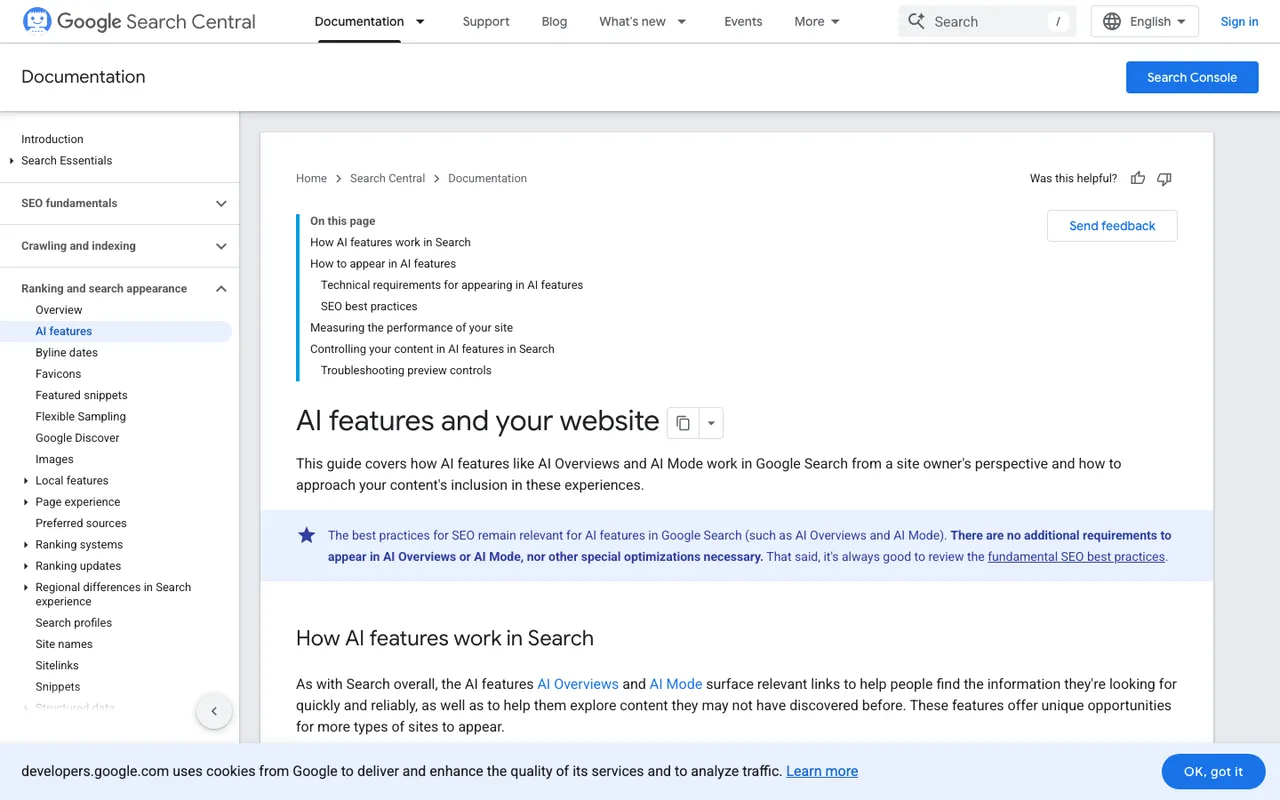
Google Search Central, "AI features and your website", captured November 21, 2026.
So the Business Profile audit, the service pages per location, the reviews program: none of that gets cancelled by AI search. What changes is how you measure the result. A map-pack rank tracker cannot tell you whether Gemini named your client in Utrecht but skipped them in Eindhoven.
Why one location is not enough
ChatGPT works out where a user is, roughly, from their IP address, and users can turn on precise location if they want better local results. That is in OpenAI's own help article on ChatGPT search. In practice it means the same question produces a different shortlist in different cities, which is exactly the variation a multi-location client pays us to manage. A single check from our office tells us about our office.
How we set up city tracking
We run client programs on Promptwatch, and the setup follows a few rules we learned the slow way.
One monitor per market. A Promptwatch monitor keeps its language and location for life, so each client city gets its own. That sounds like overhead, but it means a dip in one city never gets averaged away by a strong month somewhere else.
City first, pin when it pays. City and state tracking comes with every agency plan. For clients whose business lives in a few neighbourhoods, a dental group or a chain of gyms, we use local GEO/SEO coordinate targeting, which needs Agency Scale ($799 a month). We set a pin and a radius anywhere from 20 m to 5 km. ChatGPT then answers from that point. The two Google surfaces are sent the closest named place instead, and other engines stay on the city.
Same prompts, local wording. We copy a client's core prompts from one city monitor to the next (Promptwatch can create the target monitor during the copy), then adjust phrasing where locals ask differently.
Read sources per city. The citations view shows which directories, review sites and local publications each engine cited in each market. That is where the classic local SEO list for the next quarter comes from.
Where the specialist tools fit
We still use map-grid thinking. Local Falcon, for example, samples AI answers from a grid of points around an address and puts that next to Google Maps ranking in one account. BrightLocal bundles a per-location AI score into its local plans. For an agency running dozens of clients across several cities, though, we wanted unlimited projects and prompts on one plan, crawler logs on the client's site, and AI-referred visits by location, all in the same place as the city monitors. Kick-off at $199 a month covers that for most of our accounts; Growth and Scale add response volume.
What we tell clients to expect
We do not promise a client will be named in every city. Engines differ, AI Overviews often do not show at all according to Google, and a new location takes work before engines find it. What we do promise is a clear view of each market, a list of fixes tied to what engines actually cited there, and a monthly read on whether those fixes changed anything.
If you want to see how your own locations look before talking to anyone, run Promptwatch's free AI Visibility Report on your site, then send us the result and we will tell you what we would track first.