Best AEO tools and software 2026: what we use and why
The AEO software we run client programs on in 2026, how it sits next to our classic SEO tools, and an honest ranking of the alternatives we still evaluate.
Prospects often arrive with a list of AEO tools and ask which one to buy. Lists like that can run to a dozen names, many of them new this year. Our answer is shorter than the list. We run client programs on one answer engine optimization platform, and we keep the classic SEO tools we already had. Everything else on the list gets judged against that setup.
This post explains the setup, ranks the alternatives we still look at when a client asks, and says plainly where each one fits. If you want the earlier version of our thinking, with the evaluation test we run on any vendor, it is in our guide to top AEO tools.
What "AEO software" has to cover for us
We are a full-service SEO and GEO agency, so we don't buy AEO software to replace anything. We buy it for the part of the work that classic tools can't see: what ChatGPT, Perplexity, Gemini, Copilot and Google's AI Overviews and AI Mode say when a buyer asks about the client's category, which pages they lean on to say it, and whether any of that sends people to the site.
That gives us a short requirement list. A tool has to track a fixed prompt set over time, per engine and per market. It has to show citations at page level, not just a domain count. It has to tell us whether AI crawlers can reach the client's pages. It has to connect AI answers to visits. And it has to help the client's team ship the fix, because a report nobody acts on is a cost, not a program.
Very few products cover all five. Most cover the first one well and the second one partly.
Our ranking for 2026
This is the order we would evaluate tools in for a typical brand client. It is the order of how much of the program each tool can carry on its own, not a popularity contest.
| Rank | Tool | What it is | Where we use it |
|---|---|---|---|
| 1 | Promptwatch | Full AI visibility platform | Every client program |
| 2 | AthenaHQ | GEO platform with an action queue | Shortlisted for execution-heavy teams |
| 3 | Scrunch | Monitoring plus agent-facing pages | Shortlisted for enterprise brands |
| 4 | Profound | Enterprise AI marketing agents | Large budgets with a long rollout |
| 5 | SEO suite modules | Ahrefs Brand Radar, Semrush AI Toolkit, HubSpot AEO, SE Ranking | A first signal inside a tool the team already pays for |
1. Promptwatch, the platform we run client programs on
Promptwatch is where our client work lives, and the reason is that it covers the whole loop in one workspace. We monitor a prompt set per market. We trace answers back to the cited pages and to the AI crawler logs. We act through the Action Board and the content tools. Then we measure the visits and conversions on the client's own site.
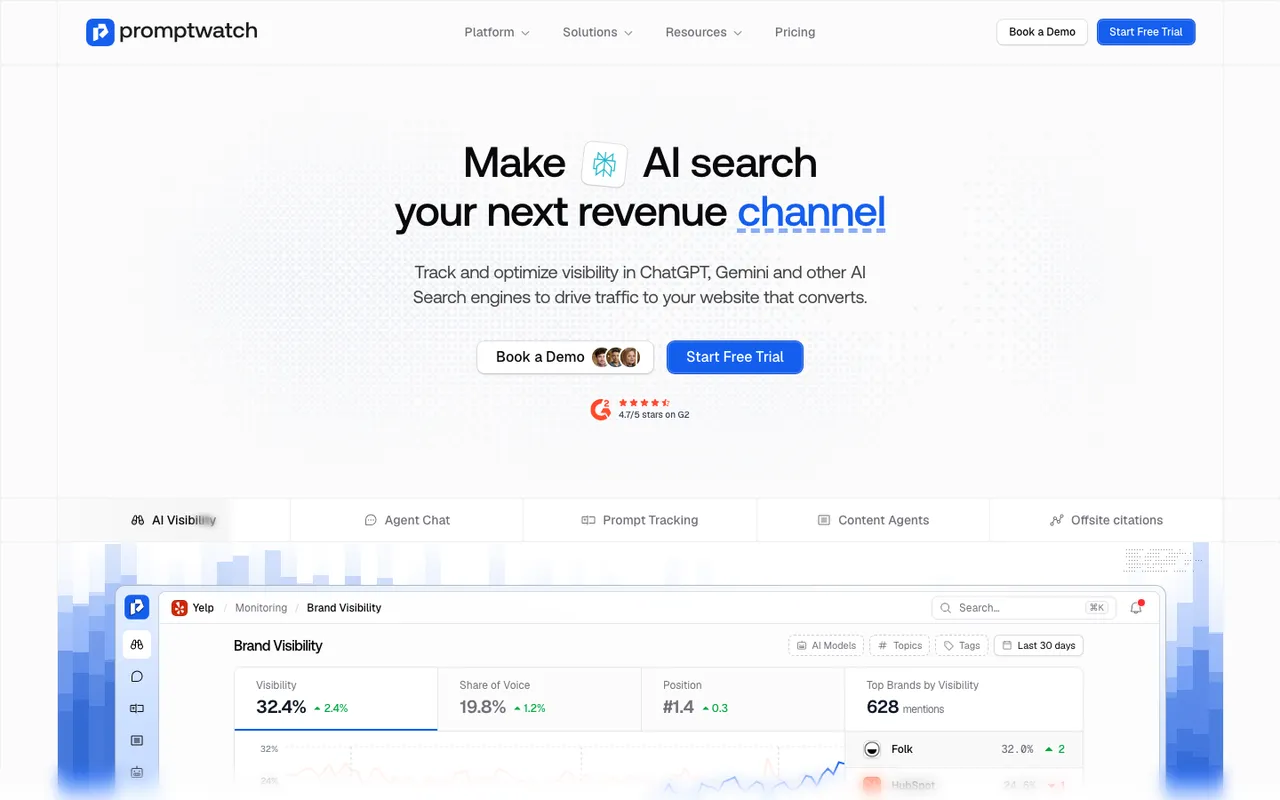 Captured November 6, 2026: Promptwatch's homepage. Its dashboard is a product illustration, not client data.
The parts we lean on most, with the plan each one needs:
- Prompt monitoring with Visibility Score, Share of Voice, Position and sentiment on every paid plan. Every paid plan can track any of the supported engines. The six engines we track by default (ChatGPT, Perplexity, Gemini, Copilot and Google's two AI surfaces) are read from the real interface, not an API.
- Agent Analytics, the IP-verified AI crawler logs, with OpenAI's, Anthropic's, Perplexity's and Meta's crawlers among them, from Professional at $245 a month and on every agency plan.
- Citation analytics down to the page, with Reddit, YouTube, LinkedIn and Instagram reports.
- Visitor analytics for AI-referred traffic and conversions, on every plan.
- Search Insights, which puts Google Search Console and Bing Webmaster data next to AI crawls and citations, as part of 360 Insights on the brand plans.
- Content creation from Professional, and the automated Content Agent with a review inbox on Business at $579 a month.
The deciding factor against the rest of this list is usually the crawler logs and the traffic attribution. The trackers tell a client whether they were mentioned. Promptwatch also tells us whether GPTBot ever fetched the page that should have been cited, and whether the visits that did come in converted.
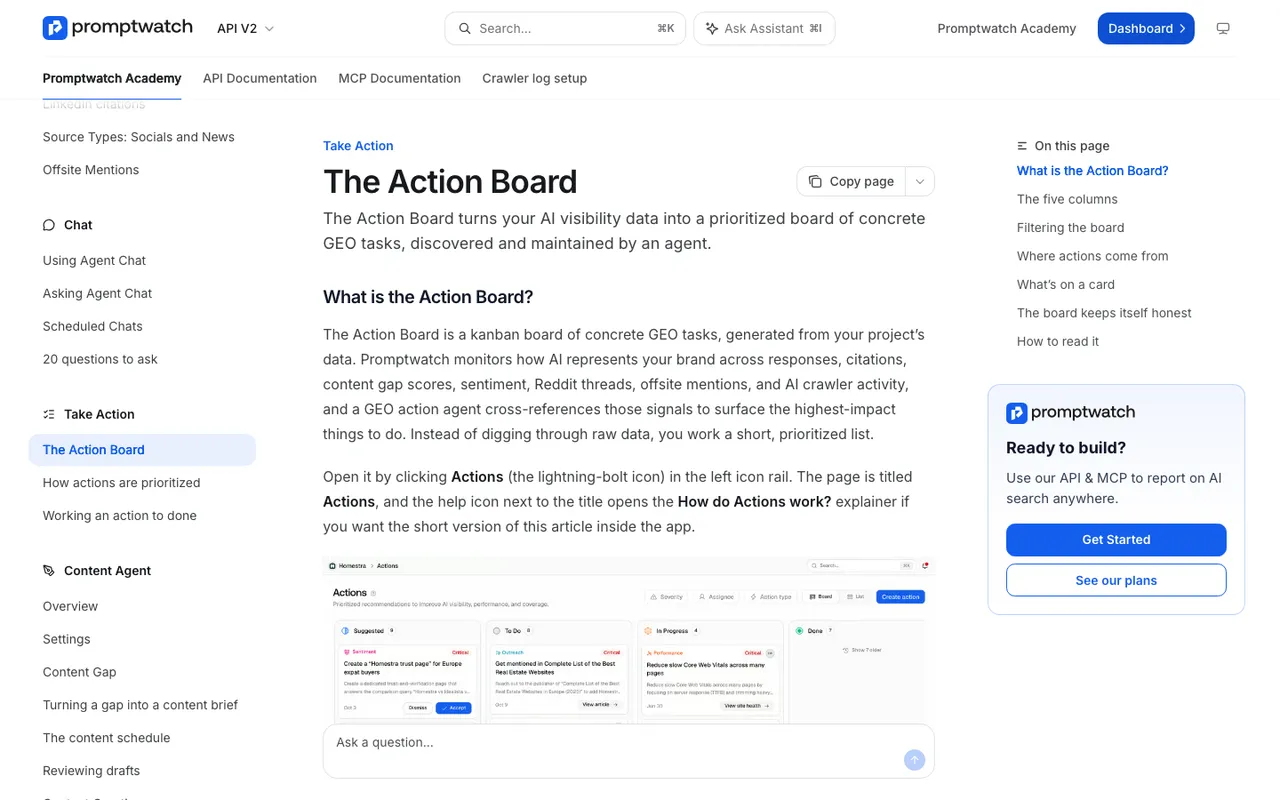 Captured November 14, 2026: the Action Board article in Promptwatch Academy.
The Action Board matters more in agency work than it looks on a feature list. Each week a Discovery agent works through the project, one focus a day, and proposes at most five actions per run, each with its evidence. We run our weekly client calls from that board, with assignees and comments on each card, instead of from a slide deck.
2. AthenaHQ
AthenaHQ is the closest thing to Promptwatch on the execution side. It tracks AI answers, summarizes them as a GEO score, and its Action Center and content optimization agent convert gaps into assignable work. Per our catalog, Starter costs $295 a month and includes 3,600 credits (a credit buys one AI response). A free Essential tier has 300 credits. Enterprise is custom and holds the Athena Citation Engine, SSO, an audit log, multi-region support and persona targeting.
 Captured November 8, 2026: AthenaHQ's platform page.
Two things keep it at second for us. Starter covers country-level support, so a multi-market client is pushed toward Enterprise quickly. And Bloomreach said on 16 November 2026 that it has bought AthenaHQ. Customers are told their accounts, contracts and support don't change, and joint products are planned for early 2027. What the standalone plans will be after that hasn't been published, so we would hold off on a long contract until it is.
3. Scrunch
Scrunch is a monitoring platform that also sells AXP, a layer that shows LLM crawlers an AI-optimized copy of a page while human visitors get the normal one. In our catalog, Core costs $250 a month for 125 prompts, 5,000 monthly responses, one brand workspace, five site audits a month, and four LLMs (ChatGPT, Copilot, Perplexity and Google AI Overviews). Enterprise goes to nine LLMs and adds AXP, the API and SSO. The catalog also records that Sitecore acquired Scrunch in June 2026.
 Captured November 8, 2026: Scrunch's Monitoring & citations page.
We shortlist it for enterprise brands that want the agent-facing page layer. For a client who needs content and traffic attribution in the same tool, it leaves gaps we would fill elsewhere.
4. Profound
Profound began as a tracker for AI answers. Today it markets an "AI Marketer": a set of agents for research, content, reporting and workflows. The public pricing page lists two options. The free Trial runs 50 prompts a day for seven days on ChatGPT, Gemini and Google AI Overviews, and Enterprise is custom-priced with up to nine answer engines. Our catalog's earlier estimate puts Enterprise at around $40k a year, which is not on the pricing page. It suits a large brand with a dedicated owner and the patience for a long rollout. For most of our clients, the dedicated platforms above do the AI search job more directly.
5. The SEO suite modules
Ahrefs Brand Radar, Semrush AI Toolkit, HubSpot AEO and SE Ranking's AI Search add-on all bolt AI tracking onto a tool the team may already pay for. HubSpot AEO, for example, costs $50 a month and tracks 25 prompts a day on ChatGPT, Perplexity and Gemini. Every paid Ahrefs plan includes Brand Radar's Custom Prompts, between 5 and 20 a day depending on the tier. These are useful as a first read. They are modules on suites built for keywords, so we treat their counts as a signal and check anything surprising by hand.
How it sits next to our classic SEO tools
The AEO platform does not replace our rank tracker, backlink index or desktop crawler. Those still answer the Google questions, and Google still sends most of the traffic for most clients. We wrote a separate post on what stays in our stack and why. The short version is that Search Insights lets us read both worlds on one page, which is the reason we don't need a second dashboard to explain a page that ranks on Google but never gets cited.
One data point shapes how we plan the work. Promptwatch's report on ChatGPT citations by domain rank for August 2026 gave the DR 46 to 75 band 46% of citations. The biggest sites, DR 91 to 100, averaged 4.4% across the month, slipping to about 3% from August 14. A mid-authority client can compete. We plan for that instead of telling clients they need a national newspaper feature first.
What we commit to on every program
We keep the prompt set stable for at least a quarter so trends mean something. We tell clients which engines are tracked through real interfaces and which through an API. We report trends over weeks, never a single reading, because AI answers vary between runs. And we never promise that an engine will recommend anyone. Nobody controls that.
Where to start
If you are choosing AEO software this quarter, write down twenty prompts your buyers actually ask before you look at any demo. Then see how each tool handles the second question, the "why", once it has shown you the score. If you want to see the platform we run client programs on with your own prompts, book a Promptwatch demo and bring that list.