AEO tools vs SEO tools: what stays in our stack in 2026
Which classic SEO tools keep their job in 2026, what only an AEO platform can do, and how we read Google and AI search data side by side on client programs.
Once a team starts paying for AI visibility software, someone asks whether the SEO suite can go. It is a fair question, since budgets are fixed and both invoices say "search". Our answer is no, and the reasons are worth writing down, because they also explain what an AEO tool is for.
Classic SEO tools and AEO platforms measure different systems. One measures a ranked list of ten blue links that is the same for most people in a market. The other measures generated answers that change between runs, cite a handful of sources, and often name a brand without linking to it at all. You need instruments for both, and you need one place where the two sets of numbers meet.
The jobs classic SEO tools still own
We keep three categories of classic tool on every full-service program.
Rank tracking. Google organic still drives most of the traffic for most of our clients. A keyword rank tracker tells us where pages sit, how that moves after a release, and which competitors are gaining. No AEO platform we use tries to replace this, and Promptwatch says plainly that it is not a classic SERP rank tracker.
Backlink indexes. Link data from a large third-party index is still how we size up authority, find broken inbound links, and plan digital PR. AI engines lean on third-party pages too, so this work feeds AEO. But the index itself lives in the SEO suite.
Technical crawlers. A desktop or cloud crawler that walks the site the way Googlebot does is still the fastest way to find redirect chains, canonical mistakes and thin templates at scale. We run one before any migration, whatever else is in the stack.
Search Console and Bing Webmaster Tools stay too, since they are free and nothing else has Google's own impression data.
What only an AEO platform does
The second set of jobs has no classic equivalent. These are the reasons we pay for Promptwatch, the platform we run client programs on.
Answers, per engine. A monitor runs the same prompt panel every day across the engines the client chooses, in a fixed language and market. The output is not a position on a page. It is whether the brand was named, in what order, with what tone, next to which competitors. Visibility Score, Share of Voice, Position and sentiment are the numbers we report.
Citations per answer. Every response stores the pages the engine used. That is how we find out that a competitor's comparison page, a Reddit thread or a directory listing is doing the work in a category. A backlink index can't tell you which of those pages an engine actually read when it answered.
AI crawler logs. Agent Analytics records IP-verified visits from GPTBot, OAI-SearchBot, ChatGPT-User, ClaudeBot, PerplexityBot and the rest, and follows a page from crawl to citation with a citation rate per page. That separates an access problem from a content problem, which is the first question on any account that "isn't showing up". Crawler logs start on Professional at $245 a month and are on every agency plan.
AI-referred visits. Visitor analytics counts visits and conversions from ChatGPT, Perplexity, Gemini, Claude, Copilot and others. Since ChatGPT stopped sending a referrer on October 8, 2026, there is a toggle that counts utm_source=chatgpt.com visits as ChatGPT again, and a real referrer always wins so nothing is double counted. Generic analytics setups miss that unless someone configures it.
Query fan-outs. For each tracked response, Promptwatch shows the sub-queries the engine ran before answering. That is the closest thing AI search has to keyword research, and it often reveals that the engine searched for something the client has no page about.
The overlap zone: AI modules inside SEO suites
The big suites have all added AI tracking, and for a team that lives in one of them, the module is a reasonable first look.
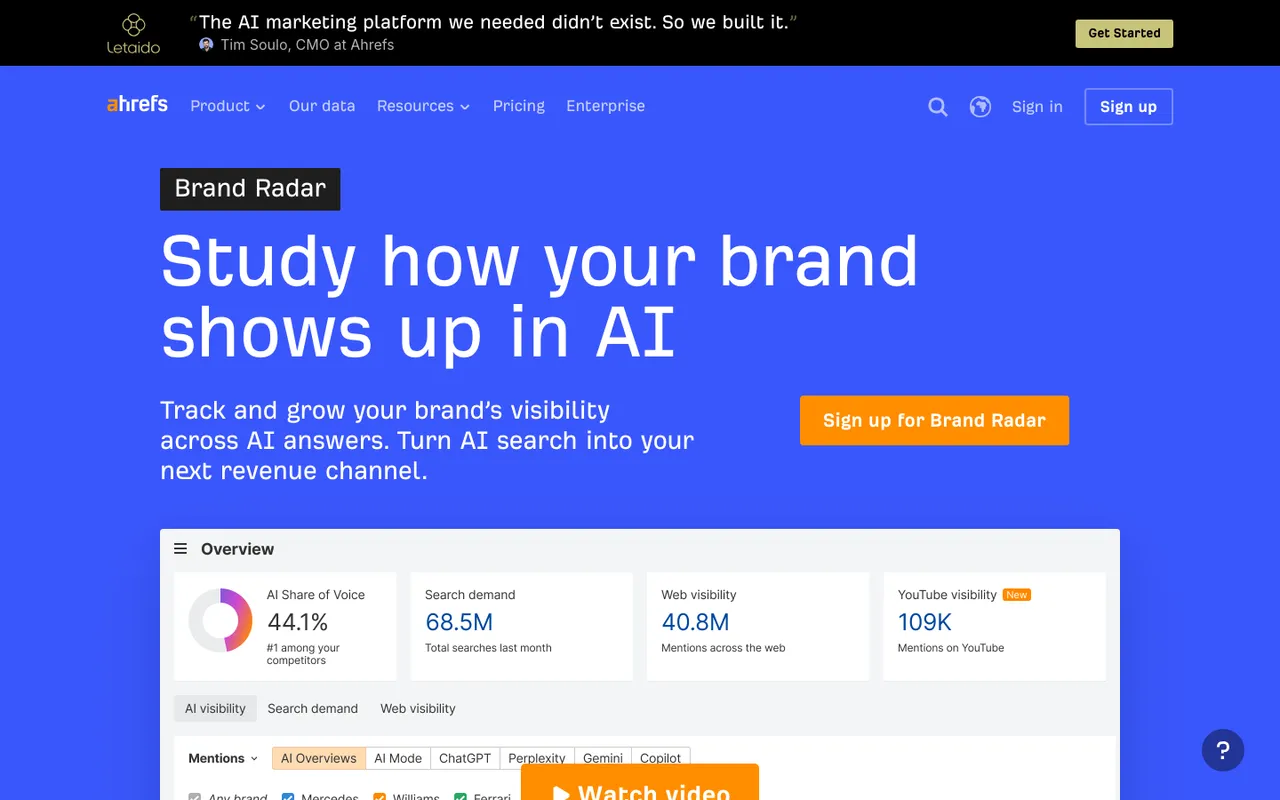 Ahrefs Brand Radar page, captured November 6, 2026.
Ahrefs Brand Radar includes Custom Prompts on every paid Ahrefs plan, with a daily quota of 5 prompts on Lite, 10 on Standard and 20 on Advanced, and sells an AI Visibility Index of prompts modeled from its keyword data from $199 a month. Semrush's AI Toolkit is listed in our catalog at $99 a month per domain with 25 prompts, though the catalog marks those figures as unconfirmed against Semrush's current pages. SE Ranking sells an AI Search add-on for AI Overviews, AI Mode and ChatGPT from EUR 79 a month on top of its core plans.
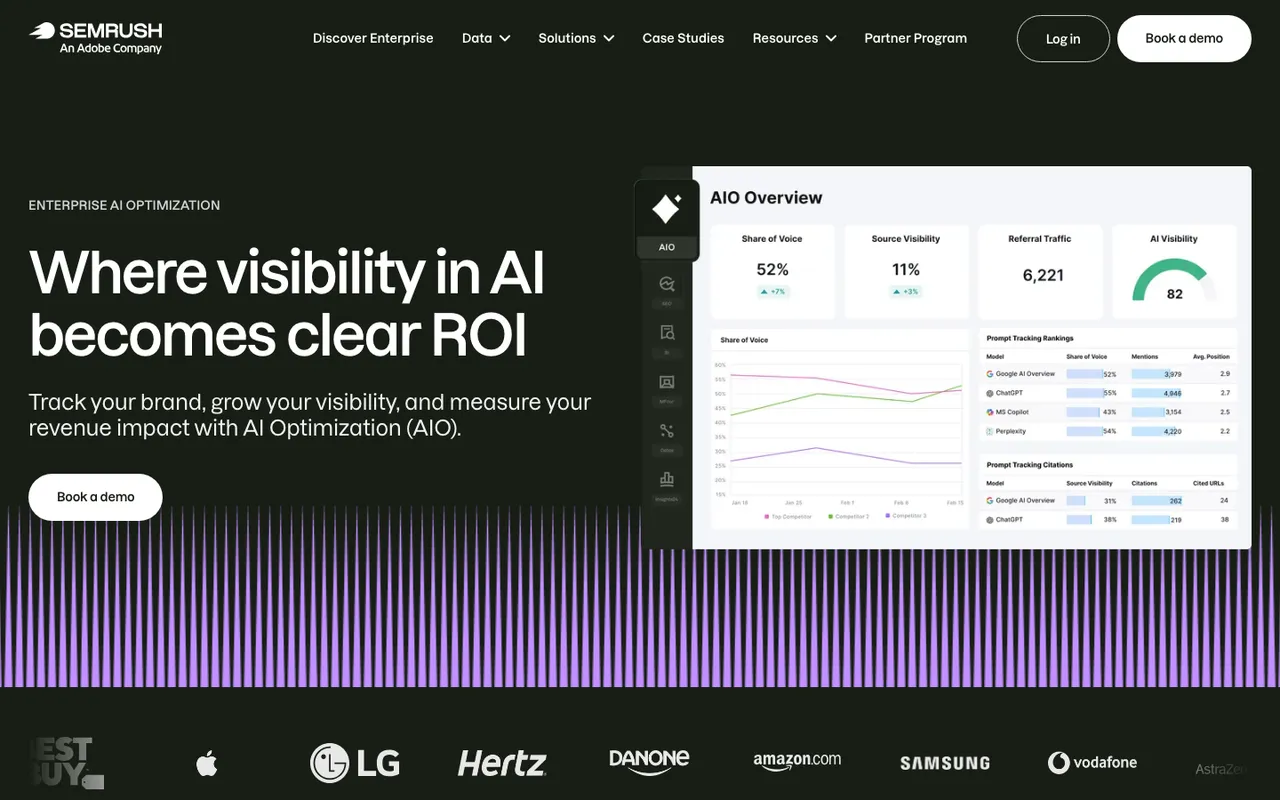 Semrush's Enterprise AI Optimization page, captured November 8, 2026.
Where these modules stop, for our purposes, is the second half of the list above. Our catalog entries for Semrush, SE Ranking and Ahrefs don't document crawler-log tracking tied to citations, AI-referred conversions, or content publishing from the same workspace. One note on Ahrefs: its catalog entry describes reports on AI crawler activity in one place and says no published crawler-log product in another, so ask Ahrefs directly what its crawler view covers. Either way, the module tells you that something changed. The AEO platform tells you why and what to do.
Where the two meet: Search Insights
The most useful screen for a full-service agency is the one that shows both worlds for the same page. In Promptwatch that is Search Insights, part of 360 Insights on the brand plans. It overlays Google Search Console and Bing Webmaster clicks and impressions, including Microsoft Copilot data from Bing, on top of AI crawls, citations and AI clicks, per page and per topic.
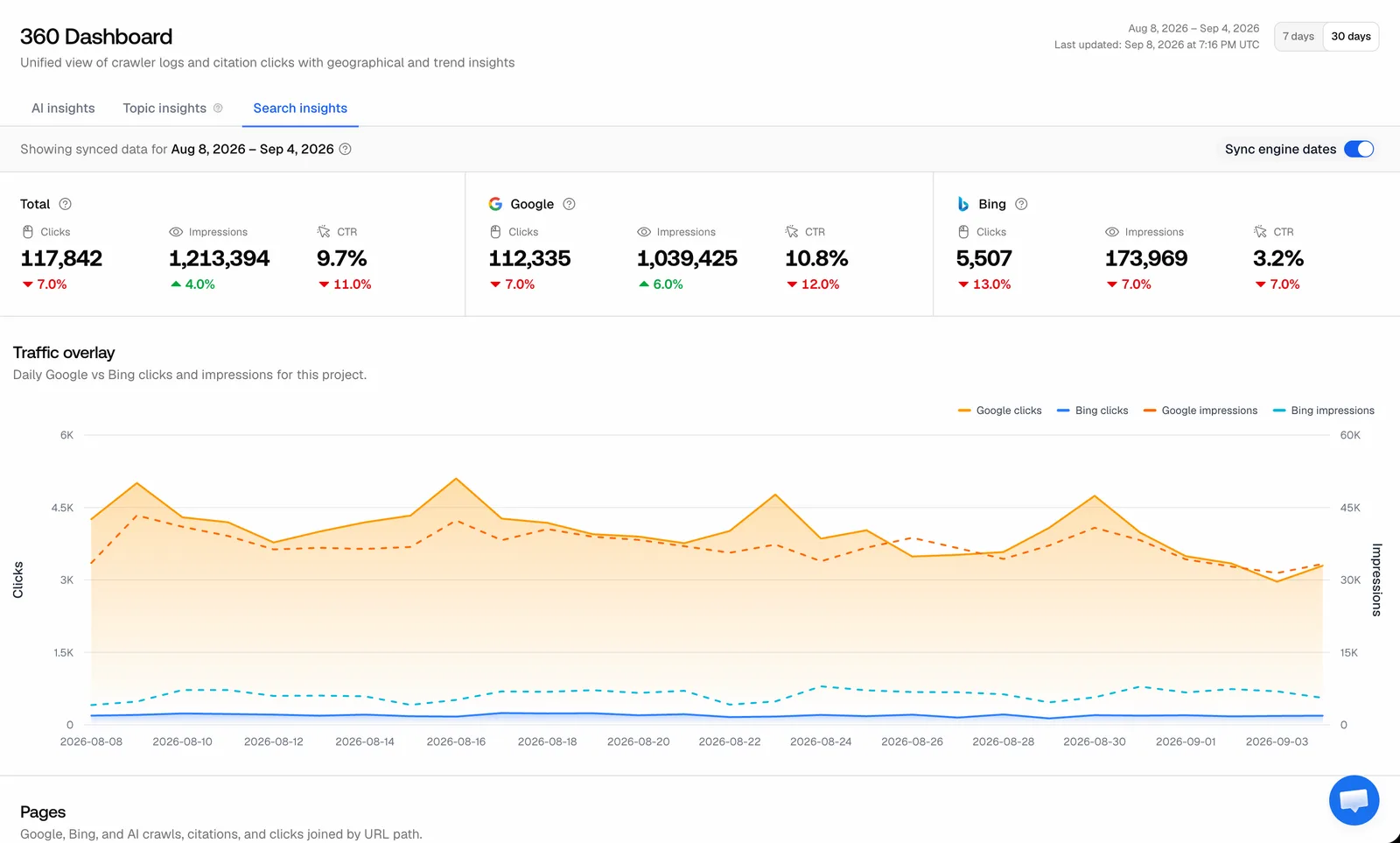 Promptwatch 360 Dashboard Search insights, from the Promptwatch changelog. Example project data.
With both on one page, we look for three patterns:
- A page ranks well on Google and AI crawlers fetch it, but it is never cited. That is a content problem: the page doesn't answer the way an engine quotes. We rewrite the opening and add the facts engines lift.
- A page is cited often but gets few Google impressions. That page is earning attention in AI answers that the keyword tools undervalue, so we protect it in any redesign.
- A page gets neither crawls nor impressions. That is usually discovery: internal links, sitemap, or a robots rule. We fix it in the technical workstream.
Since November 6, 2026, individual sitemap pages also have Google Search Console and Bing Webmaster tabs, with clicks, impressions and CTR over 7 or 30 days. That saves a round trip to Search Console when we review one URL. One plan note matters for agencies: 360 Insights is on every brand plan and Enterprise, but not on the self-serve agency plans. When a client needs this overlay, we put them on a brand plan of their own.
Content types that move both
The overlap also shows up in what to publish. Promptwatch's content type report for ChatGPT, covering September 28 to October 4, 2026, found that for commercial prompts, product pages took 26.0% of citations, landing pages 20.6%, listicles 15.0% and comparisons 7.9%.
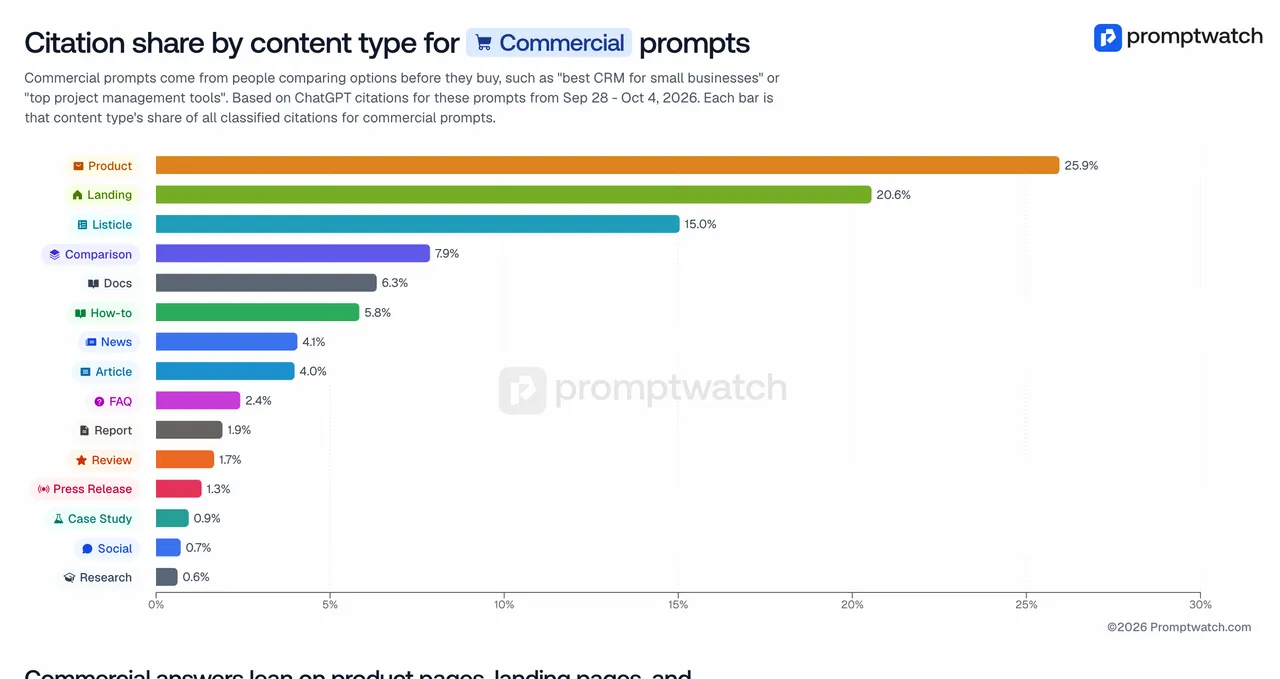 Promptwatch's "Citation share by content type for Commercial prompts" chart from the content type report, captured November 14, 2026.
Those are the same page types a good SEO program already maintains. The difference is the standard they're held to. For Google, a product page needs to rank. For an engine, it has to state the price, the specs and who it's for in sentences that can be quoted. We review both at once now.
What stays, in one table
| Job | Tool that owns it | Why |
|---|---|---|
| Google rankings | Classic rank tracker | Still most of the traffic |
| Backlinks and PR targets | SEO suite link index | Largest third-party link data |
| Site-wide technical crawl | Desktop or cloud crawler | Fastest at scale before releases |
| AI answers and citations | Promptwatch | Daily prompt panels with stored sources |
| AI crawler access | Promptwatch Agent Analytics | IP-verified logs tied to citations |
| AI traffic and conversions | Promptwatch visitor analytics | Counts AI referrers, including the ChatGPT UTM case |
| Google and AI on one page | Promptwatch Search Insights | Brand plans only |
What we tell the client who wants to cancel something
Keep the SEO suite if your team uses its rank tracking and link data each week. Drop its AI module if you add a dedicated platform, since paying twice for a weaker version of the same signal makes no sense. And don't let anyone sell you an AEO platform as a replacement for Search Console.
If you want to see the overlay on your own site, Promptwatch has a 7-day free trial on monthly billing on every self-serve plan. Connect Search Console on day one, so the first week of AI data already has Google next to it. For the wider tool comparison, see what we think the best AEO tools are.