Can advertisers see which prompts triggered their ads in ChatGPT? An SEO and paid search agency's answer
Clients ask us for a ChatGPT search terms report. OpenAI doesn't offer one. How we combine ChatGPT ad data with SEO work, and where Promptwatch fills the gap.
The question usually arrives from the paid media side of a client's team. They've launched a ChatGPT campaign, they're used to reading the queries behind every click in classic search advertising, and they want the same thing here. We have to give the same answer each time: OpenAI doesn't provide it.
Here is what we tell clients, and how we work around it.
What the advertiser account shows
OpenAI's help center describes ChatGPT ad reporting as aggregated: impressions, clicks, spend, CTR, average CPC and CPM, and conversions, split by device, country, and platform. Campaigns built on a product feed get a products view. That's it for breakdowns.
On privacy, the wording leaves no room. Advertisers "do not have access to your chats, chat history, memories, or personal details." The one route to a user's words is when someone chooses to message an advertiser through an ad, and then the advertiser sees only those direct messages.
Targeting doesn't work like a keyword list either. Advertisers write context hints per ad group. OpenAI says those hints don't guarantee delivery in specific conversations and aren't exact-match keywords. The system looks at the conversation's context and intent, the landing page, and the ad copy, then ranks eligible ads on relevance and bid. So even a well-structured account can't tell you which question led to an impression.
Why this matters for the SEO side of the house
We run search programs that cover classic rankings and AI answers together, so we look at ads in ChatGPT through both lenses. Three things stand out.
First, ads appear below the response, and OpenAI says they don't influence the answer itself. The organic answer above the ad still decides which brands a buyer reads about first. Our SEO and GEO work targets that answer.
Second, the landing page matters in a way paid teams sometimes overlook. OpenAI's crawler page says OAI-AdsBot visits pages submitted as ads and may use their content to judge when an ad is most relevant. A thin landing page is a weak relevance signal. That's an on-page brief, which is SEO work.
Third, ads are no longer rare. Promptwatch's ChatGPT ads report counted an ad in 20.1% of web-search responses between May 20 and August 17, 2026, with daily rates passing 30% from July 1.
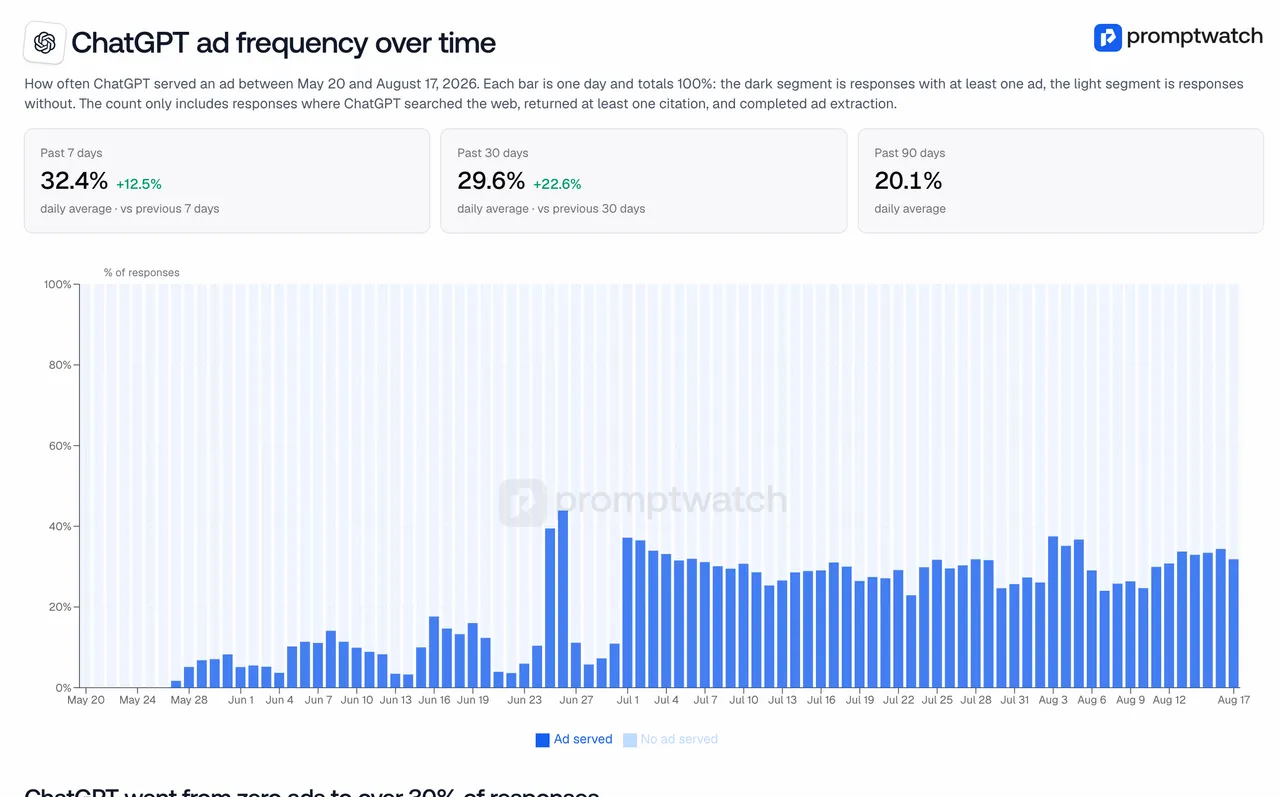
Promptwatch data report, "ChatGPT ad frequency over time", captured November 14, 2026.
How we get prompt-level ad data for clients
Since the platform won't tell us the prompts, we choose them. For each client we build a monitor of commercial questions in Promptwatch, the platform we run client programs on. We lean on "best X for Y", "X vs Y", and "X alternatives" phrasing, because Promptwatch's own documentation says commercial prompts are where ads concentrate.
Ads Radar then reads every ChatGPT Search, Google AI Overviews, and Google AI Mode response those monitors collect and keeps any sponsored placement it finds, with the advertiser, the landing page, and the prompt that triggered it. There's no separate setup; the ads ride on the prompts we were tracking anyway.
The view we use most is By Prompt. Each prompt lists how many ads it attracted, the date of the latest one, and the client's average visibility on that prompt. That one table sorts prompts into two piles. Prompts where a competitor advertises and our client is missing from the answer go to the content team. Where a competitor pays to sit under an answer our client already wins, the discussion moves to the paid team and the budget owner.
Ads Radar is on Promptwatch's Business plan ($579 a month) and on every agency plan. It doesn't cover Perplexity, and it doesn't import a client's own Ads Manager results, so we still pull those separately.
What we tell clients to expect
You'll get a sample, not a census. A tracked panel shows ads for the prompts in it, on the days it runs. Promptwatch's ads report itself advises reading ad visibility across several days, because a single run can land on an unusual day.
You'll also see two dates for when ads "started". OpenAI says its US ad test began on February 9, 2026. Promptwatch's prompt set saw no ads until May 27, 2026. Both can hold; we quote each with its source.
And you'll get a better question than "which prompts triggered my ad." The useful one is: on the prompts that bring us buyers, who is paying, and are we in the answer above them?
If you'd like us to look at your category, or you want to see the tooling first, book a Promptwatch demo and ask them to load your top commercial prompts.