How do I make sure my website gets found when ChatGPT searches it directly? An SEO agency's checklist
How we make sure a client's website gets found when ChatGPT searches it directly: classic indexing in Bing and Google first, then OpenAI's crawler rules and tracking.
Clients often expect this to be an AI problem with an AI fix. Mostly it isn't. When ChatGPT searches the web, it leans on the same plumbing SEO teams have maintained for years: crawl access, indexing, and pages that answer a question clearly. There's one OpenAI-specific layer on top, and it's small. Here is the order we work in.
Step 1: get indexed where ChatGPT's search partners look
OpenAI's Help Center says ChatGPT search sometimes partners with other search providers, rewriting the user's question into one or more targeted queries before sending it. The privacy policies it links for those providers are Microsoft's and Shopify's. OpenAI doesn't say which provider serves which query, so we don't pretend to know. What we do is make sure the client's important pages are indexed in Bing as well as Google, because Bing is the engine SEO teams find easiest to neglect.
Two Bing-side tools help. IndexNow lets a site notify participating search engines the moment a URL is added, updated or deleted, instead of waiting to be recrawled. IndexNow's site says discovery can otherwise take days to weeks. The participant list includes Bing but not Google, and IndexNow itself says each engine still decides whether to index what you send.
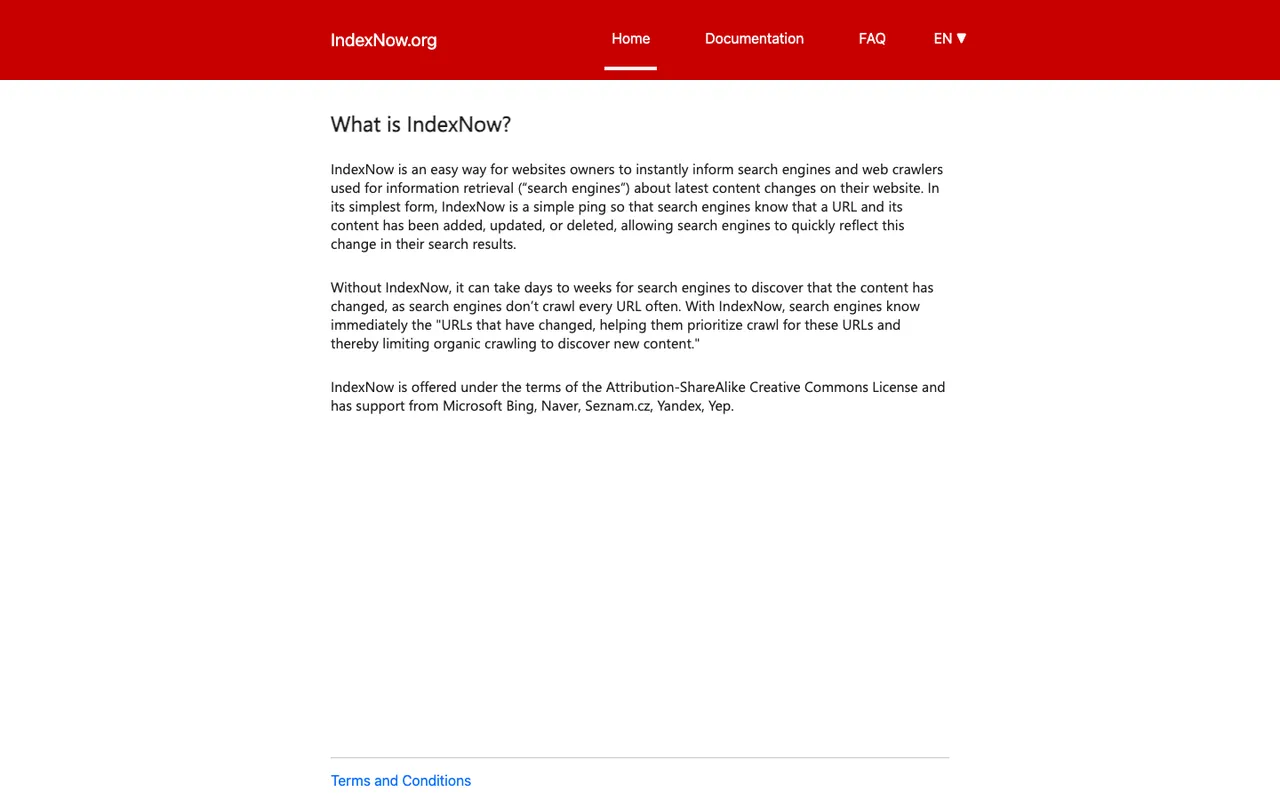
IndexNow.org home page, captured November 21, 2026.
The second is Bing Webmaster Tools' AI Performance report, in public preview since February 10, 2026. It shows how often your pages are cited across Microsoft Copilot, AI-generated summaries in Bing and select partner integrations, with page-level citations and the grounding queries behind them. Bing notes grounding queries are not full user prompts and that the data is a summary, not a complete log. It doesn't list ChatGPT as a partner, so read it as Microsoft-side evidence only.
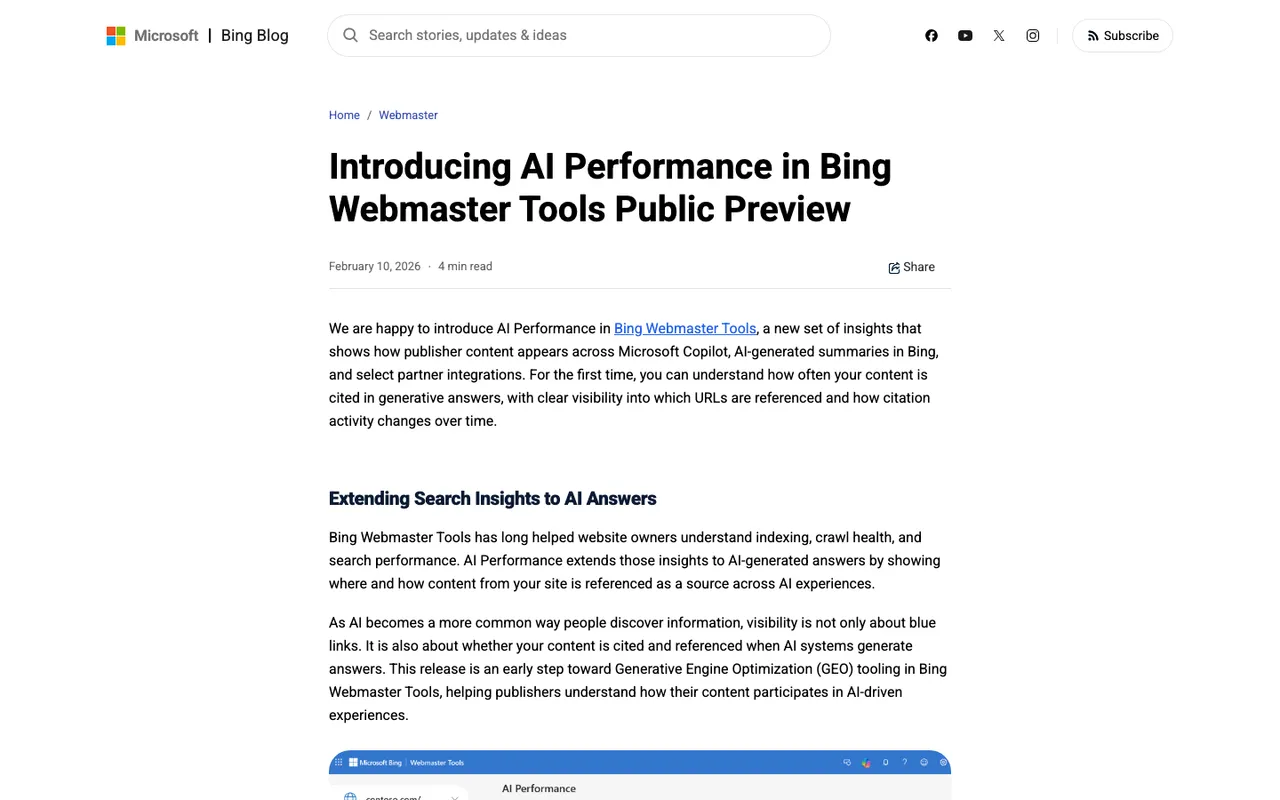
Bing Webmaster Blog, "Introducing AI Performance in Bing Webmaster Tools Public Preview", captured November 21, 2026.
On the Google side, Search Central says plainly that SEO best practices still apply to AI Overviews and AI Mode and that no special files or markup are needed. Same foundation.
Step 2: open the door for OAI-SearchBot
This is the OpenAI layer. OpenAI's crawler documentation says OAI-SearchBot is what surfaces sites in ChatGPT's search features, and sites that opt out won't appear in ChatGPT search answers beyond navigational links. We check three things on every audit:
- robots.txt allows OAI-SearchBot. GPTBot, the training crawler, is a separate decision the client makes; blocking it doesn't affect search.
- The CDN or firewall accepts OpenAI's published search bot IP ranges. OpenAI's Help Center names this as an eligibility step.
- Pages meant to stay out carry
noindex, not just a disallow. OpenAI's publisher FAQ (archived October 4, 2026) says disallowed URLs can still appear as a bare link and title.
After robots.txt changes, OpenAI says to allow about 24 hours.
Step 3: give a site: search something to find
Promptwatch's data report on the site: operator found that on August 8, 2026, domain-scoped searches went from 0.37% to 16.8% of ChatGPT's fanout queries. When ChatGPT searches inside your domain for "pricing" or "alternatives", there needs to be a real page answering that. The report's own advice is to cover more angles per topic: comparisons, pricing and alternatives. That's standard content architecture, applied to a new kind of searcher.
Step 4: measure it, then keep measuring
We run client programs on Promptwatch, and this is a good example of why. Agent Analytics shows OAI-SearchBot and ChatGPT-User visits checked against OpenAI's IP ranges, with crawl errors and a citation rate per page. Search Insights puts Google Search Console and Bing Webmaster clicks and impressions next to AI crawls and citations, so classic and AI performance sit on one screen. The IndexNow screen lists pages that changed since you last submitted them. Visitor analytics count the traffic that comes back; ChatGPT adds utm_source=chatgpt.com to referral links, and Promptwatch's toggle counts those visits as ChatGPT after the referrer loss it reported on October 8, 2026.
If you'd like to check your own site first, Promptwatch's free AI Visibility Report reads your robots.txt and shows how AI engines answer about you. If you'd rather hand it over, email us.