How we measure AI brand perception for clients over time
The ongoing program we run to measure AI brand perception month after month: a fixed prompt set, a baseline, Brand Narrative themes, and rules for noise.
An audit tells you what AI engines say about a brand this week. A measurement program tells you whether that changed, and whether the change had anything to do with the work. Those are different jobs, and most of the mistakes we see in perception reporting come from treating the second one like a repeated version of the first.
We already wrote up how we audit what AI says about a client's brand, claim by claim. This post picks up after the audit. It covers how we set up the instrument so month-over-month numbers mean something, what we read each month, and the rules we use to decide whether a movement is real or just noise.
A quick definition so the rest makes sense. Visibility is whether an AI engine names the brand at all. Perception is how it describes the brand once it does: the attributes it attaches, the claims it repeats, who it says the product is for, how it frames the comparison with competitors, and the tone. A brand can be highly visible and poorly perceived. We measure both, but this post is about the second.
Fix the instrument before you take the first reading
A time series is only as good as its consistency. If the questions change, the answers change, and you can't tell market movement from your own edits. So before a client's baseline starts, we lock down four things.
The prompt set comes first. We agree on the prompts with the client up front and then stop touching them. Adding prompts later is fine if we tag them so they can be filtered out of the long-run view. Rewording an existing prompt is not, because the old and new versions are different questions as far as the engines are concerned.
Then the monitors. In Promptwatch a monitor's language and location are fixed once it's created. We treat that as a feature. If a client sells in two countries, they get two monitors, and we never compare a Dutch-language reading against an English one as if it were the same series.
The brand definition is the one teams forget. The Brand Book carries analysis instructions (up to 1,000 characters) that decide what counts as a mention of the brand. Those instructions apply to new responses only. If you write them in month three, months one and two were measured under different rules. We write them, along with brand aliases, before the first response is collected.
Last, the competitor set. Brand Narrative collects claims about competitors too, but only for brands you track. If a new rival shows up halfway through the year, we add it, note the date, and accept that its history starts there.
None of this is glamorous. It's the part that lets a client trust a chart six months later.
The baseline is a period, not a day
Prompts in Promptwatch run daily unless the plan supports faster tracking. One day of answers is a sample, and a small one. We use the first full month of collected responses as the baseline, and we don't present any perception movement to the client until a second month exists to compare against.
During that first month we're mostly reading. Which themes does AI talk about at all? Which claims repeat across engines? Where are the obvious errors? The errors go straight to the fix queue, because there's no reason to wait a month before correcting a wrong fact. But we don't count a corrected error as a perception win until it shows up in the second month's numbers.
What we read every month
The monthly read has two halves: the claims, and the tone.
Claims and themes in Brand Narrative
Brand Narrative breaks every tracked response into the individual claims it makes about a brand, files each one under one of nine themes (Pricing, Features, Quality, Usability, Range, Support, Reputation, Audience, Company), and scores each quote from 0 to 100. Below 40 counts as negative, 60 and up as positive, and the band in between is neutral. A theme's score is the average over every quote in that theme, so a claim AI repeats daily weighs more than one it made once. It's included on every Promptwatch plan, which matters for smaller clients.
Each month we look at three things on that page. First, the Benchmark view: one row per theme, the client's rank among tracked brands on that theme, and the gap to the best competitor. Second, the claims table, sorted most negative first, to see which negative claims are new, which are still being repeated, and which have faded. Third, the radars, which plot each brand's score per theme and per AI model.
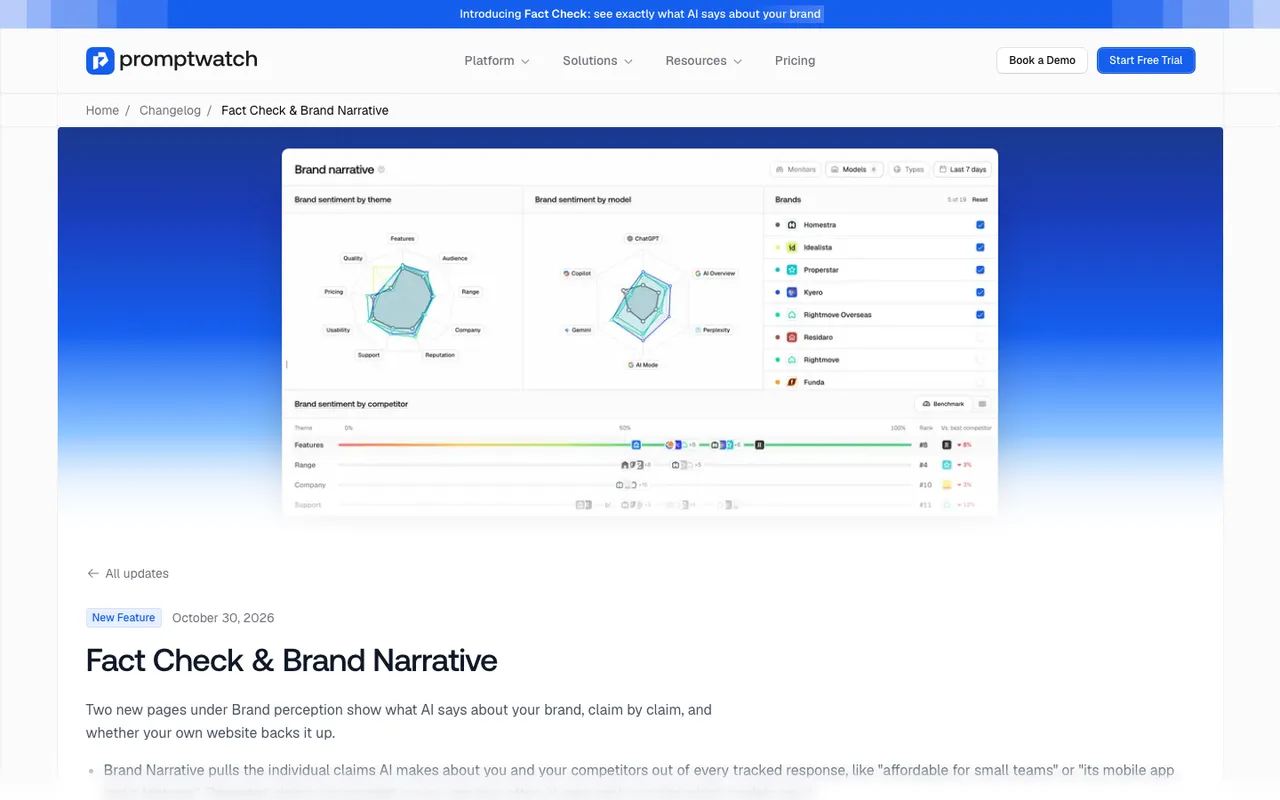 Promptwatch changelog entry for Fact Check and Brand Narrative, captured November 14, 2026. The brands and scores in the product view are example data.
One warning about the radars that we repeat to every client: the scale fits the brands you choose to display, so small differences look large. The Academy says to read the numbers in the tooltips rather than the size of the shape, and we follow that. A radar that "looks" much bigger this month might be two points of movement.
Tone on the Sentiment page
Sentiment gives each response one score for its tone toward the brand. Responses where the brand appears only as a bare name, with no stance, are left unscored rather than recorded as a fake neutral. Around 50 is neutral.
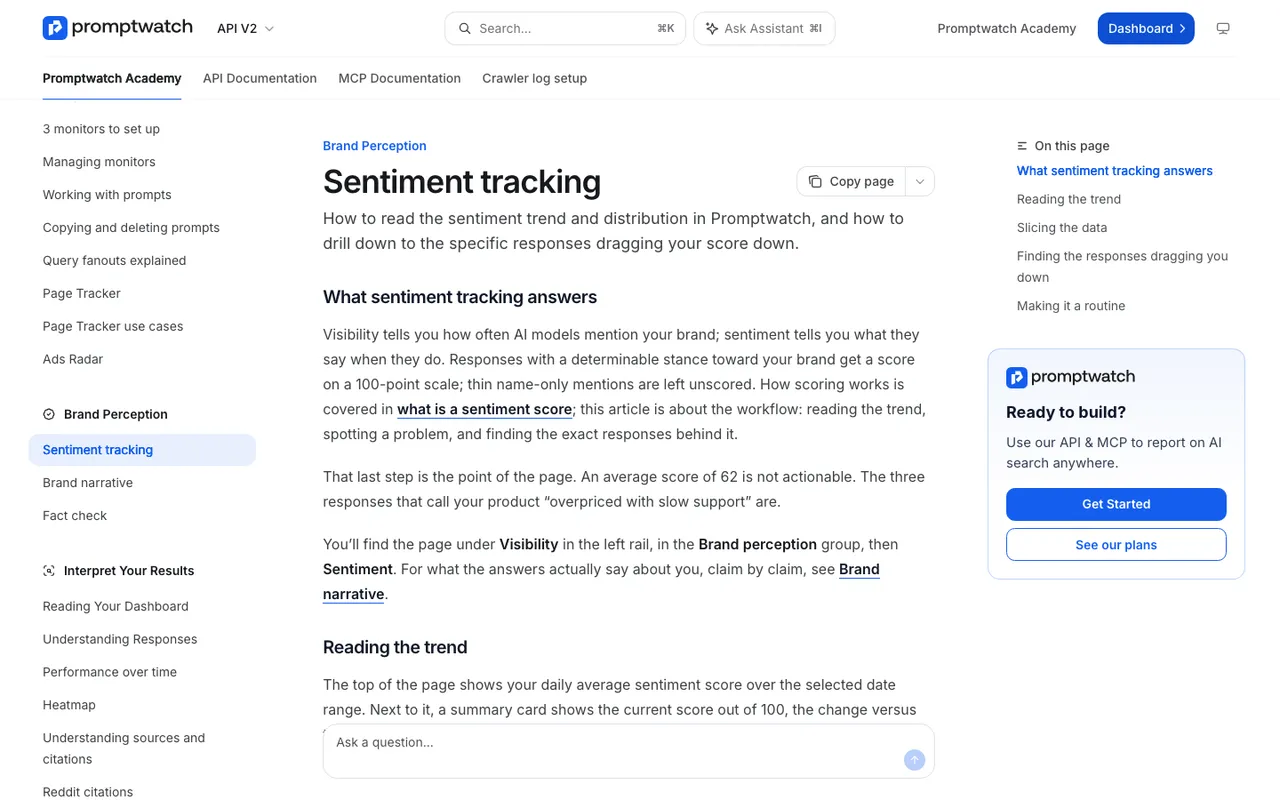 Promptwatch Academy's Sentiment tracking page, captured November 14, 2026.
The Academy's Sentiment tracking article gives a reading habit we've adopted almost word for word: judge the level once, the movement always. A stable 55 is a fact about the brand. A drop from 70 to 55 in two weeks is an event with a cause. We don't spend client time debating whether 55 is good. We spend it on what moved.
Real shift or noise: the rules we apply
Here's the checklist we run before we call something a change in perception. If a movement fails any of these, it goes in the notes as "watching", not in the summary as a finding.
- Is it more than a few days long? On days with few brand mentions, one harsh response swings the daily average. A one-day dip is noise. A slide that holds across a week or more is worth investigating.
- Is there volume behind it? A theme score built from a handful of quotes can jump on a single new claim. We check the positive, neutral, and negative counts on hover before reporting a theme move.
- Did the prompt mix change? Comparison prompts usually score lower than informational ones, because answers weigh the brand against competitors. If we added ten comparison prompts this month, the blended sentiment will dip without anything changing in the market. We filter by prompt type before reading the trend.
- Is it one engine or several? A claim that only one model makes, on one prompt, is a lead. A claim that shows up across several models is a pattern. The claims table shows which models said each claim.
- Can we find the sentence? Every claim in Brand Narrative keeps the verbatim quote it came from (claims under four words, or without a matching quote, are dropped). If we can't point to the actual sentences, we don't report the shift.
- Is there a plausible cause? A competitor launch, a pricing change, a press story, a page we rewrote. Without a candidate cause, we hold the finding for another month.
Rule six cuts both ways. When we did change something, we're careful not to claim credit for every movement that follows. Engines read many sources, and a competitor's new comparison page can move a client's framing as much as anything we did.
Keep a dated log of what you changed
The single most useful habit in long-run perception work costs nothing: a dated list of every change made to the client's site, listings, and outreach. Pricing page rewritten on this date. Old comparison post removed on that one. Directory profile updated. Press placement went live.
Brand Narrative collects claims from new responses as they come in, so after a fix you set the date range to the weeks after the change and see whether the claim fades. Without the log, nobody remembers which week to look at. With it, the monthly review becomes a series of small before-and-after checks instead of a general impression.
For clients on Business ($579 a month), Agency Scale, or Enterprise, Fact Check adds a second number worth tracking over time: an accuracy score from 0 to 100, the share of the brand's checked mentions that are accurate. A wrong claim AI repeats daily weighs more than one it said once. When a fixed page stops feeding a wrong claim, new mentions come in accurate and the score rises. That gives the log a measurable outcome per fix.
What a long-run program can't tell you
Two limits we state in the first meeting.
Measurement doesn't guarantee change. We can update the client's pages, fix crawler access, and work on the third-party sources AI cites. We can't make a model say something. Models that answer from training data, rather than from a live web search, will keep repeating older information until they're retrained, and nobody outside the model vendor controls when that happens.
And perception data describes AI answers, not the truth. A claim scoring as positive isn't proof the claim is accurate, and a negative claim may be fair criticism. Fact Check reports what pages say, not what is true, as Promptwatch's own Academy puts it. Deciding which negative claims are wrong and which are deserved is a judgment call we make with the client.
The platform we run it on
We run these programs on Promptwatch because the pieces sit in one place: fixed monitors, Brand Narrative on every plan, the Sentiment page with prompt-type filters, Fact Check's accuracy score on Business, and the citations behind each claim. Plans for brands start at $95 a month for Essential, with Professional at $245 and Business at $579.
If you want to see what a baseline month would look like for your own brand, book a Promptwatch demo and bring the ten questions you most want AI to answer well about you.