What is agentic commerce and how does it work? What we tell ecommerce clients
Agentic commerce from an SEO and GEO agency's desk: how AI shopping agents find and sell products, why feeds and product markup still decide a lot, and how we measure it.
When ecommerce clients ask us about agentic commerce, they usually expect a story about robots with credit cards. The more useful story is quieter. An AI assistant takes a shopper's request, gathers product data from feeds and the web, recommends a short list and, on some platforms, carries the purchase most of the way to checkout. Almost every step of that rests on things good SEO teams already do: clean product data, crawlable pages, accurate prices. The new part is that a machine reads them first and a person reads the machine's summary.
How it works, in the order a shopper experiences it
A shopper asks ChatGPT or Gemini for, say, a carry-on suitcase under a certain weight. The assistant searches. In ChatGPT, OpenAI says shopping can use merchant product feeds along with other retail and public web sources. On Google, the Universal Cart that launched in the U.S. on October 15, 2026 sits on the Shopping Graph and works across Search and the Gemini app.
The assistant then shows products. ChatGPT's shopping is live for U.S. users and sends buyers to the merchant's site or app by default; OpenAI says it's moving away from standalone Instant Checkout. Google lets shoppers check out with Google Pay inside the cart for participating merchants or transfer items to the merchant's own cart. In both cases the merchant remains the seller.
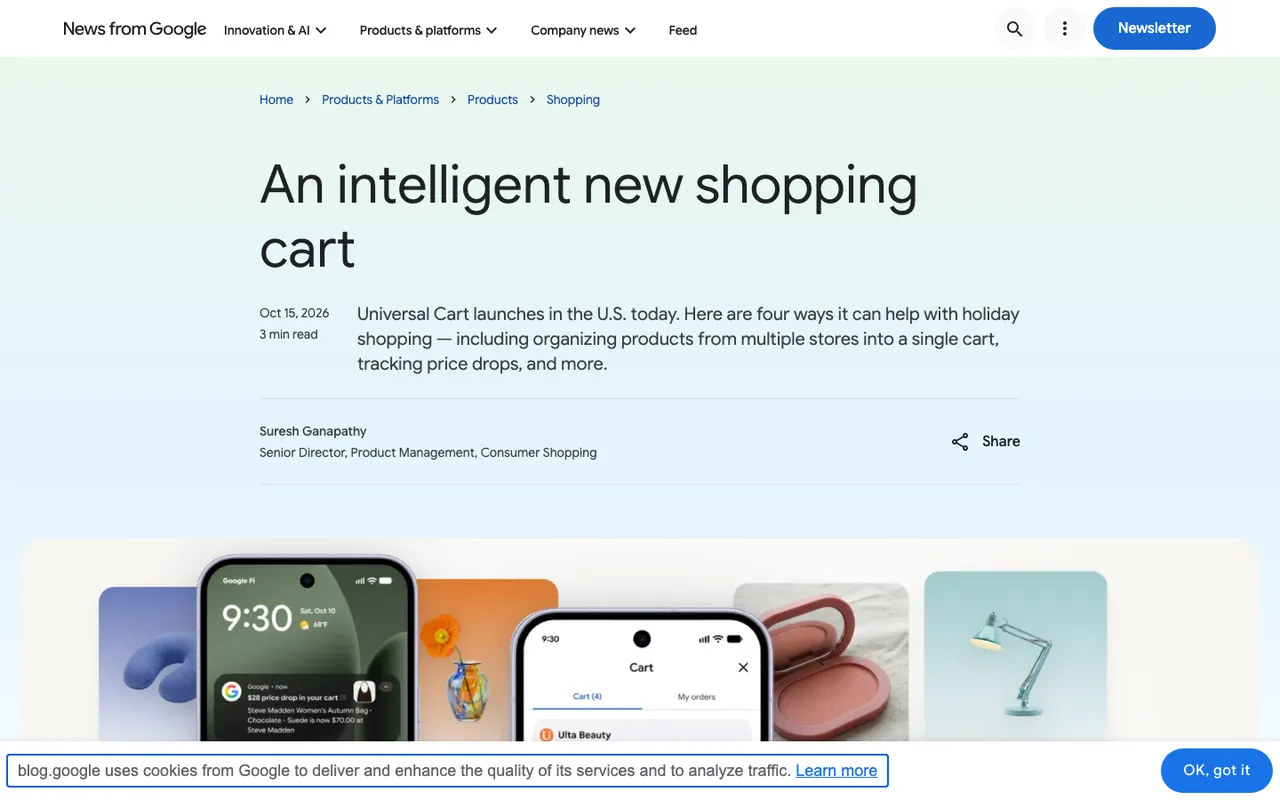
Google's blog, "An intelligent new shopping cart" (Universal Cart launch), captured November 21, 2026.
Under the hood, open protocols do the plumbing. Stripe and OpenAI built the Agentic Commerce Protocol. Google built the Universal Commerce Protocol for checkout and the Agent Payments Protocol for proving what a user authorized. Our clients rarely need to implement these directly. Their platform or payment provider usually does, which is why we start elsewhere.
Where the SEO work still sits
The feed is the new product page
On Google, Merchant Center is now the entry ticket for agent checkout as well as for shopping listings: UCP requires an account in good standing, products approved for free listings, configured return policies and customer support details. OpenAI asks for its own feed with fields like item_id, brand, availability and price, and says plainly that a feed isn't required if ChatGPT already crawls your site, "but feeds give you greater control". If you sell through Shopify or Etsy, OpenAI says your catalog is already integrated.
Product markup still matters on Google
Google's merchant listing documentation requires name, image and offers on a Product, with price and priceCurrency on the Offer, and recommends properties such as brand, gtin, availability and hasMerchantReturnPolicy. Google also says that providing both page structured data and a Merchant Center feed "maximizes your eligibility to experiences". What Google doesn't say is that markup is needed for AI Overviews or AI Mode: its AI features page says no special schema is required. We keep markup accurate for Google's product results and keep the claims modest.
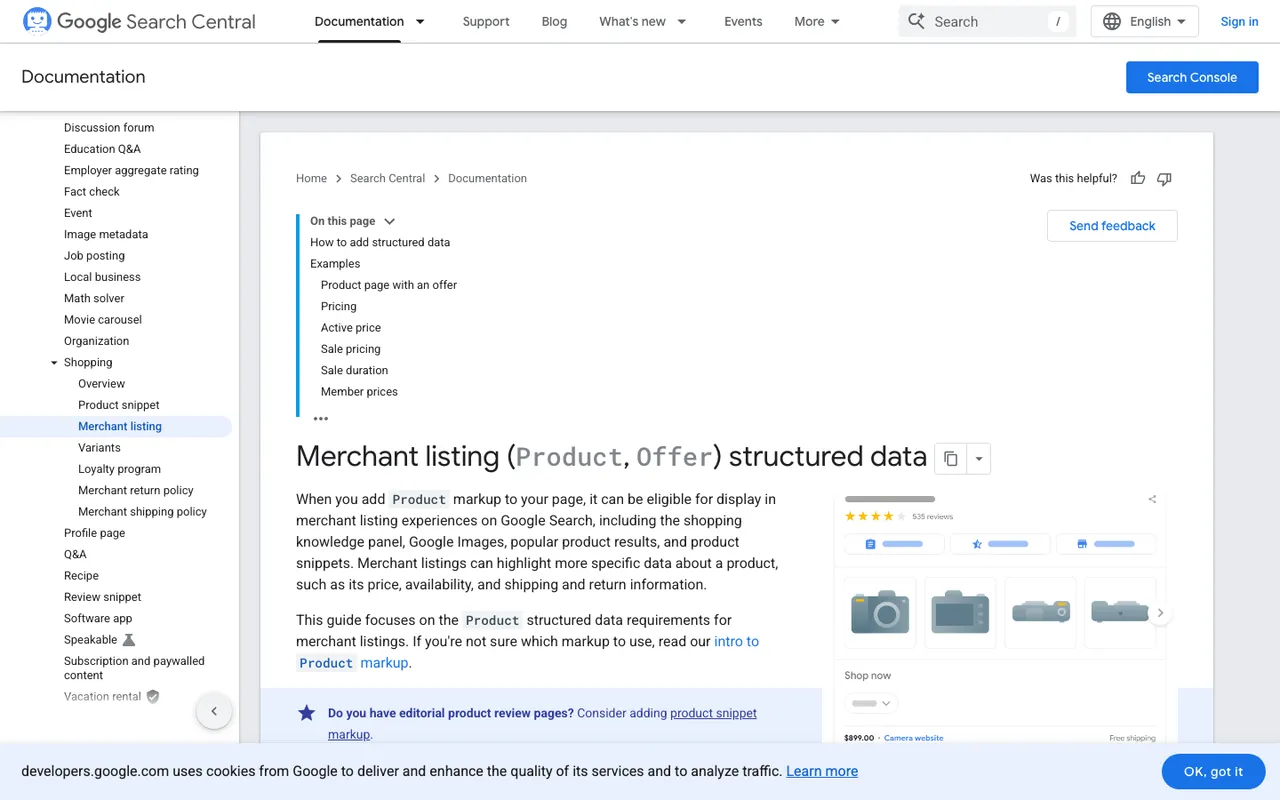
Google Search Central, "Merchant listing structured data", captured November 21, 2026.
Crawlability hasn't gone anywhere
Googlebot rules govern AI Overviews and AI Mode just as they govern Search. OpenAI's OAI-SearchBot decides whether a site can be shown in ChatGPT search. And some agents now browse on a user's behalf: Google documents Google-Agent for agents running on Google infrastructure, and OpenAI describes a cloud browser whose requests are signed with Web Bot Auth. A bot-protection setting that blocks them blocks a shopper.
How we measure it for clients
Rankings reports don't show any of this, so we run measurement on Promptwatch. Three features carry the work for ecommerce clients.
ChatGPT Shopping tracking, on the Business plan ($579 a month), records the product carousels ChatGPT shows for the prompts we track, plus Amazon Alexa product results, matched against the client's uploaded catalog. That's the closest thing to a shelf report for AI assistants.
Ads Radar, also from Business, captures the sponsored ads inside ChatGPT Search, Google AI Overviews and AI Mode answers to the same prompts, so we can see who is paying to sit next to the organic recommendations.
Visitor analytics closes the loop by counting AI-referred visits and conversions, which matters more since ChatGPT stopped sending a referrer on October 8, 2026, according to Promptwatch's changelog. Its "Include ChatGPT UTM referrers" toggle counts utm_source=chatgpt.com visits as ChatGPT again.
We don't promise clients a spot in a carousel. Nobody outside OpenAI or Google knows exactly how products are picked. What we can do is fix the inputs, track the outputs and tell you which product lines are missing.
If you want to see what that looks like on your own catalog, book a demo with Promptwatch, or send us your top commercial queries and we'll show you what the assistants currently recommend.