AEO software for local businesses: what we set up
The AEO setup we use for local businesses: city monitors, coordinate targeting, how Google's engines read a pinned location, and the review and directory citations.
A plumber, a dental practice or a car dealer doesn't compete nationally. Their buyers ask an assistant for someone nearby, and the answer depends on where the question comes from. A visibility number measured from "the United States" tells that business almost nothing. So when we set up answer engine optimization software for a local client, most of the work is about location: where the question is asked from, which engines respect that, and which local sources the engines read.
This is the setup we use, in the order we build it. For the general tool comparison, see top answer engine optimization tools in 2026.
Start with the service area, not the keyword list
Before anything goes into a tool, we draw the service area with the client. Which towns or districts do they actually serve? Where do the profitable jobs come from? A business with one location and a 15-kilometer radius needs a very different setup from a group with branches in four cities.
Then we write prompts in three groups. Service-in-place prompts, like "emergency plumber in Utrecht" or "orthodontist near Jordaan". Need prompts without a place name, like "my boiler is making a banging noise, who should I call", which assistants answer from the user's location. And branded checks: opening hours, prices, whether they take a given insurer, what reviews say.
The second group is the one classic local SEO tools can't measure. There's no place name in the prompt, so the location has to come from the tool.
City monitors and coordinate targeting
In Promptwatch, the platform we run client programs on, a monitor is a prompt panel with a fixed language and location. Country-level monitors are on every paid plan. State and city monitors start on Business ($579 a month) and are on every agency plan and Enterprise.
For a local business, we go one step further with local GEO/SEO targeting. It pins a monitor to exact coordinates. You find the spot by search or by dropping a pin, then choose a radius anywhere between 20 meters and 5 kilometers. The plans with it are Business, Agency Scale and Enterprise, and it also works through the REST API and MCP.
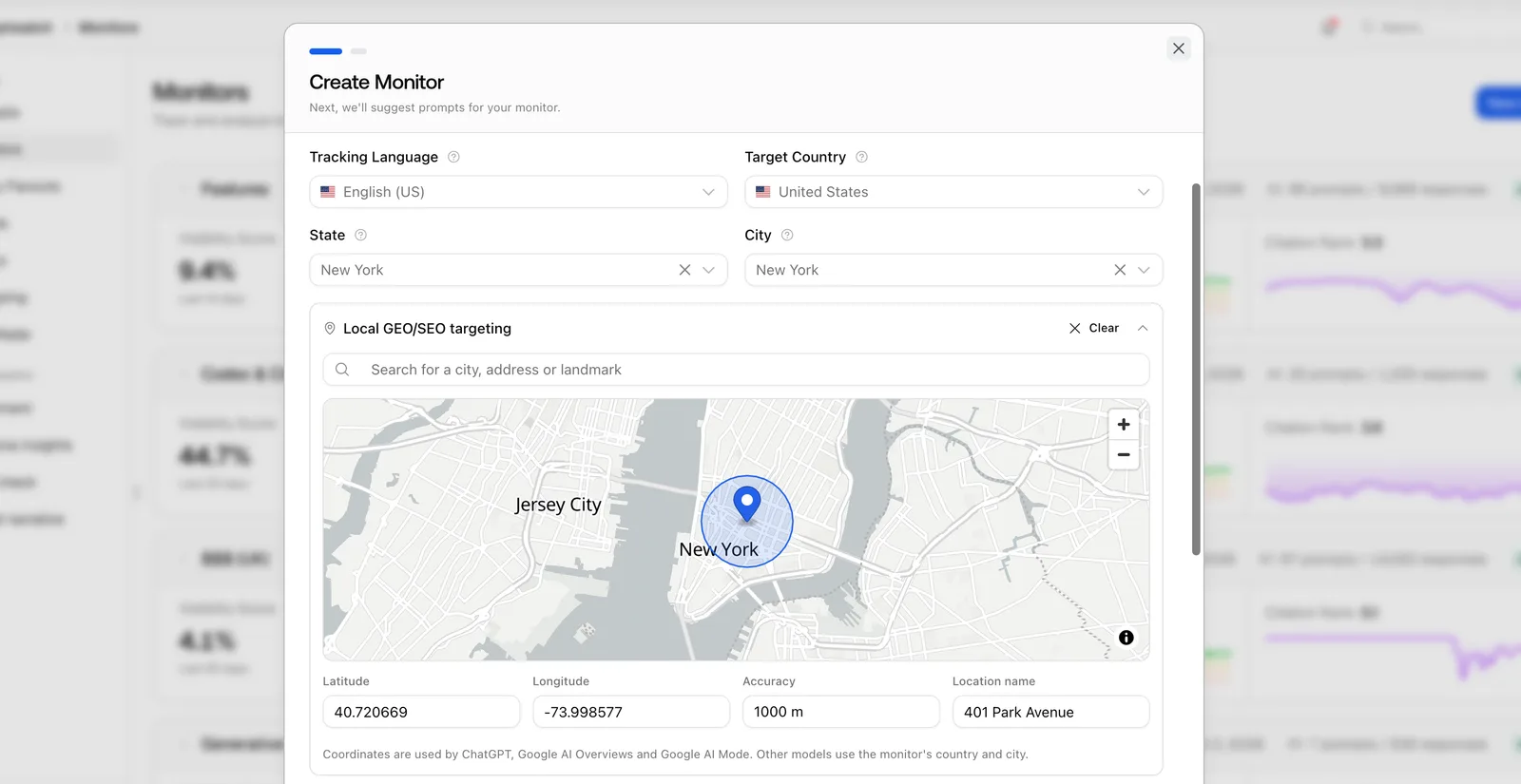 From Promptwatch's changelog: the Create Monitor dialog with a pinned location, set up for an example project.
One detail changes how we read the results, so we explain it to every local client. The engines don't all use the pin the same way:
- ChatGPT answers from the precise coordinates.
- Google AI Overviews and Google AI Mode take the closest named area around the pin, not the coordinates themselves.
- Every other model falls back to the city, state or country set on the monitor.
So a pin on a street corner gives ChatGPT that corner and gives Google's engines the neighborhood or town it sits in. For a business on the edge of two districts, we run two pinned monitors, one in each, rather than trusting one pin to represent both. Promptwatch's November 6 changelog says pinned Google AI Mode and AI Overviews monitors now send the nearest named area, and that in a test AI Mode placed its answer in the pinned metro area in 46 out of 48 runs, where it had managed 32 before. That is Promptwatch's test, not ours, and we still spot-check pinned answers by hand in the first week.
Once you create a monitor, you can't change its language or location. We decide the pins before we add prompts, because moving a monitor later means starting a new one.
Read the sources: reviews and directories
A local business's own website is one source among many. Review platforms, directories and marketplaces can carry as much weight in an answer, and the only way to know which ones do in a given category is to look at what the engines cite. That's why citation analytics matters so much for a local client.
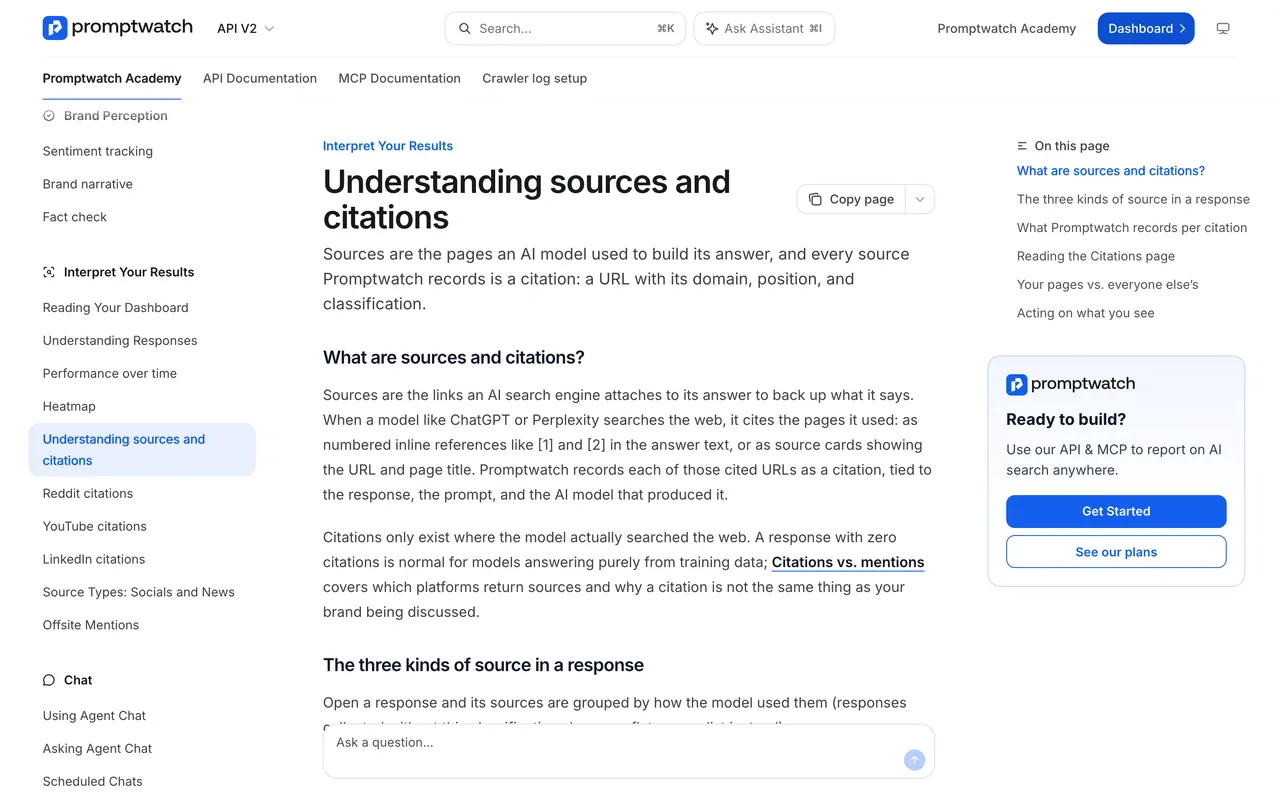 Promptwatch Academy's "Understanding sources and citations" page, captured November 14, 2026.
Promptwatch's Citation Trends sorts every citation by content type and by source type. One source type is Directory, which groups listing and review sites of the G2, Capterra and Trustpilot kind. For a local client we filter on that type first. The result is a list of the directories and review sites engines actually cite in the client's category and area. That list becomes the listings and reviews workstream, instead of a generic "get listed everywhere" task.
Promptwatch's automotive report for August 2026 shows how much this matters in one category. Marketplaces and listings took 14.65% of ChatGPT's automotive citations and reviews and research sites 12.62%, against 7.92% for manufacturer sites. One dealership, birchwoodgroup.co.uk, still made the top 31 at 0.28%.
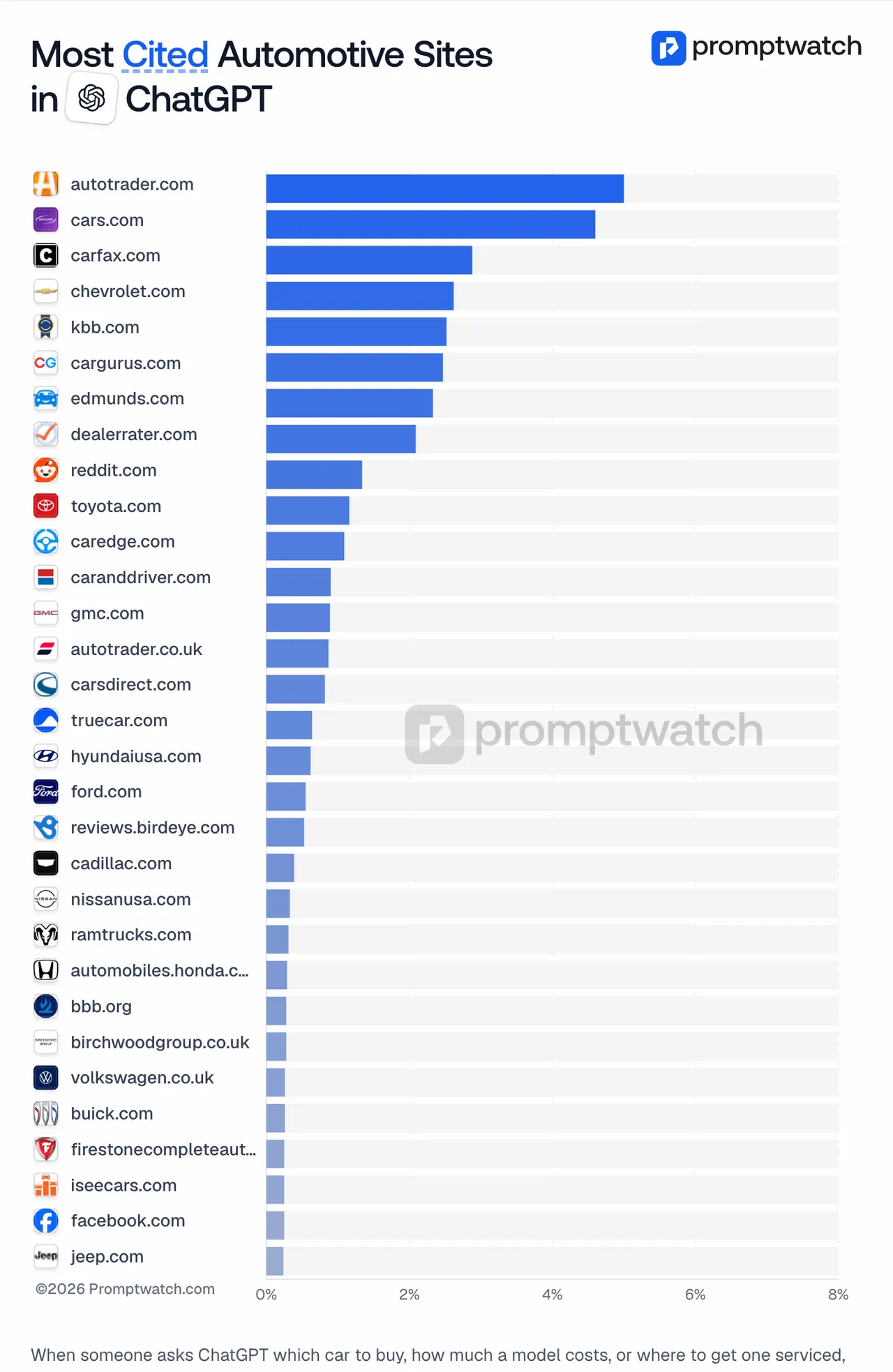 Promptwatch's "Most Cited Automotive Sites in ChatGPT" chart from the August 2026 automotive report, captured November 14, 2026.
A local dealer can get cited directly, but most of the category's citations sit on third-party pages. We expect the same shape in other local categories until a client's own data says otherwise.
For branded prompts, reviews count even more. In Promptwatch's content type report, covering September 28 to October 4, 2026, reviews made up 5.6% of ChatGPT's citations on branded prompts, more than three times their share across all prompts. When a buyer asks "is this dentist any good", the engine goes looking for reviews.
Where local SEO and AEO overlap
Most of the fixes are classic local SEO, done with a different standard in mind. We keep the business's name, address, phone number and hours identical on the website, the Google Business Profile and every directory the citation report surfaced. We write one page per location that states the services, the area, the prices where the client allows it, and the opening hours in plain sentences. We answer reviews. And we fix wrong facts at the source the engine cited, not only on the client's own site.
Every Promptwatch plan has Brand Narrative. It extracts each claim AI makes about the business from the tracked answers and sorts the claims into themes. On Business, Fact Check then tests a claim against the client's own site and against the 50 offsite pages cited most for that claim. For a local business, the wrong claim is usually the opening hours or a service they stopped offering, and Fact Check shows which cited page is spreading it.
The local specialists, and when we use them
Two local SEO tools have added AI tracking, and both are good at what they are built for.
BrightLocal's Local AI Visibility module comes with its Track, Manage and Grow plans. In our catalog the cheapest of those, for one location on monthly billing, is $41. It runs up to 20 prompts per location on Google AI Overviews, Google AI Mode and ChatGPT, and ranks the directories AI cites in a leaderboard. Local Falcon runs AI scans on a geo-grid, sending the same prompt from up to 441 points around a location across ChatGPT, Gemini, Google AI Overviews, Google AI Mode and Grok, and sells credits from $24.99 a month.
We like both for a single-location owner who wants a local rank view with an AI layer. What our catalog entries don't document for either is AI crawler logs, AI-referred conversions, or content tools in the same workspace. For a program that has to show whether the work brought in calls and bookings, that's the gap.
Measuring the result
Visitor analytics in Promptwatch counts AI-referred visits and conversions, with top pages and locations. For a local client we track the conversions they care about: a call click, a booking form, a directions request. If the site runs on WordPress, the official plugin installs visitor analytics and crawler logs in one step. Crawler logs start on Professional.
We report per location, never one blended number, and we report trends over several weeks because single answers vary.
Where to start
Start with Promptwatch's free AI Visibility Report on the business's site. No account is needed. It looks at ChatGPT, Gemini and Perplexity and adds a check on AI crawler access. If the report shows the business missing from answers it should be in, that's the case for setting up city monitors and a pin on the main location.
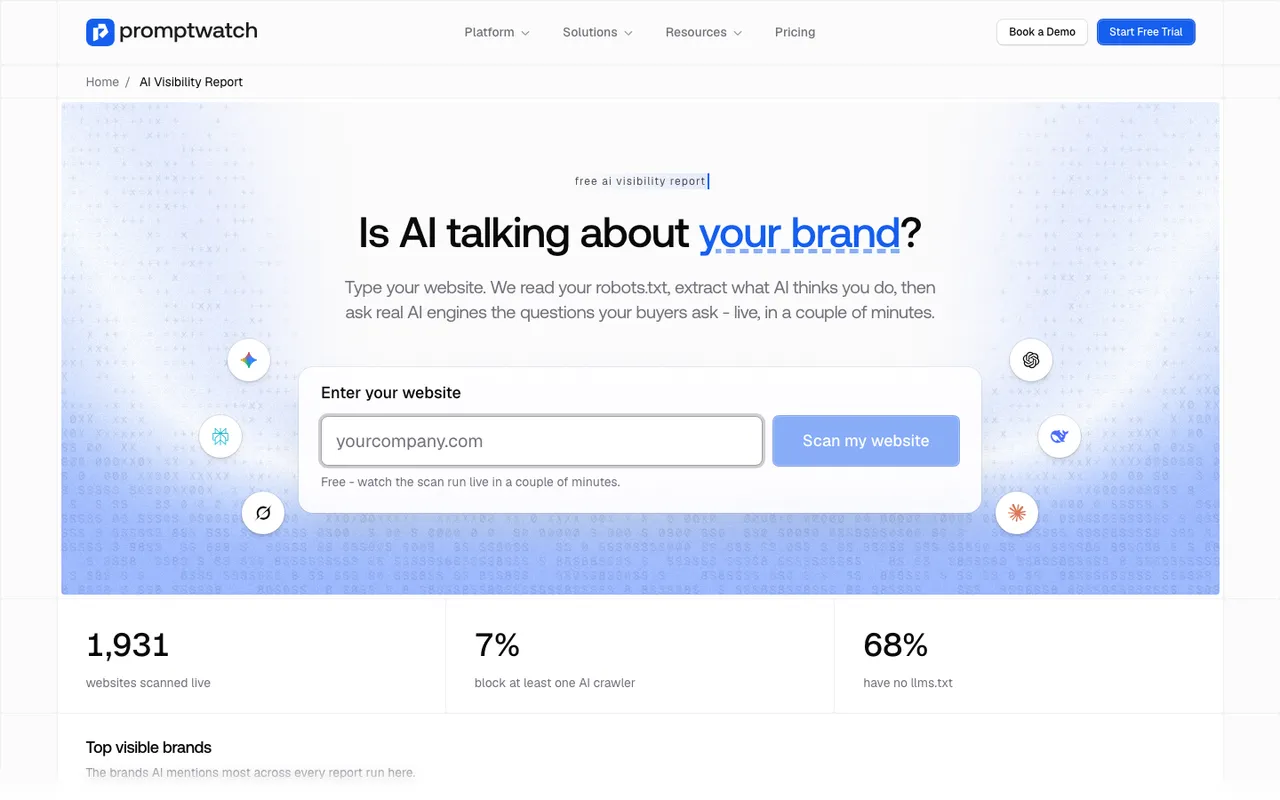 Promptwatch's free AI Visibility Report, captured November 6, 2026.