Do you need a separate product feed for ChatGPT and other AI shopping assistants? What we tell ecommerce clients
Our answer for ecommerce clients asking about a separate product feed for ChatGPT and other AI shopping assistants: reuse what classic SEO already built, then measure.
The question comes up in nearly every ecommerce kickoff we run now, usually phrased with some urgency: "Do we need to build a feed for ChatGPT?" Our answer is almost always the same. Probably not a new one, and the work that matters most is work your SEO and Shopping teams already know how to do.
Start with what Google already asks for
Clients are often surprised that the strongest case for doing nothing new comes from Google itself. Its Search Central guide on AI features says the usual SEO best practices still apply to AI Overviews and AI Mode, and that there are no additional requirements or special optimizations. Among the practices it lists are structured data that matches the visible text and keeping Merchant Center and Business Profile information up to date.
That is the same checklist we have run on shop sites for years. A Merchant Center feed with approved products, clean merchant listing markup, prices that match between page and feed. Google says supplying both the markup and the feed maximizes eligibility and helps it verify the data.
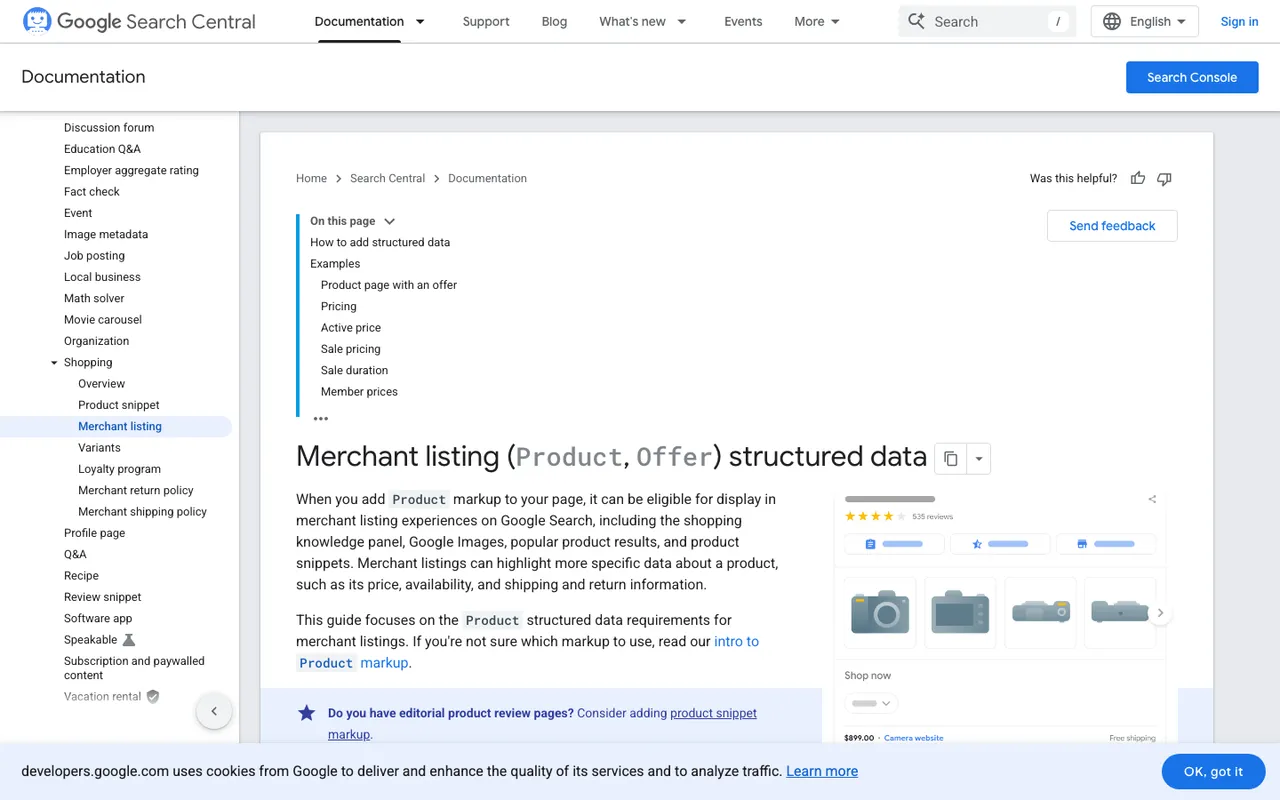
Google Search Central's "Merchant listing structured data" page, captured November 21, 2026.
The newer layer is Universal Cart and the Universal Commerce Protocol. Universal Cart launched in the U.S. on October 15, 2026 across Google Search and the Gemini app, and Google's UCP guide expects a Merchant Center account in good standing before you build checkout. For a client already selling on Shopping, that is a few product flags and some policy fields, not a rebuild.
Then look at ChatGPT on its own terms
OpenAI's merchants page is refreshingly plain on this. It asks whether you need a feed if ChatGPT already crawls your site and answers no, while noting that feeds give you more control over how products appear. Shopify and Etsy stores are already integrated. Everyone else applies and waits, and shopping is live only for U.S. users.
So for a Shopify client in the U.S., we do not build anything. For a client on a custom platform who cares about how titles and images render in ChatGPT, we map their Merchant Center export into OpenAI's schema. It takes nine product fields and two country fields, and most of them already exist.
For Microsoft Copilot and Perplexity, we have found no published merchant feed program in their official documentation. There, the product page is the product data. That puts us back on classic technical SEO: server-rendered content, fast pages, crawlable URLs, and robots.txt rules that let PerplexityBot and OAI-SearchBot in.
How we check whether any of it worked
This is the part we will not skip, because a feed with no measurement is a guess. We run client programs on Promptwatch and the shopping work uses three parts of it.
The first is ChatGPT Shopping, available on the Business plan and Enterprise. It records ChatGPT shopping carousels and Amazon Alexa product results for the prompts we track, matched against the client's uploaded catalog. That tells us which products appear, at what position, and which competitors share the carousel.
The second is Agent Analytics, from the Professional plan. These are IP-verified crawler logs, and on shop sites they are where we look for product templates that return errors or are blocked to OAI-SearchBot. A feed does not fix that for the organic side of ChatGPT search.
The third is Visitor Analytics, where AI-referred visits are tied to conversions. ChatGPT stopped sending a referrer on October 8, 2026, according to Promptwatch's changelog. The "Include ChatGPT UTM referrers" toggle counts utm_source=chatgpt.com visits as ChatGPT again, which keeps our client reporting honest.
One honest caveat we give every client: Promptwatch's own data shows ChatGPT switching shopping features on and off in steps, at a low rate across all prompts and a much higher one on buying-intent queries. Week-to-week swings are not always about you.
Our usual order of work
We fix the Merchant Center feed and product markup first, because they serve classic Shopping, AI Mode, and Gemini at once. Then crawler access. Then, only if the platform calls for it, the OpenAI export. Measurement runs from day one so there is a baseline.
If you want a quick read on where your brand stands before talking to anyone, Promptwatch's free AI Visibility Report scans ChatGPT, Gemini, and Perplexity without a login. Send us the result and we will tell you which of the steps above we would start with.