How do I get my online store ready for AI shopping agents? The order we work in for ecommerce clients
Readying an online store for AI shopping agents builds on ecommerce SEO you may already have. The order we work through for clients, from crawl access to feeds.
When an ecommerce client asks us to get their store ready for AI shopping agents, the honest first answer is that half of the job is ecommerce SEO they should have done already. Crawlable product pages, clean structured data, an accurate Merchant Center feed. The AI layer adds a second feed, some new bots, and in Google's case a checkout protocol. It also adds a measurement problem that classic SEO tools don't solve.
Here's the order we work in, and why.
First: can the bots and agents actually load your product pages?
We start with access because every later step depends on it. OpenAI's Help Center says that to appear in ChatGPT search results, a site should allow OAI-SearchBot in robots.txt and let OpenAI's published search IP ranges through the host or CDN. Google's AI features guidance asks for the same openness to Googlebot from robots.txt and any CDN. Google also lists Storebot-Google, the crawler for its Shopping surfaces, and Google-Agent, a fetcher that acts on a user's request and generally ignores robots.txt.
Robots.txt is the easy part to check. The hard part is the firewall. We run client programs on Promptwatch, and its Agent Analytics shows each AI crawler visit, verified against the operator's published IP ranges, with the status code and an explanation when it fails. That's the check a robots.txt review can't give you: a file that allows OAI-SearchBot doesn't help much if a CDN rule answers it with an error.
Second: structured data that matches the page
This is classic SEO, and Google is clear that it still applies. Its Search Central page on AI features says the best practices for SEO remain relevant for AI Overviews and AI Mode, with no special schema needed to appear there. For product results, though, its merchant listing documentation spells out what a buyable product page needs: a Product with name and image, and an Offer with a price above zero and a currency.
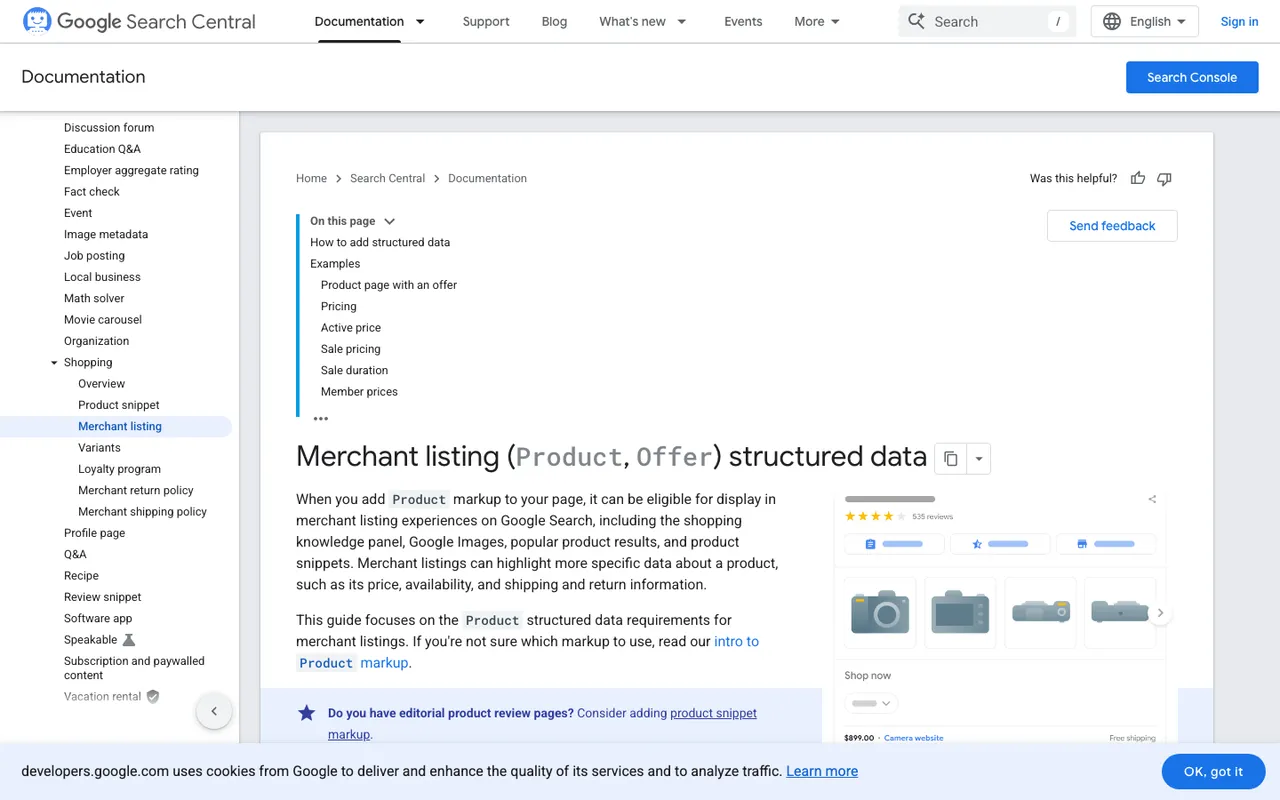
Google Search Central, "Merchant listing (Product, Offer) structured data", captured November 21, 2026.
We add the recommended properties where the client has the data: brand, gtin, sku, description, aggregateRating, and on the offer availability, shippingDetails and hasMerchantReturnPolicy. Google also recommends return policy markup at the Organization level. The rule we hold to: markup matches what's visible on the page, because Google says it should.
Third: Merchant Center, then the ChatGPT feed
Google says supplying both markup and a Merchant Center feed maximizes eligibility and helps it verify your data. If the client wants Google's agentic checkout later, Merchant Center also needs return policies and support contact details before any UCP work can begin, so we set those up now.
For ChatGPT, it depends on the platform. OpenAI says Shopify and Etsy catalogs are already integrated. Other stores apply to share a feed and go on a waitlist.
OpenAI's merchants page, "Power product discovery in ChatGPT", captured November 21, 2026.
The feed has nine required product fields and two geo fields. Most of them map straight from an existing Google feed, which is why we do Merchant Center first. OpenAI says the feed isn't mandatory if ChatGPT already crawls you, but it gives more control over how products appear.
Fourth: decide about checkout, with the finance team in the room
On ChatGPT, OpenAI says it's moving away from standalone Instant Checkout, so purchases finish on the client's own site. On Google, Universal Cart (live in the U.S. since October 15, 2026) can check out with Google Pay through UCP, or hand the cart to the merchant's checkout. Native checkout means a waitlist, development work, a program addendum and Google's approval. It also excludes whole product types, from subscriptions to pre-orders to used items. That's a commercial decision, not an SEO one.
Fifth: product content that keeps getting cited
Product pages don't hold AI citations forever. In Promptwatch's ChatGPT content half-life report, which followed every page ChatGPT cited on July 6, 2026 for 90 days, product pages, reviews and how-tos reached their half-life after 74 to 77 days. Landing pages and docs lasted longer. We plan refreshes for top product and category pages on that basis.
Then: measure the AI side separately
Search Console folds AI feature appearances into normal Web search traffic, so it won't isolate them for you. For ChatGPT, Promptwatch's ChatGPT Shopping tracking (Business plan) shows which products ChatGPT recommends against the catalog you upload, and its visitor analytics count AI-referred sessions and conversions. Those two numbers are what we report to clients.
Want a second pair of eyes on your store?
Run Promptwatch's free AI Visibility Report on your domain first; it includes a check of whether AI crawlers can reach the site. Then send it to us and we'll tell you which of the five steps above your store needs most.