Which AI writing tool creates content briefs for AI search? How our agency builds them now
An SEO and GEO agency on how content briefs changed for AI search, what Google's own guidance implies, and the AI writing tool we use to build briefs for clients.
For most of our history, a content brief at our agency was a two-page document a strategist wrote by hand. Target keyword, intent, the top five ranking pages and what they cover, headings to include, internal links, a word count range. Writers liked it because it was predictable, and it worked because Google was predictable enough.
That brief still forms the base of what we hand a writer. It just isn't enough anymore when the client also wants to show up in ChatGPT answers and Google's AI Overviews. Here's what we changed and which tool does the heavy lifting.
What Google's guidance actually implies
Clients often expect a secret AI formatting trick. Google's own Search Central page, "AI features and your website", says the opposite: SEO best practices remain relevant, there are no additional requirements to appear in AI Overviews or AI Mode, and no special schema or AI text files are needed. Structured data should match the visible text, and important content should be in text.
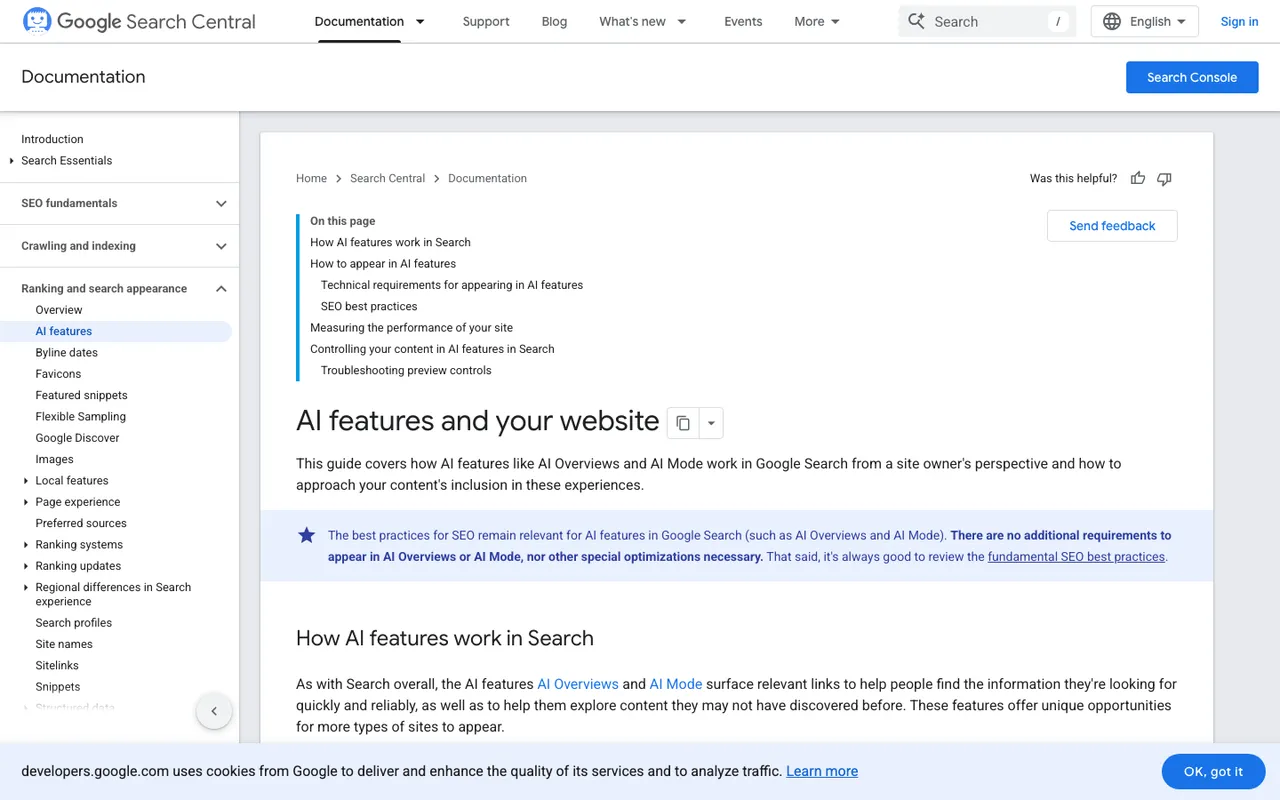
Google Search Central, "AI features and your website", captured November 21, 2026.
The same page mentions that AI Overviews and AI Mode may use a "query fan-out" technique, running several related searches across subtopics. For a brief, that line matters more than anything else on the page. It means an AI answer is assembled from multiple searches, and a page that only targets the head keyword covers one of them.
The three additions we made to every brief
First, we replace the single target keyword with a target prompt, phrased as a buyer would type it into an assistant. Second, we list the sub-queries engines actually run for that prompt, so the writer covers them as sections. Third, we note which pages engines currently cite and what type they are. If the cited pages are all comparison tables, a narrative blog post probably won't displace them.
Our classic SEO fields stay: intent, internal links, the client's facts, the writer's notes. We've found clients get the most out of pages that work for both channels, and Google itself tells you that's the same page.
The tool behind it
We build these briefs in Promptwatch, which is also where we track each client's prompts. Its query fanouts view lists the exact sub-queries each model ran for a tracked response, captured from the response itself rather than simulated. Content gap analysis shows which tracked prompts the client's pages don't answer, with a coverage score. From either view, a brief can be started on a prompt, a fanout or a page engines cite.
Promptwatch's brief then gathers Google results, news, YouTube transcripts, live page screenshots and up to five competitor URLs. Before drafting it selects internal links, preferring pages with many Search Console impressions and few clicks. That's a classic SEO move we used to do manually, and having it built into the brief saves our team a linking pass on every article.
We've compared it with the tools clients sometimes already pay for. Frase and Surfer make solid Google briefs with some AI tracking on top, and Clearscope shows the searches AI platforms trigger. None of them start the brief from the client's own tracked AI answers, and none follow the published page through AI crawler logs and AI-referred conversions afterwards.
Plans we recommend
Content gap analysis is on every Promptwatch plan, but drafting through AEO articles starts on Professional at $245 a month (5 articles, add-on up to 50). Business at $579 adds the scheduled Content Agent with a review inbox, which we use for clients publishing weekly. Essential at $95 tracks prompts but includes no articles, so it suits monitoring, not production. Seats are unlimited on every paid plan, so the client's editors can sit in the same workspace.
Where people still matter
The brief makes coverage systematic. Expertise still comes from people: a client's own data, a real customer process, an opinion the brand is willing to defend. We add those by hand to every brief, and they are usually what separates a cited page from one that merely covers the topic.
Want to try our process yourself? Start Promptwatch's 7-day free trial, track the five prompts that matter most to your sales team, and open the fanouts for the weakest one. That list is the skeleton of a better brief.