What AEO software costs in 2026, and how we budget it
Real AEO software prices for 2026, the response math that decides which plan you need, catalog prices for the alternatives, and how we split tool cost from agency hours.
A monthly price on a pricing page tells you what the smallest plan costs. It doesn't tell you what your program will cost, because AEO software is metered. The meter is usually prompts, responses or credits, and the number you need depends on how many questions you track, on how many engines, in how many markets, and how often.
This post gives the real prices for the platform we run client programs on, the arithmetic we use to pick a plan, the published prices of the alternatives from our catalog, and how we separate the software line from the agency line in a client budget. For the tool comparison itself, see what we think the best answer engine optimization platform is.
Promptwatch prices
Promptwatch publishes its prices. In US dollars a month on monthly billing, with euros in brackets:
| Plan | Price | Prompts | Responses a month |
|---|---|---|---|
| Essential | $95 (€85) | 50 | 6,000 |
| Professional | $245 (€205) | 150 | 18,000 |
| Business | $579 (€499) | 350 | 42,000 |
| Enterprise | Custom | Custom | Custom |
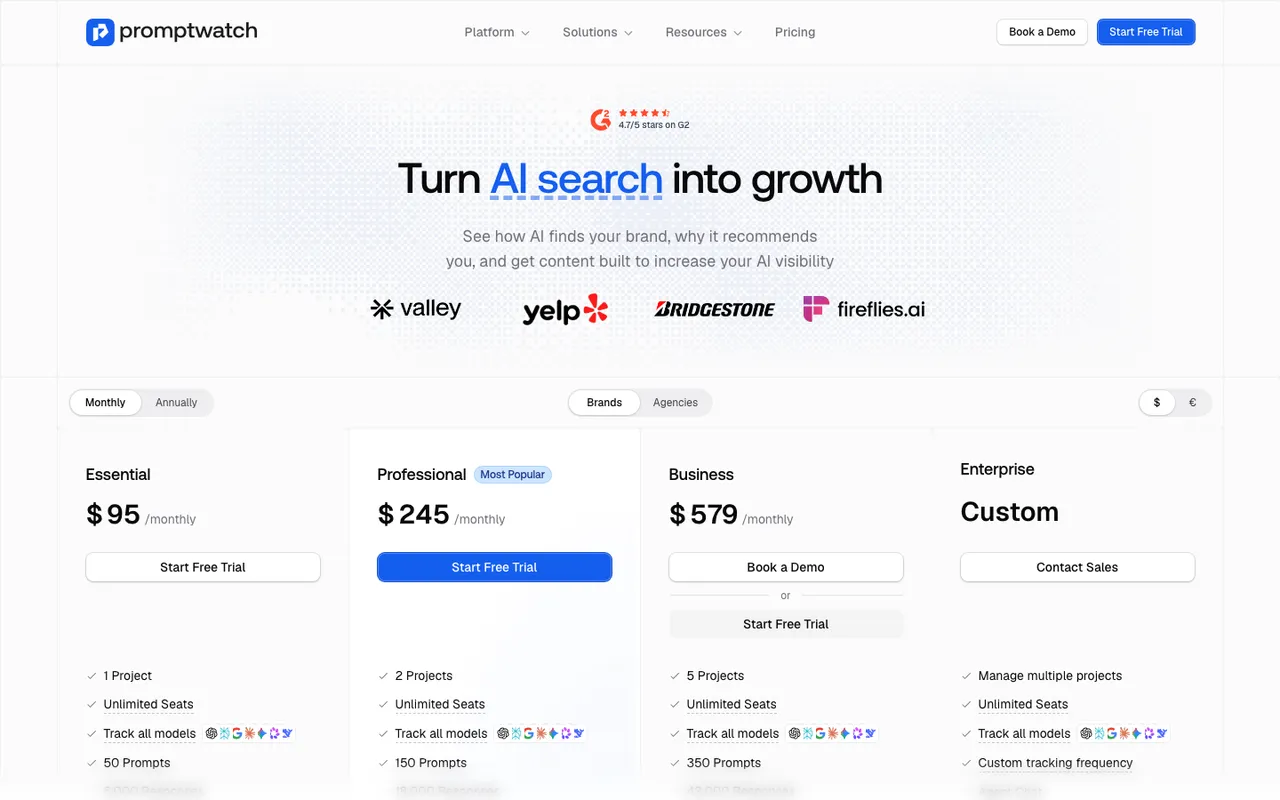 Promptwatch brand pricing in US dollars, captured November 6, 2026.
Annual billing is 12 months for the price of 10. All six self-serve plans have a 7-day free trial on monthly billing, and team seats are unlimited on every paid plan, so a bigger team doesn't change the bill. There's no free plan to sign up for. The free starting points are the trial and the free AI Visibility Report.
For agencies there are three self-serve plans: Kick-off at $199 (€170) with 10,000 responses, Growth at $399 (€343) with 25,000, and Scale at $799 (€685) with 65,000. All three have unlimited projects, prompts and seats, all AI models, and crawler logs. They don't include AEO articles, the Knowledge Base, the Content Agent, ChatGPT Shopping or 360 Insights. Partner, the custom agency tier, has no published price.
What the plan tiers actually buy
The price steps are not only about volume. Features switch on at specific tiers, and those tiers decide the plan more often than the prompt count does.
- Essential has no crawler logs, no AEO articles, no Knowledge Base and no Looker Studio connector. It does have Agent Chat, Brand Narrative, site audits (1,500 pages), 360 Insights, content gap analysis, visitor analytics, and MCP and API access.
- Professional adds crawler logs (an allowance of 25M logs), five AEO articles a month, a Knowledge Base of 100 items, custom reports and Looker Studio.
- Business adds the automated Content Agent, state and city tracking, coordinate targeting, tracking every 12, 6 or 1 hours, Fact Check, ChatGPT Shopping, Ads Radar and the audit log.
So a client who needs crawler logs starts at Professional, whatever their prompt count. A local business that needs city monitors starts at Business. We decide the plan from the feature list first, then check the response math fits.
The response math
A response is one answer from one engine to one prompt. The formula we use is prompts times engines times runs per month.
Fifty prompts on four engines, run daily, is about 6,000 responses a month, which is the Essential allowance. Every paid plan can track any of the supported engines, so the engine count is a choice, and it moves the number as much as the prompt count. Two markets doubles it. Tracking every 12 hours doubles it again.
Frequency is where budgets break. Hourly tracking on a few hundred prompts uses more responses than most plans include. Promptwatch shows the response cost before you change a monitor's frequency, and you can't pick a frequency your remaining quota can't cover. Lowering a frequency always works. We keep most client monitors on daily and reserve faster tracking for a small panel of high-stakes prompts, like launch terms.
Two worked examples, using nothing but the published allowances. A brand in one market with 40 prompts on four engines, daily, needs about 4,800 responses a month. That fits Essential on volume, but if the program needs crawler logs, the plan is Professional anyway. A brand in two countries with 60 prompts each, on the same four engines, has 120 prompts and needs about 14,400 responses. That fits Professional's 150 prompts and 18,000 responses with a little room for testing new prompts. Add city monitors to either one and the answer becomes Business, whatever the volume.
Two other meters exist. Agent Credits (500 on Essential up to 2,500 on Business, 1,000 to 6,500 on agency plans) pay for Agent Chat work and Fact Check runs, and Fact Check shows an estimate first. Extra credits are an add-on on every paid plan, and extra AEO articles on Professional and Business. Yearly add-ons are 20% off.
What the alternatives cost
These figures come from our catalog's reading of each vendor's pricing page. Where the catalog marks a figure as unconfirmed, we say so.
| Tool | Published starting price | Unit |
|---|---|---|
| AthenaHQ | Starter $295/mo; free Essential tier | 3,600 credits, one credit per AI response |
| Scrunch | Core $250/mo | 125 prompts, 5,000 responses, 4 LLMs |
| Profound | Free 7-day trial; Enterprise custom | Earlier catalog estimate about $40k a year |
| Semrush AI Toolkit | $99/mo per domain (unconfirmed) | 25 prompts |
| Ahrefs Brand Radar | Index from $199/mo; Custom Prompts on paid Ahrefs plans | Needs an Ahrefs base plan |
| HubSpot AEO | $50/mo ($45 yearly) | 2,500 answers, 25 prompts daily |
| Conductor | Not published | Usage-based tiers |
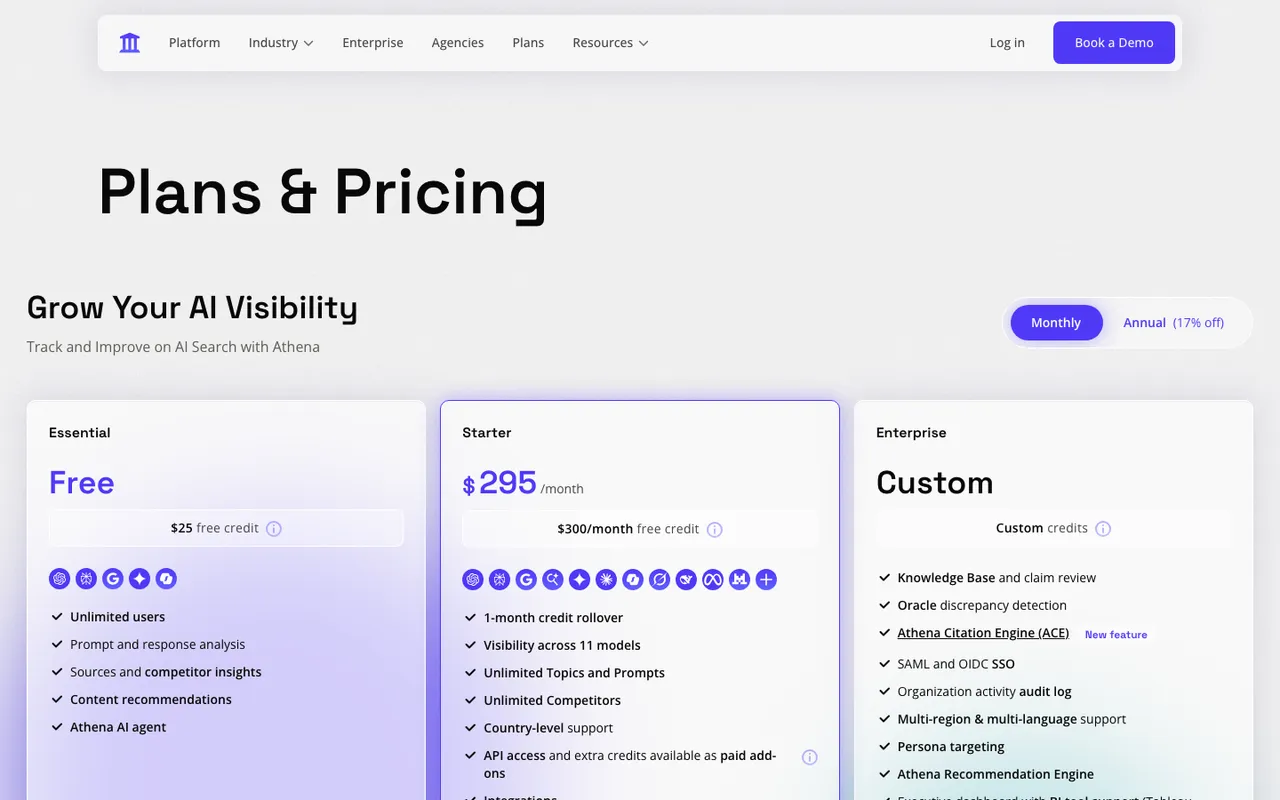 AthenaHQ's plans page, captured November 6, 2026.
The per-unit comparison matters more than the headline. AthenaHQ's 3,600 credits are 3,600 responses. Scrunch Core's 5,000 responses cover four engines. Promptwatch Essential's 6,000 responses cost $95. And AthenaHQ was acquired by Bloomreach on 16 November 2026, with standalone plans after its early 2027 joint launches not yet stated, which is worth weighing before a long commitment.
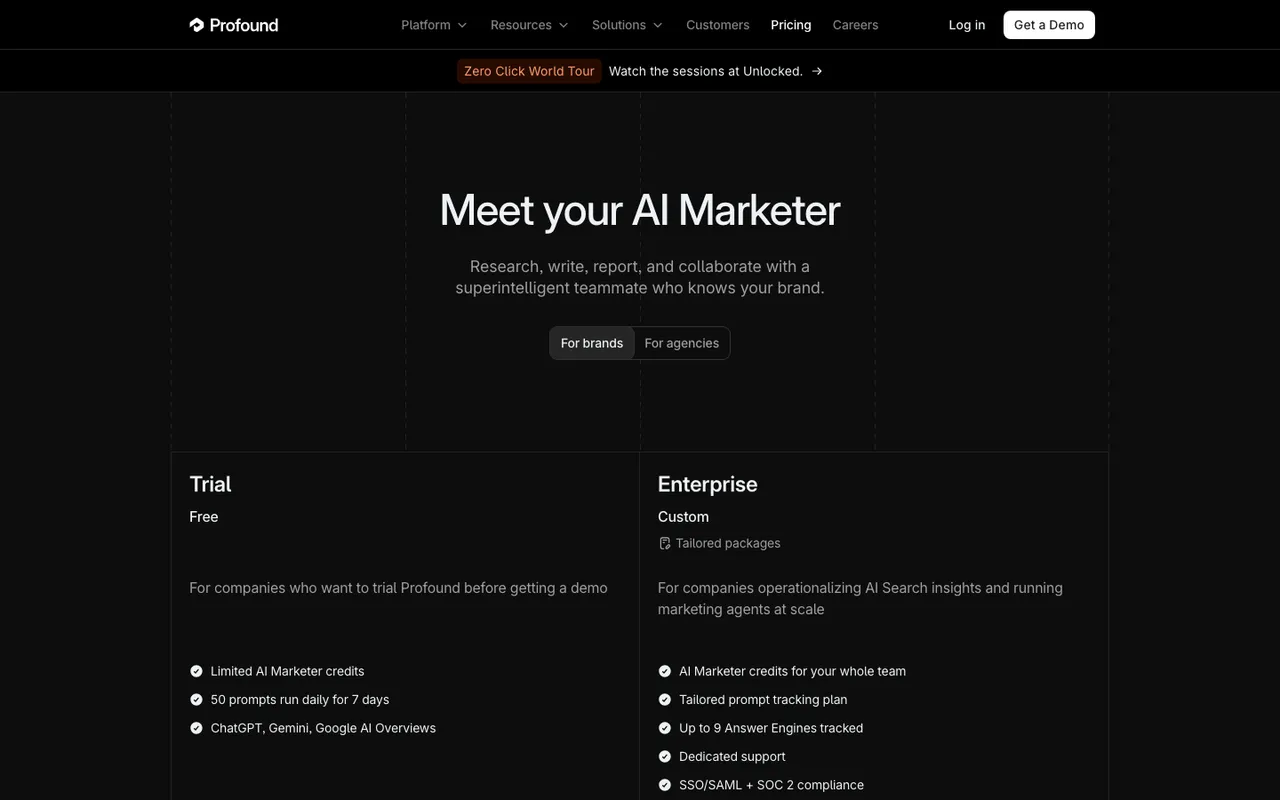 Profound pricing for brands, captured November 6, 2026.
Enterprise platforms that don't publish prices, like Profound and Conductor, need a sales process before you can compare them. We ask for the unit (prompts, responses or credits), the engines included, and the contract term in writing.
 Conductor's pricing page, captured November 6, 2026.
Tool cost versus agency hours
The software is one line in a program budget. The other line is the work: writing the prompt set, reading the data, fixing crawler access, writing and refreshing pages, outreach to the third-party sites engines cite, and reporting. We scope that line separately, after we've seen the client's prompt set and the first trial data, and we don't publish a rate card for it here.
How we handle the split on client programs:
- The subscription sits on the client's own account where possible, so the data stays with the client if they leave us.
- We recommend the smallest plan that has the features the program needs, and we revisit it after the first quarter.
- When a program needs content creation or Search Insights, the client gets a brand plan, because the agency plans don't include AEO articles, the Content Agent or 360 Insights.
- We don't add tools to a budget that duplicate a signal the client already pays for.
A cheaper tool can cost more overall. If a tracker shows a gap but not why, someone has to find the cause by hand, and that time is billed. Crawler logs, cited pages and visitor analytics in one workspace shorten that diagnosis, which is why we weigh them more heavily than the monthly price difference.
Where to start
Do the response math on your own prompt set before you look at any plan. Then start Promptwatch's 7-day free trial on the plan whose features you need, and watch the Usage Overview for a week to see your real consumption.